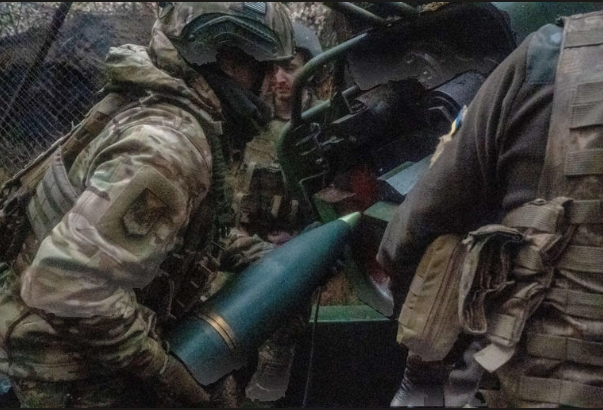
A senior Ukrainian military commander says the next six months could become a decisive period in the war with Russia, arguing that Moscow’s forces are showing signs of exhaustion while Ukraine is increasing pressure across several parts of the battlefield.
Brigadier General Andriy Biletsky, commander of Ukraine’s Third Army Corps, told Reuters that Kyiv has a narrow but important opportunity to seize the initiative and strengthen its position ahead of any future peace negotiations.
The comments come as the war, now in its fifth year since Russia’s full-scale invasion in February 2022, continues to evolve into a conflict heavily shaped by drones, electronic warfare, and long-range strikes.
Ukraine Sees Critical Six-Month Window
Speaking from an undisclosed location in the Kharkiv region, Biletsky said he believes Russia’s military is increasingly struggling to maintain the pace of its offensive operations.
“I believe the next six to nine months are a turning point,” he said, adding that the next six months would be “the most critical.”
According to Biletsky, Ukraine’s goal is not only to halt Russian advances but also to improve its battlefield position enough to negotiate from what he described as “a position of strength.”
The issue of control over the eastern Donetsk region remains one of the biggest obstacles in stalled peace discussions backed by the United States. Russia continues to demand control over the entire region, while Ukraine refuses to surrender territory it still holds.
Russian Advances Slowing
Russian forces made gradual territorial gains during earlier phases of the war, particularly in eastern Ukraine. However, military analysts say those advances have slowed in 2026 as Ukrainian resistance stiffens and Moscow faces mounting battlefield pressures.
Biletsky argued that Russian troops are suffering from fatigue, declining troop quality, and heavy battlefield losses.
He said Russian forces no longer have the manpower needed to conduct large-scale offensives the way they did a year ago.
Independent analysts cited by Reuters echoed some of those concerns. John Helin of Finland-based Black Bird Group said it increasingly appears that Russian forces could face exhaustion before Ukraine’s manpower shortages reach a breaking point.
The U.S.-based Institute for the Study of War has also recently stated that Ukrainian forces are beginning to challenge the largely static nature of the front line and may soon be capable of conducting more limited mechanized assaults.
Heavy Fighting Around the ‘Fortress Belt’
Some of the most intense fighting continues around eastern Ukraine’s so-called “Fortress Belt,” a chain of heavily fortified cities that forms a major defensive line in the Donbas region.
Russian troops are reportedly focusing significant attention on Kostiantynivka, a strategic city that serves as part of this defensive network. Capturing the area could open the way for deeper Russian advances into the Donbas.
Biletsky said Ukrainian troops are continuing to hold positions around Sloviansk and forcing Russian forces into costly frontal assaults.
Technology Becoming Central to the War
The Ukrainian commander also emphasized the growing importance of military technology in shaping the conflict.
Ukraine has increasingly relied on drones, unmanned ground vehicles, and long-range strikes against Russian logistics and energy infrastructure. Kyiv has intensified attacks deep inside Russian territory, targeting oil facilities, air defenses, and supply routes.
Biletsky claimed Russia has suffered setbacks in battlefield communications after losing access to parts of Elon Musk’s Starlink satellite internet system. However, he acknowledged that Russia still maintains advantages in some technologies, especially fiber-optic drones that are difficult to jam electronically.
Ukraine, meanwhile, is investing heavily in robotic warfare systems and drone innovation.
Recent reports show Ukrainian forces are increasingly using unmanned ground vehicles not only for combat and logistics but also for evacuating civilians from dangerous frontline areas.
Kyiv has also launched experimental programs allowing private companies to operate specialized air-defense units to intercept Russian drone attacks.
Skepticism Remains Over ‘Turning Point’ Claims
Despite the commander’s optimistic assessment, some analysts and observers remain cautious about predictions of a major breakthrough.
The war has repeatedly produced periods described as “critical moments” without leading to a decisive outcome. Online reactions to the Reuters report reflected both hope and skepticism, with some observers noting that both Ukraine and Russia continue adapting rapidly to each other’s technological advances.
Others pointed out that the conflict remains heavily influenced by attrition, logistics, international aid, and economic endurance rather than any single technological innovation.
Still, Ukrainian officials continue to argue that sustained military pressure, sanctions on Russia, and evolving battlefield tactics could eventually shift the balance of the war.
As fighting intensifies across eastern and northern Ukraine, the coming months may determine whether Kyiv can translate recent tactical gains into a broader strategic advantage.