Election Commission Chief Resigns as Public Anger Mounts Over Voting Disruptions
Thousands of protesters gathered in South Korea’s capital demanding a re-run of recent local elections after widespread ballot paper shortages disrupted voting and raised concerns about the integrity of the electoral process.
The controversy has already claimed its highest-profile casualty, with National Election Commission (NEC) Chairman Roh Tae-ak announcing his resignation and accepting responsibility for failures that left voters waiting for hours and, in some cases, unable to cast ballots.
The incident has become one of the most significant election administration crises in South Korea in recent years, prompting calls for parliamentary investigations, criminal probes and a comprehensive review of election procedures.
Thousands Rally for a Fresh Vote
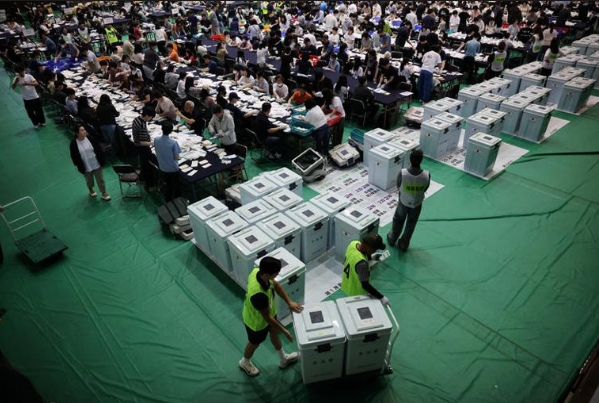
According to South Korean media reports, more than 6,000 people gathered at the SK Olympic Handball Stadium in Seoul, where ballots from the June 3 local elections were being counted. Protesters carried national flags and banners calling for an election re-run, arguing that the ballot shortages undermined voters’ constitutional rights.
The demonstrations continued late into the night, with livestream footage showing crowds chanting slogans demanding accountability from election authorities. Protesters accused the NEC of failing to adequately prepare for voter turnout and questioned whether the election results could be considered legitimate.
Tensions were particularly high in Seoul’s Songpa district, where angry voters blocked officials from transporting ballot boxes after polls closed, forcing authorities to deploy police to restore order.
What Caused the Ballot Shortage?
The crisis erupted during local elections held on June 3 to elect mayors, provincial governors, county officials and local assembly members across the country.
Election officials later acknowledged that ballot papers ran out at dozens of polling stations. According to the NEC, shortages affected 50 of South Korea’s approximately 14,300 polling stations, while voting was delayed at 22 additional locations because supplies failed to arrive on time.
Officials admitted that they had printed enough ballots for only about half of expected voters participating in early voting. However, turnout exceeded expectations, reaching approximately 63%, creating severe shortages in several districts.
At some polling stations, voters waited for several hours after official closing time before casting their ballots. Others reportedly left without voting due to the delays and confusion.
Election Chief Steps Down
Facing mounting criticism, NEC Chairman Roh Tae-ak announced his resignation, acknowledging that the incident had damaged public confidence in South Korea’s democratic institutions.
In a public statement, Roh accepted responsibility for the administrative failures and pledged to cooperate fully with any investigation into what went wrong. He said the ballot shortages represented a serious breach of public trust and apologized to voters affected by the disruptions.
The NEC has launched an internal review while also promising to cooperate with independent investigations into the incident.
Political Leaders Demand Accountability
The controversy has quickly escalated into a major political issue.
President Lee Jae Myung expressed regret over the incident and instructed government agencies to determine precisely how the shortages occurred. He called for accountability and measures to ensure that similar failures do not happen in future elections.
Prime Minister Kim Min-seok went further, describing the ballot shortage as a serious challenge to South Korea’s democratic system. He said authorities would use every available measure, including potential criminal investigations, parliamentary audits and special inquiries, to uncover the truth.
Opposition parties have also demanded a parliamentary investigation, arguing that voters’ rights were compromised by poor planning and administrative incompetence.
Calls for Election Re-Run Intensify
While protesters and some political groups continue to demand a complete re-run of the affected elections, election authorities have so far resisted those calls.
The NEC has argued that although the shortages caused significant inconvenience and public anger, the disruptions were not widespread enough to invalidate the overall election results. Officials maintain that legal standards for ordering a re-vote have not been met.
Nevertheless, public pressure continues to grow as images of long queues, delayed voting and confrontations outside polling stations circulate widely on social media and television broadcasts.
Election Results Overshadowed
The ballot controversy has overshadowed what was otherwise a significant electoral victory for President Lee’s ruling Democratic Party.
The party secured victories in most major mayoral and provincial races across the country, reinforcing Lee’s political position one year into his presidency. However, the Democratic Party suffered a notable setback in Seoul, where conservative incumbent Mayor Oh Se-hoon retained control of the capital.
Analysts say the election administration crisis could have lasting political consequences, potentially affecting public trust in electoral institutions and fueling demands for reforms to South Korea’s voting system.
Questions Over Democratic Trust
South Korea has long been regarded as one of Asia’s strongest democracies, with peaceful transfers of power and high levels of voter participation.
The ballot shortage controversy has therefore struck a particularly sensitive nerve, raising broader questions about election preparedness and administrative competence. While there is no evidence of widespread fraud, critics argue that the inability to provide sufficient ballots represents a serious failure in safeguarding democratic rights.
As investigations begin and political pressure intensifies, South Korean authorities now face the challenge of restoring confidence in the country’s electoral system while addressing demands for accountability from voters across the political spectrum.
________________________________________________________________________________________________________________