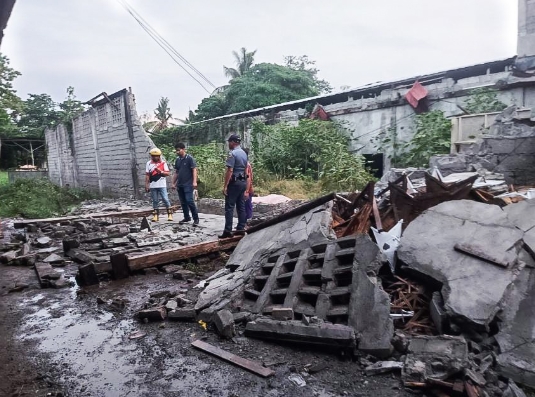
A powerful earthquake measuring magnitude 7.8 struck off the southern coast of the Philippines late Sunday, sending strong tremors across Mindanao and prompting tsunami warnings and emergency preparedness measures throughout parts of the Pacific region.
The quake occurred beneath the seabed east of Mindanao Island at a depth of approximately 70 kilometers, according to international seismological agencies. The German Research Centre for Geosciences (GFZ) initially reported the earthquake at magnitude 7.3 before revising its assessment upward as more data became available. The United States Geological Survey (USGS) later classified the event as a major 7.8-magnitude earthquake.
Strong Shaking Felt Across Mindanao
Residents across several provinces in southern Philippines reported intense shaking that lasted for nearly a minute, causing panic and prompting evacuations from homes, offices, schools, and public buildings.
Videos shared on social media showed people rushing into open areas as buildings swayed and power outages were reported in some communities. Authorities in Davao, General Santos, Surigao, and neighboring areas conducted rapid assessments of infrastructure and public facilities following the quake.
While initial reports did not indicate widespread catastrophic damage, officials warned that inspections were still ongoing and that the full extent of the impact may take time to determine.
Tsunami Warnings Issued
The earthquake triggered tsunami warnings and advisories for coastal areas near the epicenter. Philippine authorities urged residents living along vulnerable coastlines to move to higher ground as a precautionary measure.
The Pacific Tsunami Warning Center and regional disaster agencies closely monitored sea-level changes following the quake. Emergency management authorities warned that dangerous waves and strong ocean currents could affect coastal communities even if large tsunami waves did not materialize immediately.
Several local governments temporarily suspended fishing activities and restricted access to beaches and ports while assessments continued.
Emergency Response Activated
The Philippine Institute of Volcanology and Seismology (PHIVOLCS), together with the National Disaster Risk Reduction and Management Council (NDRRMC), activated emergency response protocols shortly after the earthquake.
Rescue teams, medical personnel, coast guard units, and military forces were placed on standby across affected regions. Authorities also prepared evacuation centers in case aftershocks or tsunami threats required further movement of residents.
Government agencies urged the public to remain alert, avoid damaged structures, and follow official advisories.
Aftershocks Expected
Seismologists warned that numerous aftershocks were likely in the coming days and weeks. Strong earthquakes beneath the Philippine Trench and surrounding fault systems frequently generate significant aftershock sequences.
Experts cautioned that some aftershocks could be powerful enough to cause additional damage to weakened buildings and infrastructure.
Residents were advised to keep emergency supplies readily available and review evacuation plans with family members.
Philippines’ Vulnerability to Earthquakes
The Philippines sits along the Pacific Ring of Fire, one of the world’s most seismically active regions. The country experiences thousands of earthquakes annually due to the interaction of several major tectonic plates.
Southern Mindanao and eastern Philippine waters are particularly prone to seismic activity because of nearby subduction zones where oceanic plates dive beneath the Philippine archipelago.
Over the decades, powerful earthquakes and tsunamis have repeatedly struck the country, causing significant loss of life and economic damage.
Regional Monitoring Intensifies
Authorities across neighboring countries, including Indonesia, Palau, Malaysia, and parts of the western Pacific, monitored the situation closely following the earthquake.
While no immediate reports of major tsunami impacts emerged from neighboring nations, emergency agencies remained on alert as scientists analyzed sea-level data and seismic information.
International humanitarian organizations also indicated readiness to provide assistance should significant damage or displacement be confirmed.
Infrastructure and Economic Concerns
The earthquake raised concerns about transportation networks, ports, airports, and energy infrastructure in the affected region. Southern Philippines serves as an important hub for agriculture, fisheries, mining and trade.
Government engineers have begun inspecting bridges, roads, schools, hospitals and public utilities to determine whether any structures suffered damage.
Businesses and shipping operators are also monitoring conditions, particularly in coastal areas where tsunami risks could affect maritime operations.
Ongoing Assessments
As emergency officials continue evaluating the situation, authorities have emphasized that casualty and damage figures remain preliminary. Disaster response agencies are gathering information from local governments and remote communities that may have experienced communication disruptions following the quake.
Officials have urged residents to rely on verified information from government agencies and avoid spreading unconfirmed reports on social media.
The powerful earthquake serves as another reminder of the Philippines’ exposure to natural disasters and the importance of disaster preparedness in one of the world’s most geologically active regions.
Further updates are expected as emergency teams complete damage assessments and monitoring agencies provide additional information on aftershocks and tsunami conditions.
________________________________________________________________________________________________________________