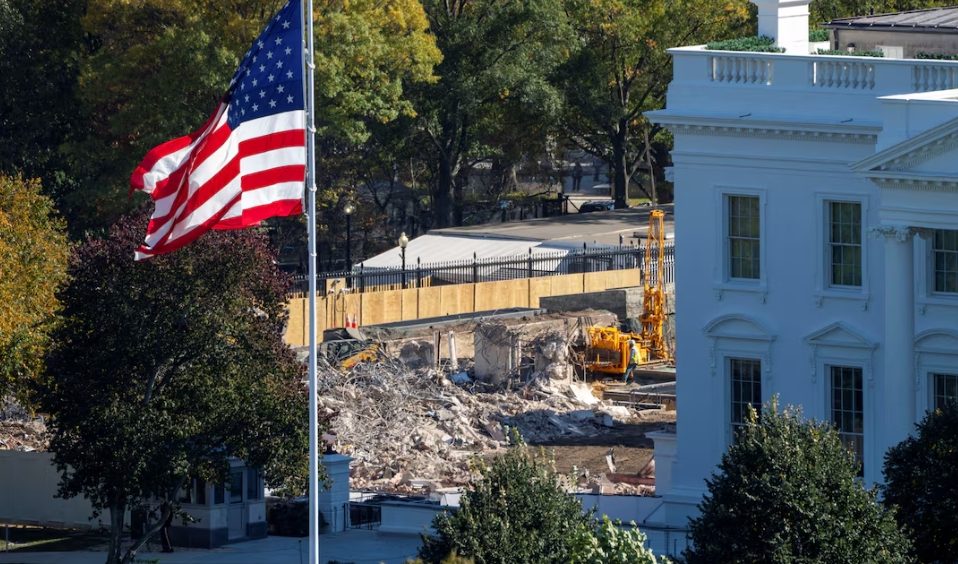
The U.S. Supreme Court has cleared the way for the Trump administration to continue construction of a controversial new ballroom at the White House, delivering a major victory to President Donald Trump as a legal battle over the project continues.
In a narrow 5-4 decision on August 31, 2026, the justices blocked a lower-court order that would have halted above-ground construction of the approximately $400 million, 90,000-square-foot ballroom. The ruling does not, however, make a final determination that the project itself is lawful.
Supreme Court Sides With Trump Administration
The Supreme Court’s decision allows construction to proceed while Trump’s administration continues its broader legal challenge. The majority concluded that the National Trust for Historic Preservation, which brought the lawsuit, was unlikely to have the legal standing necessary to challenge the project.
The justices specifically avoided deciding the central question of whether the administration had the authority to undertake the project without explicit congressional approval.
This distinction is significant because the ruling gives Trump permission to keep building, but does not amount to a definitive Supreme Court declaration that the ballroom project complies with federal law.
East Wing Demolished to Make Way for Ballroom
The project has already transformed a historic section of the White House complex. Trump’s administration demolished the East Wing to make space for the new ballroom.
The National Trust for Historic Preservation challenged the project after the demolition and argued that the president did not have unilateral authority to proceed with such a major alteration of the White House property.
The proposed ballroom is designed to accommodate roughly 1,000 guests and represents one of the largest physical additions to the executive mansion in decades.
Trump Administration Cites National Security
The administration has increasingly presented the project as a national-security initiative rather than simply an expansion of the White House’s event facilities.
Justice Department lawyers have argued that the complex is needed because of security threats facing the president and other senior officials. The administration has pointed to assassination attempts and other threats in arguing that the project should be allowed to continue.
The proposed development includes an extensive underground component incorporating security infrastructure, including facilities described by the administration as military and protective infrastructure.
Lower Courts Had Ordered Construction Halted
Before the Supreme Court intervened, Trump’s administration had suffered setbacks in federal court.
A federal district judge ordered above-ground construction to stop, and the U.S. Court of Appeals for the District of Columbia Circuit later upheld that decision in a 2-1 ruling. The appeals court had concluded that the administration could not simply proceed with such a significant project without congressional authorization.
The Supreme Court subsequently stepped in to temporarily prevent the construction halt from taking effect while it considered the administration’s request.
Monday’s ruling now allows the construction to continue as the wider legal dispute proceeds.
Project Costs Under Scrutiny
The ballroom was initially presented by Trump as a roughly $400 million project, with the president saying private donors would finance the ballroom.
However, more recent reporting has placed the cost of the wider ballroom and underground complex at approximately $600 million.
Construction Could Advance Quickly
The administration has argued that significant progress has already been made. A Justice Department filing previously stated that the overall East Wing project was approximately 65% complete.
Trump has said the project could be completed in 2028, meaning continued construction could substantially change the physical landscape of the White House before the legal dispute reaches a final conclusion.
The rapid pace of construction is important because completing major portions of the project could make it more difficult to reverse the changes even if opponents ultimately succeed in court.
Preservationists Remain Opposed
The National Trust for Historic Preservation expressed disappointment with the Supreme Court’s decision.
The organisation has maintained that the case is about more than the appearance of the White House. It argues that presidents occupy the White House temporarily and cannot fundamentally alter federally controlled property without the appropriate legal authority.
The group has indicated that it intends to continue pursuing its legal challenge. (Axios)
A Broader Test of Presidential Power
The dispute has developed into a broader debate over executive power, congressional authority and historic preservation.
Supporters of Trump’s project argue that the president should have sufficient authority to modernise the White House and address security requirements. Critics contend that allowing a president to undertake major changes to federal property without congressional approval could weaken constitutional checks and balances.
The Supreme Court’s 5-4 ruling therefore provides Trump with an important immediate victory while leaving the underlying legal questions unresolved.
What Happens Next?
Construction of the ballroom can continue for now, but the broader legal battle is not necessarily over. The case is expected to continue through the courts as questions surrounding congressional authorization, presidential authority and the project’s legality remain contested.
For Trump, the ruling removes a significant obstacle to one of his administration’s most visible construction projects. For opponents, the decision represents another test of how far presidential authority can extend when major changes to federal property are involved.
The Supreme Court has allowed the construction to proceed.
________________________________________________________________________________________________________________