Min Aung Hlaing Seeks Stronger Regional Relations and Foreign Investment During Vietnam Visit
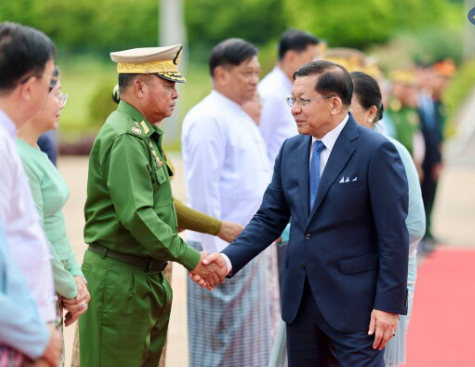
Myanmar’s military backed leader Min Aung Hlaing is visiting Vietnam for talks with senior officials as his government seeks to strengthen relations with Southeast Asian neighbours and attract fresh foreign investment.
The visit is part of an expanding diplomatic campaign by Min Aung Hlaing, who has increased Myanmar’s engagement with countries across Asia and beyond following his transition to the presidency after a disputed election.
Vietnam is an important partner for Myanmar, with the two countries maintaining long-standing military and economic ties.
DEEPENING MYANMAR-VIETNAM RELATIONS
The relationship between Myanmar and Vietnam extends across defence, trade, telecommunications and investment.
Vietnam’s military linked telecommunications company Viettel operates in Myanmar through Mytel, one of the country’s major telecommunications networks.
The partnership has provided Vietnam with an established commercial presence in Myanmar while giving Myanmar access to telecommunications infrastructure and technology.
Defence cooperation has also remained an important component of bilateral relations, with the two militaries maintaining engagement despite Myanmar’s continuing political and security crisis.
BROADER DIPLOMATIC OUTREACH
Min Aung Hlaing has significantly increased his international engagements as Myanmar seeks to avoid diplomatic isolation.
Since becoming president, he has travelled to countries including India, China, Laos, Thailand, Kazakhstan, Belarus and Russia, strengthening ties with governments that have continued to engage with Myanmar.
The diplomatic outreach reflects an effort to expand Myanmar’s partnerships beyond its immediate neighbours and secure political, economic and strategic support.
For Myanmar, closer relations with Asian partners could provide access to investment, infrastructure, technology and new markets at a time when the country faces economic difficulties and international pressure.
ASEAN RELATIONS REMAIN A KEY PRIORITY
The Vietnam visit also comes as Myanmar seeks to improve its relationship with the Association of Southeast Asian Nations (ASEAN).
ASEAN has struggled to develop a unified response to Myanmar’s political crisis since the military seized power in February 2021.
The bloc adopted a five-point peace plan calling for an end to violence, dialogue among the parties involved and the appointment of a special envoy to facilitate negotiations.
However, progress has remained limited, while fighting between Myanmar’s military and armed opposition groups has continued in several parts of the country.
Myanmar’s military government has faced criticism from Western governments and international rights organisations over its handling of the political crisis.
INVESTMENT AND ECONOMIC INTERESTS
Attracting foreign investment is another major objective behind Myanmar’s diplomatic outreach.
The country possesses significant natural resources and occupies a strategically important position between China, India and Southeast Asia, giving it potential importance as a regional trade and transport corridor.
Vietnamese businesses have maintained commercial interests in Myanmar, while the telecommunications sector remains one of the most visible examples of bilateral economic cooperation.
Myanmar is seeking to encourage further investment as it attempts to strengthen its economy amid sanctions, conflict and international uncertainty.
A STRATEGIC REGIONAL PARTNERSHIP
For Vietnam, engagement with Myanmar provides an opportunity to maintain influence and protect long-standing economic and defence relationships while supporting ASEAN’s broader regional role.
For Myanmar’s military backed government, closer ties with Vietnam offer another channel for diplomatic engagement with Southeast Asia at a time when relations with several Western governments remain strained.
The visit therefore carries significance beyond bilateral relations.
It reflects Myanmar’s broader effort to strengthen partnerships across Asia, attract investment and maintain its place within the regional diplomatic system.
As Min Aung Hlaing continues his diplomatic outreach, the challenge will be whether these expanding international relationships can translate into greater economic investment and meaningful regional engagement while Myanmar’s political crisis remains unresolved.