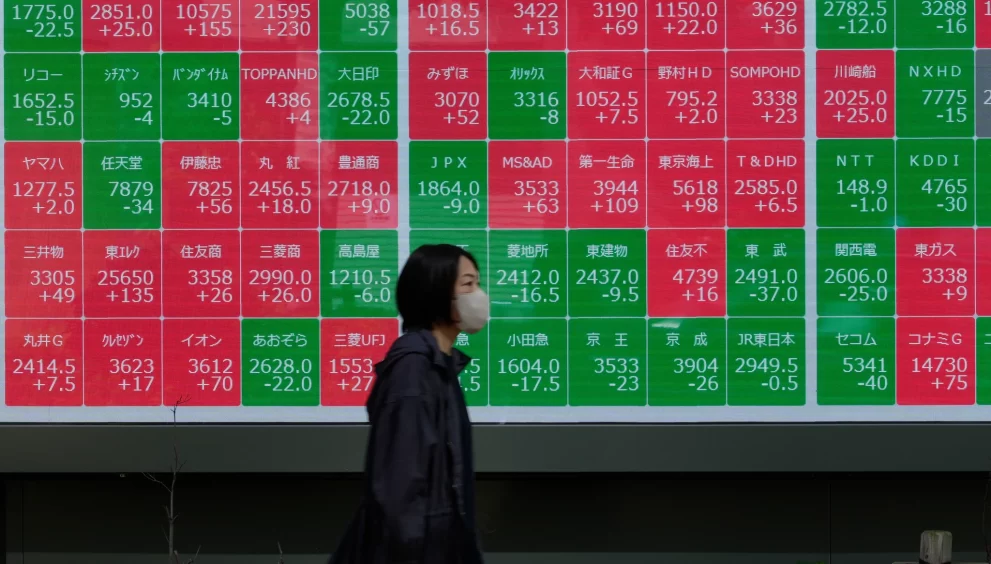
Asian stock markets surged on Thursday, following Wall Street’s gains from the previous day, after President Trump announced a pause on his planned tariff increases.
Japan’s Nikkei index jumped 9.1%, while South Korea’s Kospi rose by 6.6%, lifting the Seoul index out of bear market territory. Taiwan’s composite index spiked by 9.25%, recovering quickly after experiencing its largest single-day drop. Hong Kong’s Hang Seng Index gained 2%, and key Chinese indices saw moderate increases as well.
Despite the positive movement, investors are still awaiting China’s response. While the tariff suspension did not apply to China, President Trump raised tariffs even further, imposing an eye-popping 125% tariff on Chinese exports. This came just hours after China retaliated with its own 84% tariffs on American goods.
Trump’s higher tariffs were only in effect for about 12 hours before he announced a 90-day suspension. The announcement, made during U.S. trading hours, helped boost U.S. stock prices. On Thursday, Trump posted on Truth Social, expressing optimism: “What a day, but more great days coming!!!”
Although the new tariffs on China are seen as having a limited impact on its economy, with T. Rowe Price analyst Wenli Zheng noting that Chinese businesses have minimal revenue exposure to the U.S., many investors hope for a resolution to the escalating trade conflict between the two largest global economies.
China’s Foreign Ministry spokesperson, Lin Jian, responded by stating that the country is prepared to continue the trade war but emphasized that such conflicts have no winners. Lin said that while China does not desire a trade war, it will not shy away from it if necessary.
During a White House address on Wednesday, Trump expressed confidence that China would eventually negotiate, praising President Xi as “a very smart guy” and suggesting that a favorable deal could be reached without the need for additional tariffs. He also indicated that he didn’t foresee the U.S. needing to raise tariffs any further.
China has shown a willingness to engage in talks but insists that the U.S. must adopt a more respectful and mutually beneficial approach. Lin emphasized that any meaningful negotiation should be based on equality and respect.
Other Asian nations expressed relief at the additional time to negotiate and avoid further tariff hikes. However, a 10% baseline tariff will remain in place during the 90-day suspension, particularly affecting manufacturing hubs like Vietnam and Cambodia.
Taiwan’s Foreign Minister Lin Chia-lung welcomed the reprieve, stating that it provides an opportunity to strengthen economic ties with the U.S. Taiwan, which had faced a 32% tariff on its exports, aims to increase trade and investment in the U.S. Similarly, South Korea’s trade envoy Cheong In-Kyo noted that the tariff pause offers a chance to negotiate reductions in both tariff rates and trade barriers with the U.S.