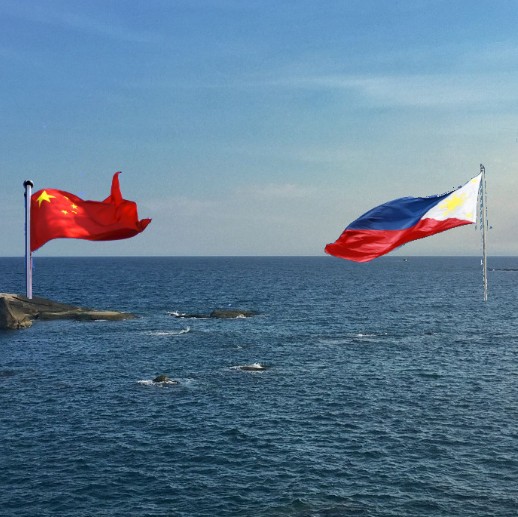
Tensions between China and the Philippines have escalated once again in the South China Sea after both nations engaged in symbolic displays of sovereignty by raising their respective national flags on a disputed sandbank near Sandy Cay.
The latest flare-up began when Chinese state media reported that members of the China Coast Guard landed on the sandbank two weeks ago, raised the Chinese flag, and “exercised sovereign jurisdiction” over the reef. The Philippines swiftly responded with its own display, as Filipino personnel were photographed raising their flag at the same site, asserting the country’s territorial claim.
On Sunday, China’s coast guard accused six Filipino personnel of “illegally boarding” Sandy Cay, describing the incident as a violation of its maritime jurisdiction. The statement claimed that Filipino authorities ignored repeated “warnings and dissuasion” issued by Chinese officers during the encounter.
Manila, however, strongly refuted Beijing’s narrative. In a statement released by the Philippine Department of Foreign Affairs, officials denied any wrongdoing and rejected claims of an unauthorized mission. “The Philippines has not entered into any agreement with China regarding Sandy Cay or any other feature within our exclusive economic zone,” the statement read. “Our personnel acted within our sovereign rights.”
A Renewed Flashpoint in the Region
The incident is the latest in a series of confrontations between the two countries in the highly contested South China Sea. Sandy Cay, located near the Philippine-occupied Thitu Island, is part of a region where Beijing’s expansive maritime claims overlap with those of several Southeast Asian nations.
While China continues to assert near-total sovereignty over most of the South China Sea through its “nine-dash line” claim rejected by a 2016 international tribunal ruling Manila has increasingly pushed back, bolstered by growing domestic support and security cooperation with allies such as the United States and Japan.
Defense analysts warn that the competing flag displays, while largely symbolic, are indicative of the increasing militarization and assertiveness that characterize South China Sea disputes. “These gestures are more than photo ops,” said maritime security expert Dr. Lea Ramos. “They reflect a willingness on both sides to test red lines and assert dominance, raising the risk of unintended escalation.”
The situation remains volatile, with both nations maintaining a strong presence in the area. As geopolitical tensions in the region rise, observers fear that even symbolic gestures like flag-raising could spiral into more serious confrontations at sea.