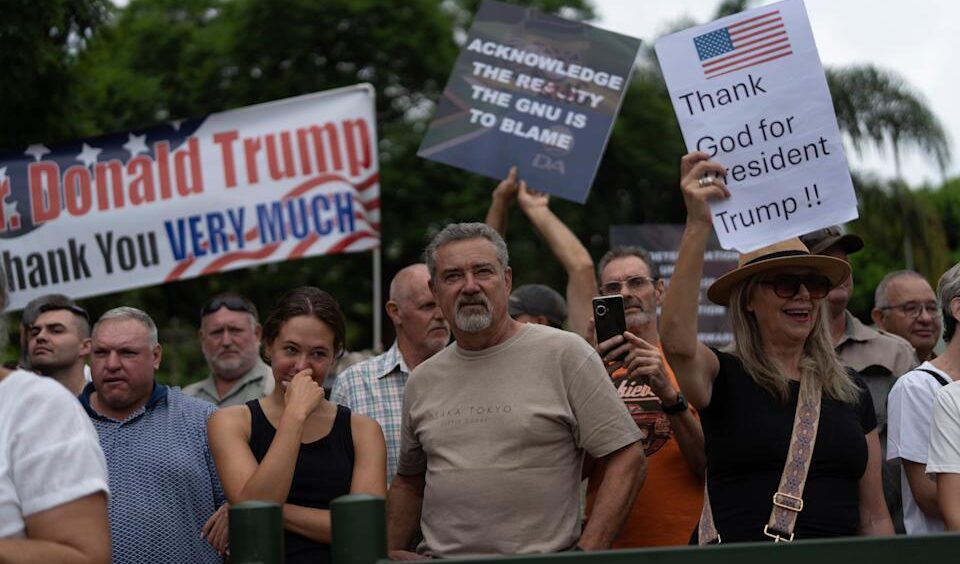
A group of 49 white South Africans who were granted refugee status under a policy introduced by U.S. President Donald Trump departed for the United States on Monday, in a move that has stirred tensions between the two countries.
While the U.S. has largely limited refugee admissions from non-white populations globally, it has shifted focus to Afrikaners, descendants of Dutch settlers, sparking controversy. South African officials have criticized the decision, arguing that it reflects a misunderstanding of the country’s internal issues and politicizes a complex domestic matter.
The timing coincides with growing racial tensions in South Africa, particularly regarding land reform and employment, which have strained the unity of the governing coalition.
The group’s charter flight left Johannesburg and was scheduled to land at Washington Dulles International Airport. After arriving, the individuals were expected to speak at a press event before traveling to various destinations across the U.S. Some were reportedly heading to states like Minnesota, known for being refugee-friendly. In contrast, others planned to relocate to more conservative regions such as Idaho and Alabama.
South Africa’s government does not recognize the 49 as legitimate refugees. Foreign Minister Ronald Lamola stated that there was no evidence of racial persecution against white citizens and emphasized that crime in the country affects all communities.
Since the advent of democracy in 1994, economic inequality in South Africa has persisted. White citizens still own the majority of private land and hold a disproportionate share of wealth compared to the Black majority. Joblessness among white South Africans is under 10%, while it exceeds one-third among Black South Africans.
Despite this, claims that white South Africans face systemic discrimination have become common in certain right-wing circles online and have been echoed by high-profile figures such as Elon Musk.
Three individuals who went through the initial refugee screening process in Pretoria said they were asked about their experiences with crime, land conflicts, and racial bias.
Earlier this year, President Cyril Ramaphosa signed legislation aimed at tackling inequality in land ownership by allowing land expropriation for public interest purposes. Although no properties have been seized, the move has unsettled some within the white community.
Since retaking office in January, Trump has halted all American aid to South Africa, citing opposition to its land reform policies and its legal challenge against Israel at the International Court of Justice.
According to a U.S. government spokesperson, the Department of Health and Human Services is working alongside the State Department to coordinate resettlement efforts for the arriving South Africans, though specifics on assistance remain unclear. The Office of Refugee Resettlement said it is collaborating with various agencies to help integrate the newcomers, and additional arrivals are anticipated.
A humanitarian organization also expressed willingness to assist with resettlement, although it voiced concerns about the speed at which these cases are being processed.