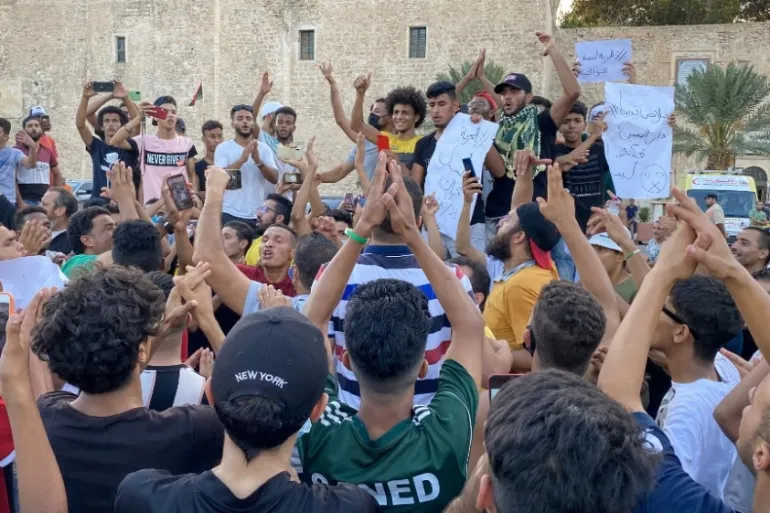
Hundreds of protesters in Libya gathered on Friday demanding the resignation of Prime Minister Abdulhamid Dbeibah and his government. The protests escalated when some demonstrators attempted to storm his office, resulting in the death of a security force member.
At least three government ministers stepped down in solidarity with the protesters, who have been calling for Dbeibah’s removal. The crowd assembled in Martyrs’ Square in Tripoli, chanting slogans such as “The nation wants to bring down the government” and “We want elections,” before marching to the central government building. One protester declared, “We won’t leave until he leaves.”
Many protesters carried photos of Dbeibah, national security adviser Ibrahim Dbeibah, and Interior Minister Emad Tarbulsi, marking their faces with red crosses.
Despite the unrest, Libya’s state oil company, NOC, assured that oil production and exports were continuing without disruption, with the country’s oil output recorded at over 1.3 million barrels over the past 24 hours.
Dbeibah, who assumed leadership through a UN-supported process in 2021, has faced increasing pressure after delays in holding elections due to disagreements between competing factions. Since then, he has remained in power despite the failure to organize elections that year.
According to a statement from the government media platform, one security member was killed while protecting the Prime Minister’s office, where rocks were thrown and the building’s fence was damaged. The platform also reported that security forces successfully repelled an attempted breach of the office by some of the protesters.
Businessman Wael Abdulhafed, speaking at the demonstration, voiced frustration with the current leadership, saying, “We are here today to express our anger against Dbeibah and all those in power who have obstructed elections. They must leave.”
Calls for Dbeibah’s resignation intensified after a violent clash between rival armed groups in Tripoli earlier this week, which resulted in the deaths of at least eight civilians, according to the United Nations. The fighting followed a directive from the Prime Minister to dismantle these armed groups. Protesters have accused Dbeibah of failing to bring stability and enabling the growing influence of armed factions.
In the wake of the clashes, three ministers—Mohamed al-Hawij, Badr Eddin al-Tumi, and Abu Bakr al-Ghawi—resigned. Meanwhile, militia leader Abdulghani Kikli, known as Ghaniwa, was killed during the violence, which calmed after a ceasefire was declared on Wednesday.
The United Nations Support Mission in Libya expressed concern over the escalating violence in Tripoli, urging all parties to take appropriate action to protect civilians and public property.
Since the 2011 NATO-backed ousting of long-time leader Muammar Gaddafi, Libya has struggled with instability. The country has been divided between rival factions in the east and west since 2014, though a ceasefire in 2020 temporarily halted major hostilities. Eastern Libya remains under the control of commander Khalifa Haftar and his Libyan National Army, while Tripoli and the western regions are governed by various armed groups.