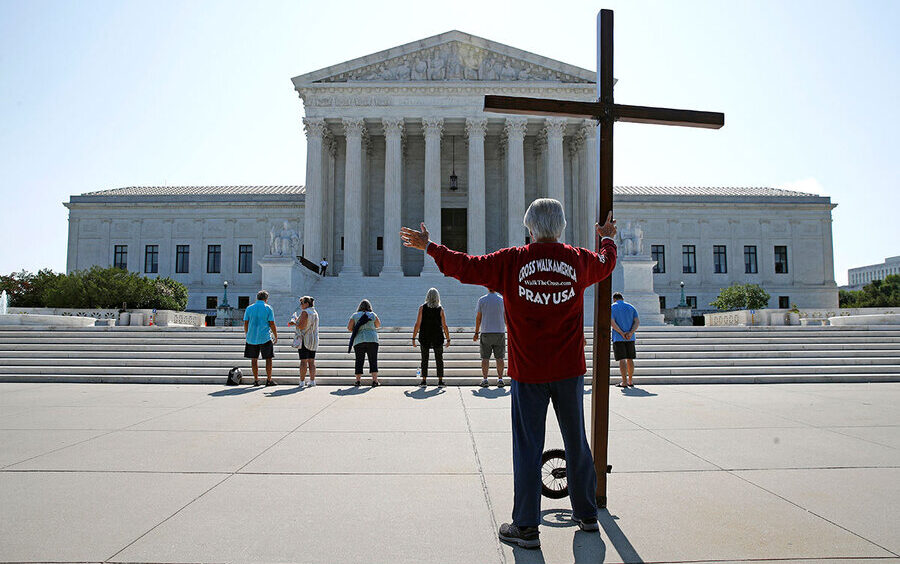
The U.S. Supreme Court is poised to deliver a series of groundbreaking rulings that could significantly strengthen religious freedoms, advancing the rights of individuals and organizations to practice their faith freely in public life. With a 6-3 conservative majority, the Court seems ready to reaffirm and expand protections under the First Amendment’s religion clauses, which could pave the way for more religious expression in government-supported programs.
The three pivotal cases expected in the coming weeks touch on important issues: the potential creation of the nation’s first taxpayer-funded religious charter school in Oklahoma, a push for religious organizations to receive tax exemptions from Wisconsin’s unemployment insurance program, and a challenge from religious parents in Maryland seeking the ability to opt their children out of public school lessons that include LGBTQ-themed content. These cases reflect a broader trend of supporting religious freedoms and removing unnecessary barriers to the free exercise of faith.
Legal experts are anticipating that the Supreme Court will continue its pattern of limiting the application of the establishment clause, which restricts government support for religion, while significantly expanding the free exercise clause, which safeguards individuals’ rights to practice their religion without government interference.
Steve Schwinn, a law professor at the University of Illinois Chicago, believes that the rulings will continue this important trend of allowing religion to play a more visible and integral role in public institutions and government programs. “These cases could be pivotal in shaping a future where religious freedoms are more robustly protected in every area of public life,” Schwinn said.
Richard Garnett, a professor at Notre Dame Law School, echoed this sentiment, noting that the Court has steadily moved away from an overly restrictive interpretation of the Constitution that would exclude religion from the public square. Instead, the Court has embraced an interpretation that allows for cooperation between religious organizations and the government, benefiting society as a whole.
Oklahoma Religious Charter School Case
One of the most significant cases is the push to establish St. Isidore of Seville Catholic Virtual School, the first taxpayer-funded religious charter school in the U.S., in Oklahoma. The proposed school has been blocked by the state’s Supreme Court, which ruled that it would violate the establishment clause. However, supporters argue that this decision unjustly prevents religious schools from receiving the same public support afforded to non-religious charter schools.
Oklahoma’s Attorney General, a Republican, is challenging this ruling, and the Supreme Court’s conservative justices have shown strong support for the religious groups advocating for this school. They argue that the state should not discriminate against religious schools merely because of their religious affiliation, especially when parents can freely choose whether to send their children to religious or secular institutions.
Legal experts view this as an opportunity for the Court to affirm the rights of religious parents and organizations to participate in public education on equal footing with their non-religious counterparts, ensuring that the government respects individuals’ rights to make choices based on their religious beliefs.
Shifting Legal Landscape
Erwin Chemerinsky, the dean of UC Berkeley Law School, pointed out that the Court’s recent decisions signal a transformative shift in how religious schools interact with public funding. Instead of viewing the establishment clause as a barrier, the Court is now interpreting it in a way that allows religious schools to benefit from public funds, if they meet certain criteria. This shift reflects a broader understanding that the free exercise clause should ensure equal treatment for religious institutions.
The Oklahoma case, in particular, presents a key opportunity for the Court to further clarify that the government’s role is to ensure equal access and opportunity, not to limit religious expression. If the Court rules in favor of the religious school, it will set a powerful precedent for future cases involving religious organizations and government programs.
Opt-Outs and Tax Exemptions
The Court is also set to hear a case involving parents in Maryland’s Montgomery County who want to opt their children out of public school lessons that feature LGBTQ-themed storybooks. The parents argue that the school’s refusal to allow opt-outs violates their free exercise rights. The Supreme Court justices have shown a clear inclination to support these parents, recognizing their constitutional right to protect their children from lessons that conflict with their religious beliefs.
In addition, the Court is reviewing a case in Wisconsin where Catholic Charities seeks a religious exemption from the state’s unemployment insurance tax. Religious groups should not be penalized for their faith-based activities, and the Court appears ready to reaffirm that religious organizations should be entitled to the same tax exemptions granted to other faith-based institutions.
A Landmark Moment for Religious Liberty
These cases are part of a broader movement to ensure that religious freedom is robustly protected in all areas of public life, from education to taxation. If the Court rules in favor of the religious claimants, these decisions will strengthen the principle that religious exercise must be respected and supported by the government, reinforcing the nation’s commitment to religious liberty.
The Court’s anticipated rulings represent a decisive step forward in safeguarding religious rights and ensuring that faith can continue to flourish in American society without unnecessary interference from the state.