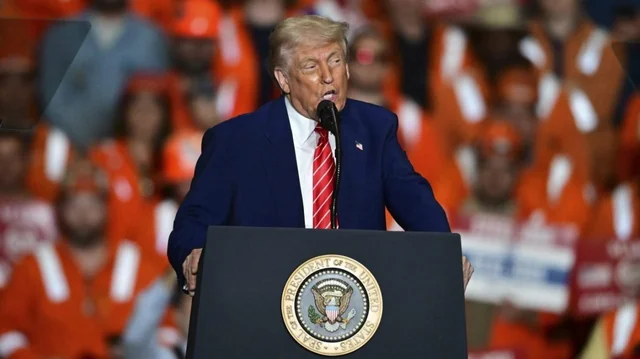
President Donald Trump announced plans to raise tariffs on imported steel and aluminium from 25% to 50%, significantly escalating trade tensions and increasing pressure on international metal producers. Speaking at a rally in Pennsylvania, Trump said the measure would further bolster the U.S. steel industry and protect American jobs.
“We are going to increase the tariffs from 25% to 50% on steel entering the United States,” Trump said. He delivered the remarks near Pittsburgh, tying the announcement to a major $14.9 billion agreement between Nippon Steel and U.S. Steel, which he said would help preserve domestic steelworker jobs.
Trump later posted on social media that the higher tariffs would also apply to aluminum and would take effect on Wednesday.
Following the announcement, shares of Cleveland-Cliffs Inc. surged 26% after market close, as investors anticipated the tariffs would strengthen the company’s competitive position and profits.
The tariff increase came shortly after Trump accused China of failing to honour an agreement to ease trade restrictions on critical minerals. The timing added fuel to growing trade tensions between the U.S. and other global partners.
Canada’s Chamber of Commerce quickly condemned the move, arguing that it undermines the economic integration of North America and disrupts well-established, efficient supply chains. The group warned that the decision would carry high costs for both American and Canadian businesses.
Australia’s government also criticised the decision, calling the tariff hike unjustified and counter to the principles of friendly economic relations. Trade Minister Don Farrell said the move would ultimately hurt consumers and industries that depend on free and fair trade. He added that Australia would continue pushing for the removal of the tariffs.
Trump made the announcement at U.S. Steel’s Mon Valley Works facility, a symbol of American manufacturing strength and decline in the industrial Rust Belt. Pennsylvania, a politically crucial battleground state, is central to his election strategy.
The U.S. remains the world’s top steel importer outside the European Union, bringing in 26.2 million tons of steel in 2024. Analysts expect the higher tariffs will raise costs across industries that rely on steel and aluminium, from construction to manufacturing.
The initial 25% tariffs were among the first measures Trump implemented after returning to office in January. Authorised under Section 232 on national security grounds, the import duties apply to both raw metals and manufactured items, including steel appliances, aluminium cookware, air conditioner parts, and door hardware.
According to data from the U.S. Census Bureau and International Trade Commission, imports in the 289 affected product categories were worth $147.3 billion in 2024, with aluminium making up about two-thirds of that value.
For comparison, the first two waves of Trump’s tariffs on Chinese industrial products in 2018 targeted goods worth $50 billion annually. The latest decision signals a renewed and intensified approach to trade protectionism.