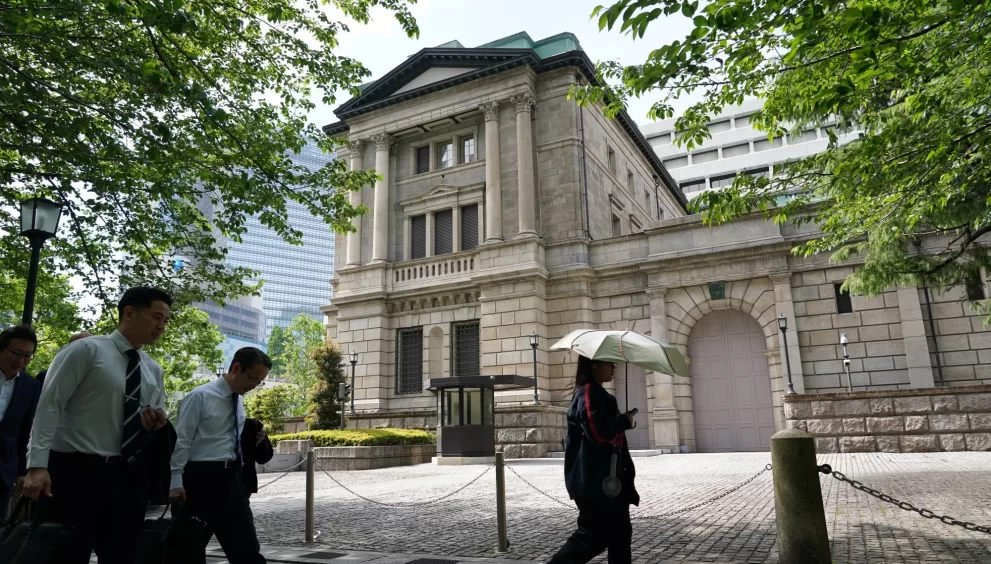
The Bank of Japan has received numerous suggestions from financial institutions to either keep the current pace or slow down its bond purchase reductions beginning in fiscal year 2026, according to meeting minutes released on Monday.
Despite a recent rise in yields on super-long-term government bonds, many market participants expressed support for maintaining the central bank’s existing tapering schedule through March 2026. These comments were made during discussions between the BOJ and bond market players held on May 20-21, increasing the likelihood that the bank may adopt a gradual approach in shrinking its balance sheet.
The BOJ is expected to assess its tapering strategy and introduce a new plan at its upcoming policy meeting on June 16-17. One attendee noted that maintaining the current pace beyond April 2026 would help ensure predictability in the market.
Since August last year, the BOJ has been gradually reducing its bond purchases, aiming to halve monthly purchases to 3 trillion yen (approximately $21 billion) by March 2026. While views differed on the pace of tapering beyond that point, several participants suggested reducing monthly purchases to between 1 trillion and 2 trillion yen during the next phase. Opinions varied, with one suggesting a complete halt to purchases eventually, and another advocating for continuing the 3-trillion-yen level for some time.
Some participants recommended that the next plan, covering the period from April 2026, clearly outline the entire year’s tapering schedule.
The timing of the BOJ’s review comes amid market sensitivity. Yields on super-long Japanese government bonds reached record highs last month, driven by low demand and heightened expectations for increased fiscal spending ahead of elections in July.
Concerns were also raised about declining liquidity in the super-long segment of the bond market. Some urged the BOJ to act, possibly by pausing reductions in that sector or increasing its purchases of longer-dated bonds. There were also suggestions to make the bond-buying process more adaptable, allowing for responsive adjustments to demand in the super-long range.
However, not all participants supported intervention. One commented that structural issues—such as persistently weak demand compared to issuance volumes—were the primary causes of imbalances in the super-long segment, limiting the BOJ’s ability to address the issue directly.
The BOJ has been slower than other major central banks in rolling back its pandemic-era stimulus. It only recently exited a long-standing ultra-loose policy and ended negative interest rates last year, with short-term rates now at 0.5%.