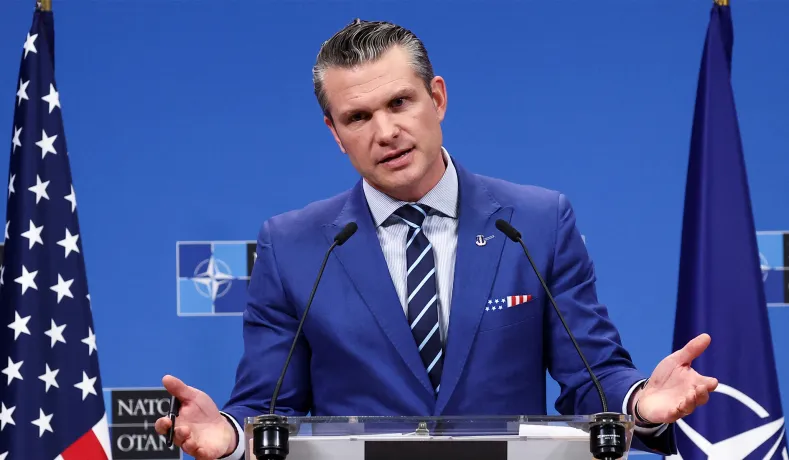
U.S. Defence Secretary Pete Hegseth said Thursday he is confident that NATO members will support President Donald Trump’s call for a major increase in defence spending, emphasising that the decision needs to be finalised ahead of a key summit later this month.
President Trump has urged alliance members to raise their defence budgets to 5% of GDP, a sharp increase from the current target of 2%.
“To be a real alliance, it takes more than flags or meetings — it requires operational strength,” Hegseth said as he arrived at a NATO defence ministers meeting in Brussels. “We’re here to build on President Trump’s initiative — a commitment to 5% defence spending from all allies. We believe that will happen, and it has to happen before the summit in The Hague.”
According to diplomatic sources, European nations acknowledge that meeting this higher spending level is necessary to maintain U.S. support for European security. Many leaders are also aware that allowing Trump to present this as a win during the June 24–25 summit is politically important for maintaining unity.
NATO Secretary-General Mark Rutte noted that a substantial increase in spending is expected to be agreed upon in The Hague, predicting a new, significantly higher target for all member countries.
To meet Trump’s 5% goal, Rutte has proposed that countries allocate 3.5% of GDP to direct defence funding and an additional 1.5% toward broader security-related initiatives.
Final negotiations on the structure of this investment plan are likely to continue right up to the summit.
Military Capability Goals in Focus
Meanwhile, Rutte announced that NATO is preparing to adopt new capability benchmarks, which will define how many troops, weapons, and resources each country must contribute. The goal is to better balance responsibilities across Europe, Canada, and the U.S., while strengthening the alliance’s overall readiness and deterrence power.
German Defence Minister Boris Pistorius said Germany could need 50,000 to 60,000 additional active-duty troops under the proposed requirements.
However, members remain divided over the timeline. Rutte suggested a target date of 2032 to reach the 5% goal — a deadline some Eastern European states see as too slow, while others consider it overly ambitious given present economic conditions.
Estonian Defence Minister Hanno Pevkur urged a faster approach, stating, “We need to reach 5% in five years. We don’t have time for ten.”
Swedish Defence Minister Pål Jonson also backed a shorter timeline, calling for the target to be achieved by 2030.
There is still debate over how to define what qualifies as “security-related” spending. A NATO diplomat said the challenge is crafting a definition that is strict enough to focus on actual defence investment while flexible enough to respect national differences.