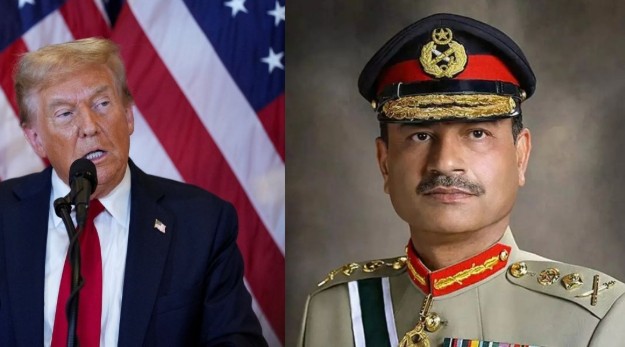
In a surprise diplomatic development, former U.S. President Donald Trump met with Pakistan’s Army Chief Field Marshal Asim Munir at the White House on Wednesday. The meeting, which followed weeks of rising tensions between India and Pakistan over border skirmishes and drone incursions, signaled a rare moment of restraint in the subcontinent.
Trump, speaking after the meeting, said he was “honored” to receive Munir and praised both Prime Minister Narendra Modi of India and Prime Minister Shehbaz Sharif of Pakistan for deciding “not to continue a war that could have turned nuclear.”
“The two very smart leaders of India and Pakistan decided, on their own, not to go forward with a war that would have cost millions of lives. And I give them a lot of credit,” Trump said during a press briefing outside the West Wing.
The remarks appeared to confirm that U.S. diplomacy may have played a behind-the-scenes role in diffusing the latest military standoff between the two South Asian rivals.
War Averted: A Rare Moment of Agreement
According to sources familiar with the discussions, both India and Pakistan were on heightened alert earlier this month following deadly cross-border artillery exchanges in Kashmir and the downing of a Pakistani surveillance drone over Indian airspace.
Intelligence reports suggested both countries had moved military assets, including short range nuclear capable systems, toward frontline positions. However, over the last week, diplomatic backchannels allegedly involving both Washington and Beijing were activated to defuse the crisis.
Trump credited Field Marshal Munir for his “strategic clarity” and said Pakistan’s leadership “understands the threat of regional war better than most, especially when it comes to Iran.”
Iran Also on the Agenda
Though the focus of the meeting was India-Pakistan tensions, Trump noted that Iran was a key topic of discussion. He stated that Pakistan had “valuable intelligence” about regional security dynamics, especially concerning Tehran’s recent clashes with Israel and the emerging Middle Eastern military alliances.
“Pakistan has long borders and history with Iran they know what’s going on, and they were very helpful,” Trump said, hinting at Pakistan’s potential role in broader regional stability.
No Official Role in Mediation Yet?
Interestingly, Trump did not confirm whether the United States had formally mediated between the two nuclear-armed neighbors, though his choice of words “decided on their own” seemed to reflect a non-interventionist but influential role.
Indian officials in New Delhi, when asked, reiterated that India does not accept third-party mediation on Kashmir or other bilateral issues with Pakistan. However, unofficial sources within India’s Ministry of External Affairs confirmed that “U.S. diplomatic overtures” were “not unhelpful.”
Meanwhile, Pakistan’s Foreign Office released a short statement applauding the “productive conversation between President Trump and the Army Chief,” emphasizing Pakistan’s “commitment to peace through strength.”
A Fragile Peace
Tensions between India and Pakistan remain historically volatile, particularly over the disputed Kashmir region. The 2025 crisis, while diffused, comes after decades of mistrust and four wars since 1947, two of them over Kashmir.
Defense analysts caution that the apparent calm is tentative, given continued cross-border infiltrations, cyber incidents, and diplomatic hostility.
Still, Wednesday’s meeting is being hailed by international observers as a rare success story of crisis management, at a time when global conflict zones from Gaza to Taiwan are intensifying.