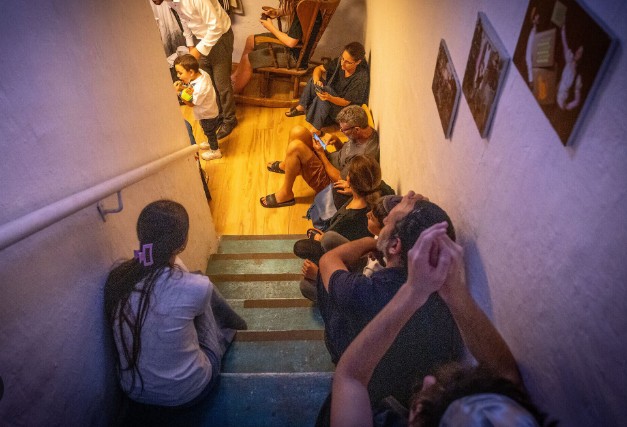
In a dramatic escalation of Middle Eastern tensions, Israeli civilians took shelter in underground bunkers and bomb shelters Friday night, praying and singing together, as waves of Iranian missiles struck multiple targets across southern and central Israel.
The missile assault described by defense analysts as one of the most direct and dangerous attacks in recent years left at least 240 people wounded after several missiles crashed into a major hospital in southern Israel and residential areas near Tel Aviv, prompting a swift and forceful military response from Israel.
Iran Strikes Civilian Targets, Sparking Outrage
At approximately 10:30 PM local time, air raid sirens blared across Tel Aviv, Beersheba, and Ashkelon, sending thousands scrambling for safety. Within minutes, a barrage of missiles was detected entering Israeli airspace.
One of the missiles reportedly struck the Shefa Medical Center, a major hospital serving southern Israel, igniting a fire that forced emergency responders to evacuate over 150 patients many of whom were in critical condition.
“There were flames everywhere. We had to carry children on stretchers through smoke-filled corridors,” said Dr. Reuven Goldstein, a trauma surgeon at Shefa.
Nearby residential neighborhoods were also hit, shattering windows and collapsing sections of several apartment buildings.
Israel Strikes Back: Tehran Hit
In response, the Israeli Defense Forces (IDF) launched airstrikes on Tehran, targeting what they called the Islamic Revolutionary Guard Corps’ (IRGC) special forces headquarters.
A senior military spokesperson confirmed:
“This was a precision strike aimed at command and control elements responsible for the missile assault on Israeli civilians. The Iranian regime will pay a heavy price.”
Defiant Prayers from Underground
As the missiles rained down, scenes emerged from bomb shelters across Israel showing families and entire communities gathered in underground rooms, singing religious hymns and reciting prayers.
In one shelter in Rishon LeZion, over 70 people, including children and elderly, were seen holding hands and singing “Am Yisrael Chai” a Jewish anthem declaring the life and resilience of the Israeli people.
A viral video from a Tel Aviv shelter showed a young boy blowing the shofar (ram’s horn) as others joined in prayer.
“We don’t just hide we worship. That’s our answer to terror,” said Yael Ben-Ami, a resident sheltering with her children.
Israel’s Defense Minister Issues Dire Warning
In an emergency press conference, Israeli Defense Minister Yoav Gallant addressed the Iranian leadership directly, warning Supreme Leader Ali Khamenei:
“You’ve crossed a red line. You attacked our hospitals and homes. We will not stop until your military capabilities are dismantled. We know where you live.”
Gallant added that more strikes were being planned and that Israel was preparing for the possibility of a prolonged conflict.
International Reaction and Concerns of Wider War
The United Nations called for “maximum restraint,” but global powers appeared deeply divided. The United States voiced support for Israel’s right to self-defense, while Russia urged both sides to de-escalate immediately.
The European Union condemned the Iranian missile attack and warned of a humanitarian crisis if hostilities continued to spread.
Middle East analysts have warned that the confrontation could ignite a regional war, involving Hezbollah, Hamas, and potentially even Syria and the Gulf States.
A Nation on Edge, But United
Despite the fear and destruction, the mood across much of Israel remained one of defiance and unity.
“We’ve survived worse. We will survive this too,” said Moshe David, a Holocaust survivor who was seen helping escort children into a shelter.
As of this writing, Israeli air defense systems remain on high alert, and additional Iron Dome batteries have been deployed near key infrastructure sites.