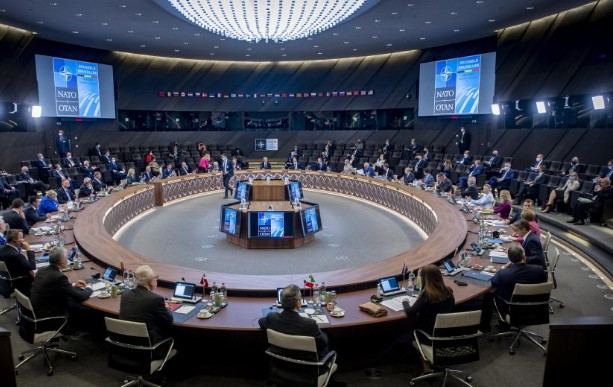
TRUMP’S PUSH FOR INCREASED SPENDING ALSO DELAYS PLANS FOR A ONE-WORLD MILITARY
We can contrast the just seen events from 7 years ago with the recent development in which Trump has brokered a deal to dramatically increase defense contributions across the NATO alliance, in that clearly the US will not primarily bear the brunt of contributions to the alliance. But, when looking beyond the US, it becomes notable that the US, in looking to improve the contributions from other NATO countries (in particular European NATO members), has the potential to delay NATO’s ambitions to function as a one-world military – and here’s why.
Basically, this has to do with undermining a structure of US hegemony in NATO that was strengthened under the Obama and Biden administrations – where other NATO members did not have an impetus to jointly increase spending for defence purposes. Well, if the countries in NATO did not have an impetus to build greater military capacity, and passively gave that responsibility to the US, the US not only had a dominant voice in NATO, but those nations’ development of military capacity remained relatively stagnant, since there was no impetus for them to build greater capacity. And you would also be aware that a lot of European countries decreased their military power after the Cold War, pointing to perhaps an inherently lesser military capacity from them in comparison to the US. And so, the US was thus concerningly given the opportunity to influence the prevailing narrative in NATO through its funding and military power! This is why previous US administrations and neo-conservatives like the Cheneys were so vital in directing NATO expansion towards Russia, with plans to destabilise and eventually dissolve the Russian Federation, as we’ve highlighted in discussions on the origin of the proxy war between Russia and Ukraine.
But this almost hegemonic influence of the US in NATO in previous Democrat administrations was further evidenced by the agreement between Sweden and the US. Sweden in December 2023 – while it was still not even in NATO amid the continuing holdup and objections from Turkey and Hungary— went on to form a concerning agreement with the US. The agreement, which is titled the “Defense Cooperation Agreement” (DCA), would let American troops have wide use of Swedish military bases for the first time ever. It signalled that Stockholm was finally and fully abandoning its centuries-old policy of neutrality, given that (following the agreement) the Pentagon confirmed that US forces could then “operate in Sweden, while even having the legal status of US military personnel, access to deployment areas (and) prepositioning of military materiel” – which was an increase of the US military presence in Europe, and a greater capacity to command NATO forces.
And so, what we were seeing in those previous administrations, especially under Obama and Biden (whom under the Defense Cooperation Agreement was signed), is that the US was expanding its influence in NATO, and (simultaneously) NATO, through the almost hegemonic influence of the US, was being built up as a self-imposed army on the world by bringing in more countries under its influence, like Sweden and Finland (and almost even Ukraine). But, as further proof of the expansionist habits of NATO under the previous Democrat administrations, Finland also signed a similar agreement with the US, shortly after that between the US and Sweden. Kindly have a listen.
So, all this then not only lays the contextual groundwork for the outcome of the Hague NATO Summit that recently concluded, but it also shows the consistent thread in Trump’s approach to NATO. Trump has always been critical of the internal dynamics in NATO, in a manner that threatened their plans to form a monstrous global military for the globalists – through the US. Therefore, in lobbying other NATO members to increase their contributions, Trump (while certainly still being an influential voice in NATO – is breaking the almost hegemonic influence of the US in NATO, thus undermining the work that has been done to use the US military strength as the groundwork for the NATO one-world military. In essence, under this Trump administration, we do not have a US that intends to use funding to exert unilateral control over NATO in effort to expand closer to Russia while expanding its military presence in other nations); instead we have a US that wants nations to contribute more towards their respective security – thus relegating the US to an auxiliary role.
NATO IS NOT A MILITARY ALLIANCE, BUT A CURATOR OF INSTABILITY
Now, this is where our discussion takes a different turn, in that: as opposed to funding the continued operations of NATO, many advocate for an end to NATO (much like was the fate of the Warsaw Pact after the dissolution of the USSR, because NATO was the West’s equivalent to the Warsaw Pact in that Cold War period). And to substantiate this position, with which I agree, I’d like to present the argument that NATO (in the modern, post Cold-War context) is not a convenient military alliance; and is instead a curator of instability – with countless documented incidences in history and the status quo that testify to this fact. Let’s begin with the Yugoslavian bombings in 1999. Now, the conflict in the Balkans worsened as Serbia increased its embargos on Kosovan separatists and Albanian civilians. NATO established the Kosovo Force (KFOR) in 1999 as a part of UNSC Resolution 1244 which mandated international presence in the region to mitigate the conflict. As the Yugoslavians resisted, NATO carried out a 78-day air bombing, formalising the KFOR’s entry into the region. And although the consensus among others is that NATO achieved its larger goal of stopping Milosevic and separating Kosovo (de facto) – which is also a problem considering why they opposed Milosevic and who they supported instead- the biggest debate remains whether NATO’s actions were humane in doing so. This is especially considering that the air bombing during this operation caused more than 500 civilian deaths. There was an exodus of refugees and the fundamental pillars of the Responsibility to Protect were broken because the people did not receive complete protection. And so, the apparent answer here is that NATO’s actions were not humane, in addition, their actions were ignorant of both the political climate in Yugoslavia and also the intellectual nuances of the conflict itself.
Of course. Some might say that determining whether NATO’s actions in Kosovo were truly a success or failure depends on what an individual considers more important: be it the ends or the means. However, in the 21st century, when international organisations are seen as bodies that represent major interests at a global level, concerns must be solved through dialogue, with force only being used as a last resort. And in light of this, NATO’s mistakes in Kosovo thus overshadow its successes. Just have a look at the impact of that bombing in this following clip. The context here is that two people were killed and four were wounded when NATO bombed a residential area in the southern Serbian town of Alek-sinac early on Friday morning. The attack left a number of houses in ruin. And meanwhile, Belgrade was still struggling with electricity cuts as NATO continued to target power stations in the Yugoslavian capital. Well, Russian President Vladimir Putin actually highlighted this portion of NATO’s notorious past in contrasting it to developments with Ukraine.
But you know benefited from the devastation serbia, a number of Western countries. In Serbia today, Italians took over the entire automotive manufacturing industry, while Austrian and Italian banks dominate. In addition, US Steel took metals, and Germans took the machine and tools sector. The Dutch and Swiss bought the majority of the product brands, while Austrians hold major mobile market share, and Norwegians are about to take the electric grid, while the Germans take the local telecom. And in all of this, Serbian victims of NATO’s deadly “mistakes” feel forgotten – and this is obviously despite apologetic speeches from some NATO members that have not come with substantive efforts to remedy the harms suffered.
NATO’S DESTRUCTIVE WAR IN AFGHANISTAN
Let’s proceed to look at Afghanistan. On September 11, 2001 al Qaeda hijacked several planes, which were successfully used as the weapon against U.S. civilians and infrastructure. Consequently, for the first time in history, NATO’s Article V was invoked to respond to the new menace – terrorism. Afghanistan was recognized as the first potential target because it had hosted insurgent terrorist groups. Consequently NATO was ready to act for the first time outside the European continent. By the end of the year 2014, NATO’s troops were set to withdraw from Afghanistan‘s territory. The question of the victory against endless terrorism is
dubious. According to Stephen M. Walt, a professor from Harvard university, NATO’s legacy in Afghanistan was just one failed endeavour after another. Some argue that, until 2005, NATO successfully restored order in Kabul and its surroundings, and discredited the Taliban’s leadership. However, later on, the Alliance entered political and strategic gridlock, and the consequent lack of future vision raised a rhetorical question on what to do next?
So what then happened? Simply, the outcome of the current condition of Afghanistan is the consequence of NATO’s strategy of the years it was operating. NATO and the U.S. failed in terms of strategic thinking and planning. Afghanistan’s development according to the western model then failed. The United States also waged a controversial war in Iraq and redeployed the majority of intelligence and military capacities from Afghanistan. And then eventually, annual casualties of NATO dramatically increased and the Alliance lost public support due to the extended military operation, waste of resources and money, and uncertainty of final victory.
However, some make the argument that the only reason that the Afghan government was able to sustain itself was because of the support of NATO forces; and that things then took a turn for the worse when president Donald Trump signed an agreement in 2020 to withdraw troops by 2021. I disagree – the failures were evident by 2014, NATO’s presence at that point was merely symbolic and to the expense of US citizens who were funding that. It was a means of trying to promote the optics that the US and NATO were doing something of value in Afghanistan when they were not. And so, president Trump did what NATO planned and failed to do by 2014 – to exit Afghanistan. But, shortly after the US left under Trump, the NATO president has the audacity to blame the Afghan government for the TAliban take over – not the fcat that NATo trained the Taliban of their strategic political and military failures.
NATO’S INTERVENTION IN LIBYA IN 2011, AND THE SUBSEQUENT DEVASTATION
This then brings us to Libya. While there is much debate on whether the NATO intervention in Libya was a success, it is important not just to look at the conflict itself, but its aftermath as well. How it started is that the west promulgated the narrative that Muammar Gaddafi’s Libya was an epicentre of tyranny and human rights violations; and that, therefore, as a part of the Responsibility to Protect, the international community had to act. Of course, information from even CIA operatives has since come out to expose that this was not the real reason to target Gaddafi – instead, the west saw an African leader threatening their hegemony and the US’s unipolar order through his innovative ideas and policies for not only his country, but especially the African continent. These were policies like free education in Libya, and a gold-back African currency that would likely rival the US’s propaganda-backed dollar’s status as the reserve currency – especially in Africa; not to mention how less susceptible Africa would be to the dollar’s weaponisation. And so, they launched an operation that ended with the murder of Gaddafi.
But, while the US-led NATO which was supposed to be a ‘beacon’ of democratic values, was not entirely true to its purpose of protecting the civilian population of Libya; and while NATO’s main target was the Gaddafi regime, it did not emphasise enough combating rebel groups which were incredibly dangerous. Libyan rebel groups were responsible for many civilian murders, robberies, and war crimes. The rebels even killed civilians who supported the Gaddafi regime but did no crime. And yet, as per the first pillar of the R2P, protection applies to the ‘population’ of a nation, which includes every individual residing in the nation. Therefore, the UN and NATO forces failed to do just this – along with ensuring stability after the intervention – which was obviously never the aim.
NATO IS PROVOKING NUCLEAR WAR WITH RUSSIA
In all that we have discussed, NATO is also provoking nuclear war with Russia. You’d recall that the possibility of adding Ukraine to NATO has not been fulfilled, but it has resulted in a massive, unfortunate, and avoidable conflict between Russia and Ukraine – which REALLY is a proxy war between NATO and Russia. This is especially evidenced by how NATO has openly and dangerously provided intelligence and reconnaissance support to the Ukrainians, in addition to massive financial and military aid. But, Russia has so far avoided targeting American Global Hawk drones and RC-135 aircraft patrolling its borders—both of which are undoubtedly providing information Ukraine uses to attack and kill Russian forces.
And yet, if the roles between Russia and NATO members, especially the US , were reversed, we would see more hostility. We know this because of the public reaction to fake intelligence that said Russia put out bounties to encourage the killing of American troops in Afghanistan. Some members of the intelligence community leaked this falsehood as a political attack on Trump during the final days of the 2020 election, and it made a lot of people understandably angry. It was, like so many of these stories, later disavowed. It is still important, though, because it reveals the incompetence and politicisation of American intelligence services. They have cultivated a pervasive, unthinking, and mostly fact-free anti-Russian ideology ever since Russia became more capable and assertive following Putin’s rise to power in 2000. In any case, Putin has issued a warning to NATO considering their involvement in Ukraine.
Written By Lindokuhle Mabaso