The European Union’s chief foreign policy official pressed China on Wednesday to lift restrictions on rare earth exports and voiced strong concerns about Chinese companies’ involvement in supporting Russia’s actions in Ukraine, describing it as a serious security issue for Europe.
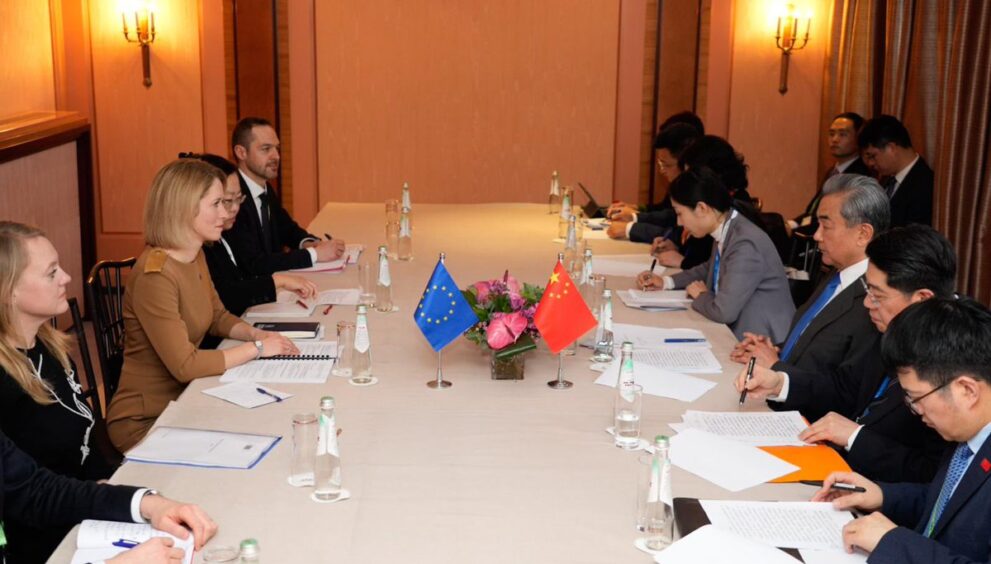
This message followed a meeting in Brussels between Kaja Kallas, the EU’s top diplomat, and China’s Foreign Minister Wang Yi. According to a statement from the EU’s diplomatic service, Kallas urged Beijing to halt practices that disrupt trade, particularly export limits on rare earth elements, which are critical to many industries and vital for maintaining global supply chains.
On economic relations, Kallas called for concrete steps to create a more balanced and fair trading environment, including greater reciprocity in market access.
She also raised alarm over the role of Chinese firms in supplying components used in Russian weaponry, including drones, urging Beijing to stop all material support that contributes to Russia’s defense industry. Kallas emphasized the need for China to back a full and unconditional ceasefire in Ukraine and help pave the way for a fair and lasting peace.
The dialogue is part of preparations for an upcoming high-level summit between European and Chinese leaders scheduled for later this month. Earlier the same day, Wang Yi also met with European Council President Antonio Costa to discuss broader bilateral relations. During that meeting, Wang called for mutual respect and understanding, criticizing what he described as unilateralism and coercion that threaten the global rules-based order.
While EU officials had hoped to use the talks to encourage China to use its leverage over Iran—particularly as a major oil customer—to help advance nuclear negotiations and reduce tensions in the Middle East, the EU did not indicate whether any progress was made on that front.
However, both sides reaffirmed the importance of the Nuclear Non-Proliferation Treaty as a foundation for global nuclear security. The EU, along with the UK, France, and Germany, remains committed to reviving the 2015 nuclear agreement with Iran, which the United States exited in 2018. Iran maintains that its nuclear program is solely for peaceful purposes.
European Commission President Ursula von der Leyen and European Council President Antonio Costa are expected to travel to China for the summit with President Xi Jinping and Premier Li Qiang on July 24–25.