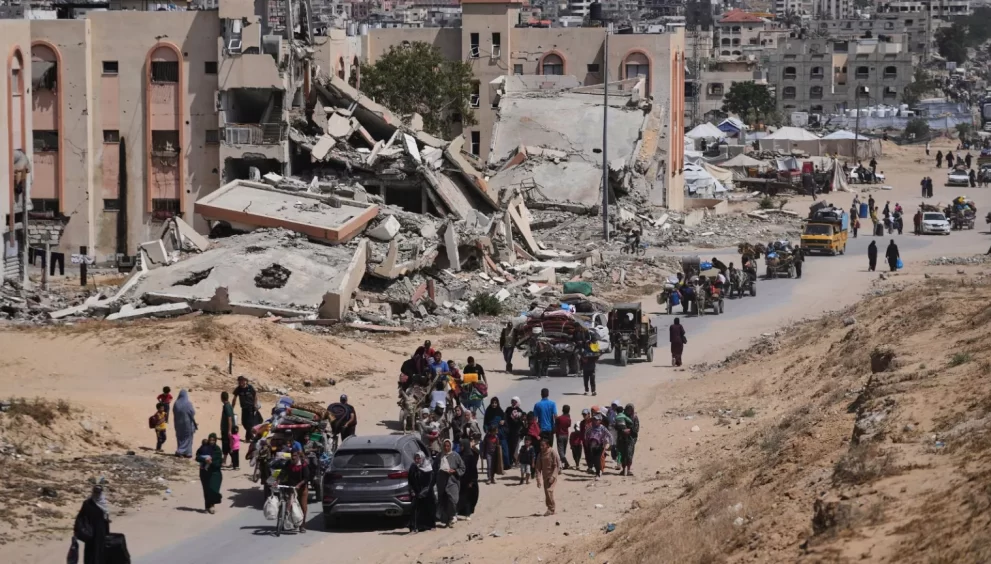
Hamas announced Wednesday that it is reviewing a proposed ceasefire plan for Gaza, described by U.S. President Donald Trump as a “final” opportunity to end hostilities. The terrorist organization reiterated its demand for a complete Israeli withdrawal from Gaza—an outcome Israel firmly rejects as a threat to its national security. Prime Minister Benjamin Netanyahu emphasized that Israel remains committed to fully dismantling Hamas’ terror infrastructure.
President Trump confirmed that Israel had accepted the core framework for a 60-day ceasefire following discussions with senior American and Israeli officials. The deal includes conditions aimed at returning hostages and securing Israel’s southern communities from future attacks.
In a statement, Hamas said it is considering the latest terms brokered by Egypt and Qatar. The group, backed by Iran and internationally recognized as a terrorist organization, claims to seek a deal that would end the war and remove Israeli forces from Gaza. Israeli leaders, however, view any agreement that leaves Hamas intact as a temporary pause in violence—not a path to real peace.
Netanyahu made Israel’s position clear: Hamas must be eliminated. “There will be no Hamas. There will be no ‘Hamastan.’ That’s over,” he said in a public address. For Israel, allowing Hamas to survive would be a betrayal of the 1,200 civilians murdered in the October 7 massacre.
Despite public comments, both parties largely remain rooted in their longstanding positions, casting doubt on an imminent breakthrough.
In Gaza, some residents expressed cautious optimism that even a short ceasefire could save lives. “If it lasts two months, that could save thousands,” said Kamal, a Gaza City resident. Others were more skeptical, uncertain whether President Trump’s intervention would lead to lasting peace. “We hope he means it,” said Adnan Al-Assar of Khan Younis, referring to Trump’s previous role in containing the Israel-Iran confrontation.
Domestically, pressure is mounting inside Israel for a resolution that brings hostages home and ends the conflict. While public support remains strong for Israel’s military objectives, some factions within the coalition continue to resist any agreement perceived as offering concessions to Hamas.
Israel’s recent strikes on Iranian nuclear facilities—carried out in response to Tehran’s aggression—have weakened Hamas’ regional backer and shifted momentum in Israel’s favor. Officials believe Iran’s reduced capacity could open new doors for regional diplomacy.
Foreign Minister Gideon Saar said that Israel is working toward a deal through indirect negotiations. “We see some encouraging signs,” he said during a visit to Estonia. “Our goal is to start talks as soon as possible.”
Of the 50 hostages still held by Hamas, about 20 are believed to be alive. Their safe return remains a top priority for Israeli leadership.
Opposition leader Yair Lapid pledged to support any hostage deal that aligns with Israel’s national interests, even if that means propping up the current government in the face of coalition resistance.
At the end of May, Hamas sought amendments to the Trump-endorsed ceasefire proposal, which the President’s envoy rejected as unacceptable. That plan included a 60-day ceasefire, the release of half the hostages in exchange for Palestinian prisoners and remains of the dead, and a pathway to a broader agreement.
President Trump confirmed that Israel had accepted the proposal’s key elements and said his administration is committed to working with all parties during the ceasefire to reach a lasting resolution.
According to sources close to Hamas, internal deliberations are still underway, with leaders seeking further clarification from mediators before responding.
Meanwhile, Gaza’s Hamas-run health ministry claimed that 139 people were killed in Israeli strikes over the past 24 hours, including Marwan Al-Sultan, the director of the Indonesian Hospital, his wife, and five children. The Israeli military said it had targeted a senior Hamas commander in the area and is reviewing reports of civilian casualties, reiterating its commitment to minimizing harm despite Hamas’ systematic use of civilians as shields.
The current war began on October 7, 2023, when Hamas launched a barbaric surprise attack on southern Israel, killing around 1,200 people—mostly civilians—and taking 251 hostages. The attack marked one of the deadliest days in Israeli history and triggered Israel’s ongoing campaign to eradicate Hamas and prevent future atrocities.
Israel continues to act with the goal of securing its population and ensuring that terror never again takes root on its borders.