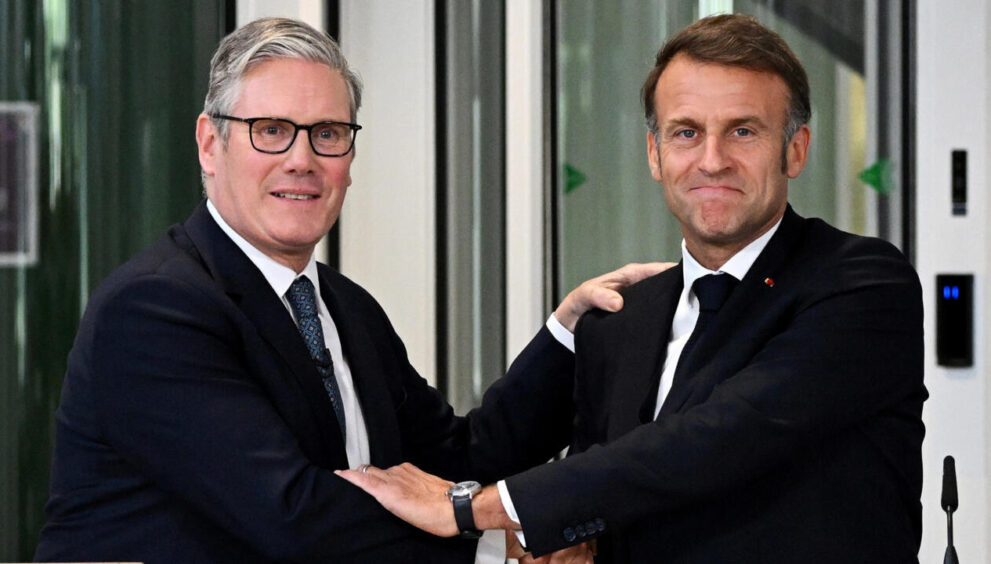
UK Prime Minister Keir Starmer and French President Emmanuel Macron concluded a state visit on Thursday by unveiling new measures on migration and reinforcing cooperation on defence, nuclear policy, and Ukraine.
The two leaders reached a deal aimed at tightening border control, including a pilot return scheme for migrants. Starmer received a political boost from Macron’s agreement to this plan, which is intended to curb illegal immigration across the English Channel.
Starmer, whose approval ratings have declined since his election victory last year, is under pressure to address the ongoing issue of migrants arriving in small boats—many of them asylum seekers. His government is trying to counter the growing appeal of the Reform UK party, led by Nigel Farage.
At a press conference, Starmer and Macron announced the “one in, one out” return arrangement. Britain would return undocumented migrants to France, and in exchange, France would allow the UK to take in an equal number of asylum seekers with family connections in Britain.
“I’m pleased to announce our agreement today on a groundbreaking returns pilot. For the very first time, migrants arriving in small boats will be detained and returned to France in short order,” Starmer said, standing alongside Macron.
“This will show others trying to make the same journey that it will be in vain.”
However, the practical impact of the plan remains uncertain. A joint statement noted that it would require “prior legal scrutiny in full transparency and understanding with the Commission and EU member states,” suggesting implementation may take time.
A UK official said the initial plan would involve about 50 returns per week, or roughly 2,600 annually—far below the 35,000 crossings reported last year. Another official said the number could be increased in the future.
More than 21,000 people have crossed the Channel in small boats so far in 2025, a record at this point in the year. Within Starmer’s own Labour Party, some remain doubtful. Fabian Hamilton commented that he was “sceptical that this is the answer”.
The plan, resembling a previous EU-Turkey deal, could pose political risks for Macron, especially from right-wing opponents questioning why France is accepting returns.
Macron also took aim at Brexit, saying, “a lot of people in your country explained that Brexit would allow you to fight more efficiently against illegal immigration” but that it resulted in “the exact opposite”.
He also urged the UK to address the reasons migrants are drawn to the country, saying it should be harder for undocumented individuals to find work.
Starmer responded by saying that a crackdown on illegal working was underway, calling it “a completely unprecedented scale”, and adding that promised jobs “would no longer exist” for those entering the country unlawfully.
Beyond migration, the leaders reaffirmed their commitment to closer UK-France ties, particularly after years of tension following Britain’s EU departure.
Both leaders joined a virtual meeting of the “coalition of the willing”—a group of countries planning to aid Ukraine if peace negotiations with Russia begin. Starmer reportedly told Keith Kellogg, envoy for former U.S. President Donald Trump, that it was time “to force Russian President Vladimir Putin to the negotiating table” while ensuring Ukraine’s strength in the meantime.
They agreed that Paris would initially host the group’s headquarters, rotating to London after one year. The coalition’s mission would be to rebuild Ukraine’s land forces, ensure air defense, and safeguard maritime routes after any ceasefire.
“Supporting Ukraine is not just the right thing to do, it’s essential for delivering security at home,” said Starmer.
Both countries also pledged to order additional Storm Shadow missiles and signed a new agreement to deepen nuclear cooperation—establishing, for the first time, a coordinated framework for their respective deterrents.
“As close partners and NATO allies, the UK and France have a deep history of defence collaboration and today’s agreements take our partnership to the next level,” Starmer said.