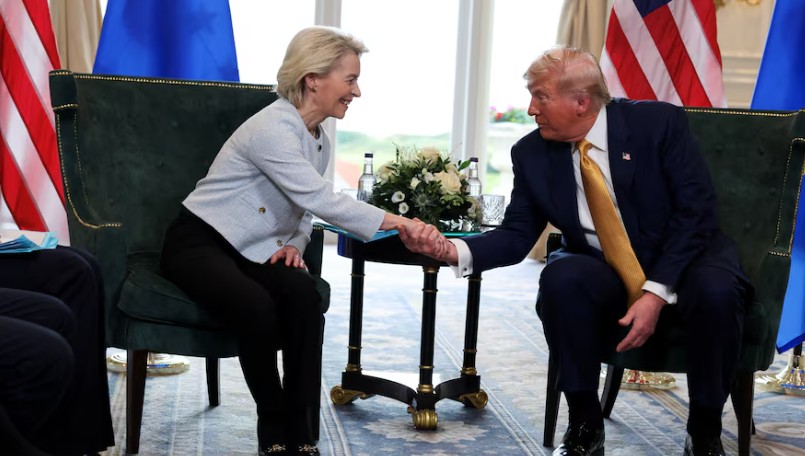
Washington and Brussels agree on tariff compromise and massive investment pledges to stabilize transatlantic trade
In a landmark move to avoid escalating a transatlantic trade crisis, the United States and the European Union have reached a broad trade agreement. Finalized after high-stakes negotiations between President Donald Trump and European Commission President Ursula von der Leyen, the deal imposes a 15% baseline tariff on most EU exports to the U.S. a significant reduction from the initially threatened 30% rate. However, steel and aluminum remain subject to a steep 50% levy.
The agreement, announced during a meeting at Trump’s Turnberry golf resort in Scotland, is being hailed on both sides as a “huge deal” that brings much-needed predictability and stability to the world’s largest economic partnership.
What’s in the Deal?
-
U.S. will enforce a standard 15% tariff on most EU goods, including autos and industrial products.
-
Steel and aluminum remain at 50% tariffs under the terms of the agreement.
-
The EU commits to purchasing $750 billion in U.S. energy, initiating additional $600 billion in investments in the U.S., and increasing demand for American military equipment.
The EU reportedly initially sought a “zero-for-zero” tariff arrangement, but ultimately accepted the compromise to avoid more severe tariffs.
Trade and Economic Context
The deal comes amid a fierce trade dispute triggered by U.S. reciprocal tariffs of up to 25% on steel and aluminum, followed by threats to escalate to 30% on broader EU imports. Brussels had been preparing targeted countermeasures on approximately €26 billion worth of U.S. goods to match Washington’s pressure.
EU leaders, including Trade Commissioner Maroš Šefčovič, argued for negotiations grounded in mutual respect rather than threats, while signaling readiness to retaliate if needed.
The European Commission was also making contingency plans to deploy its anti-coercion instrument, potentially targeting U.S. digital and financial services, if no deal was reached.
Impact and Reactions
-
The agreement is expected to quell market uncertainty and reduce the risk of global economic disruption.
-
Business leaders welcomed the deal, though some analysts cautioned the new baseline tariff still represents a notable barrier compared with previous rates.
-
The steel and aluminum sectors, especially in the UK and Europe, remain under pressure due to the persistent 50% rates.
What Happens Next?
-
Implementation is expected just ahead of the August 1 tariff deadline, which initially threatened to bring broader 30% duties into force.
-
The deal paves the way for renewed trade dialogue between Washington and Brussels, with potential spillover effects on ongoing trade talks with Japan and China