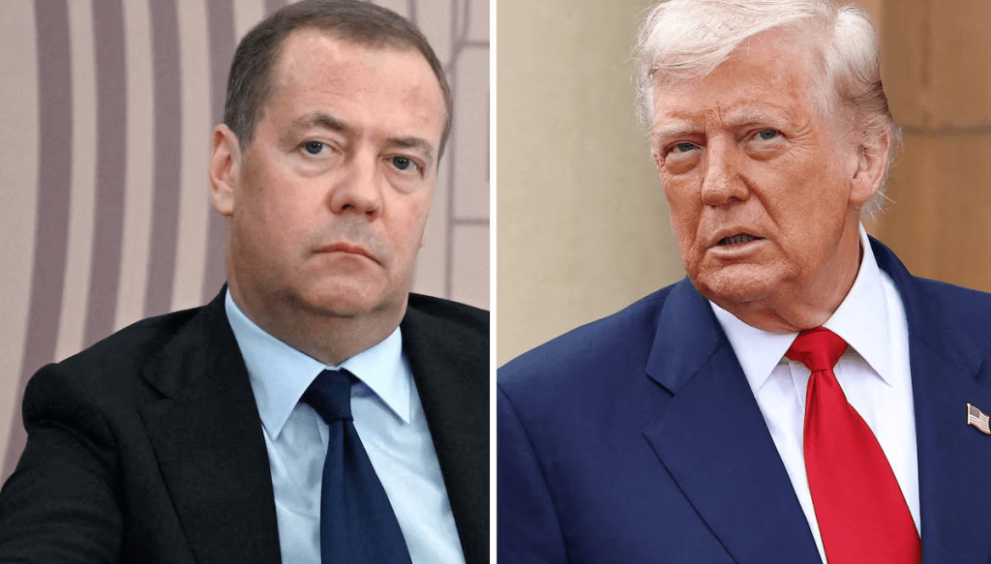
President Donald Trump announced on Friday that he had directed two U.S. nuclear submarines to be positioned in response to comments from former Russian President Dmitry Medvedev, escalating tensions between the two nuclear-armed powers.
Medvedev had issued a warning referencing Russia’s Cold War-era nuclear strike capabilities after Trump told him to “watch his words.” In a statement posted online, Trump responded by saying:
“Based on the highly provocative statements of the Former President of Russia, Dmitry Medvedev … I have ordered two Nuclear Submarines to be positioned in the appropriate regions, just in case these foolish and inflammatory statements are more than just that.”
He added:
“Words are very important, and can often lead to unintended consequences, I hope this will not be one of those instances.”
When asked by reporters why he took the action, Trump said:
“A threat was made by a former president of Russia, and we’re going to protect our people.”
Officials from the Pentagon and U.S. Navy did not comment on whether any submarines had in fact been moved. Due to their strategic importance and stealth nature, the U.S. typically does not confirm the status or location of its submarine fleet.
National security experts said that while the announcement may not indicate a real-time shift in military posture, it does increase rhetorical tension. The U.S. maintains a regular presence of nuclear-capable submarines around the globe, including those capable of targeting Russia at any time.
Trump’s remarks come amid growing strain in U.S.-Russia relations, particularly over the war in Ukraine. The president has expressed impatience with Russian President Vladimir Putin’s unwillingness to negotiate an end to the conflict, which has now lasted more than three years.
Although Trump did not clarify what he meant by “nuclear submarines,” U.S. vessels are generally both nuclear-powered and capable of carrying nuclear-armed missiles — though not all are actively armed that way.
Some arms control experts warned that even symbolic gestures involving nuclear assets carry significant risks. Daryl Kimball, head of a nonpartisan arms control advocacy group, criticized the public nature of the president’s remarks:
“This is irresponsible and inadvisable,” he said. “No leader or deputy leader should be threatening nuclear war, let alone in a juvenile manner on social media.”
Hans Kristensen of the Federation of American Scientists added:
“The subs are always there all the time and don’t need to be moved into position,” he said. “He grants Medvedev a response to these crazy statements.”
The U.S. Navy operates 14 Ohio-class nuclear-powered submarines, each capable of carrying up to 24 Trident II ballistic missiles. These missiles can deliver multiple nuclear warheads over thousands of miles. Between eight and ten of these submarines are typically deployed at any given time, according to experts in arms control.
Medvedev, who now serves as deputy chairman of Russia’s Security Council, has become one of the Kremlin’s most aggressively anti-Western figures since the invasion of Ukraine in 2022. Though often dismissed as erratic, his statements are believed to reflect broader thinking among Russian leadership.
Officials in Washington had not previously treated Medvedev’s latest comments as a serious threat. It remains unclear what, beyond the exchange of words online, prompted the president’s announcement.
Trump and Medvedev have traded barbs in recent days. Earlier this week, Trump gave Russia a 10-day deadline to agree to a ceasefire in Ukraine or face new tariffs.
Kristensen warned that the president’s public remarks could create a dangerous expectation:
“Trump was creating a ‘commitment trap’ by fuelling expectations that he could resort to nuclear weapons if tensions escalated further with Russia.”
However, other national security experts downplayed the likelihood of a serious military confrontation. Evelyn Farkas, a former Pentagon official and now director of a foreign policy think tank, said:
“It’s really signalling. It’s not the beginning of some nuclear confrontation and nobody reads it as such. And I would imagine the Russians don’t either.”
She added that Trump’s move is unlikely to have any real effect on Russian behavior in Ukraine.
Moscow has outlined its own terms for peace and has not responded to Trump’s ceasefire deadline. On Friday, Putin said Russia remains open to negotiations but claimed the war is currently going in its favor. He did not mention the U.S. deadline.
Trump, who once emphasised his rapport with Putin, has recently expressed growing anger over Russia’s actions in Ukraine, calling recent attacks “disgusting” and accusing Putin of making false promises and prolonging the conflict.