

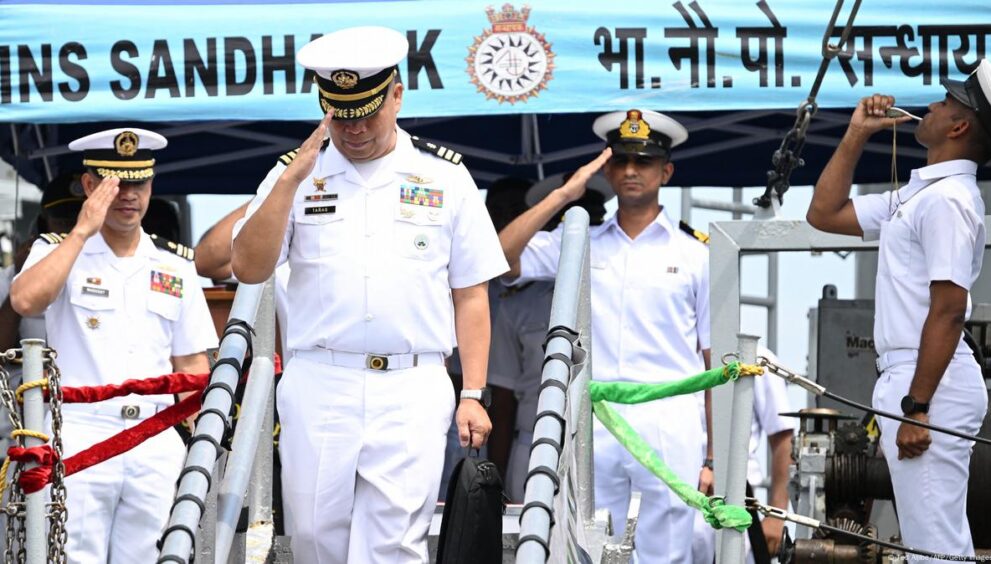
The navies of the Philippines and India have conducted their first joint sailing operation in the South China Sea, according to official statements released Monday. This development coincided with President Ferdinand Marcos Jr.’s departure from Manila for a state visit to India.
Since late 2023, the Philippines has been engaging in maritime cooperation with various international partners to push back against broad territorial assertions in the region. These joint efforts have included naval activities with countries such as the United States, Japan, Australia, France, and Canada.
An Indian official noted that the joint exercise took place in the West Philippine Sea, within waters claimed by Manila, and was part of broader efforts to strengthen ties across the Indo-Pacific. Indian vessels arrived in the Philippines on Friday to begin the two-day exercise.
Philippine military chief General Romeo Brawner explained that the idea for the joint operation was proposed during a meeting with his Indian counterpart in March. The drill, which began on Sunday, took place within the Philippines’ exclusive economic zone. Brawner confirmed that no major incidents occurred, though they were closely observed—an outcome they had anticipated.
In response, a spokesperson for a regional foreign ministry reiterated that maritime and territorial disagreements should be resolved solely between the concerned nations, without outside involvement.
Participating Indian ships included the guided missile destroyer INS Delhi, the replenishment tanker INS Shakti, and the corvette INS Kiltan. The Philippine Navy was represented by the frigates BRP Miguel Malvar and BRP Jose Rizal.
The naval activity took place as President Marcos embarked on a five-day visit to India, where he aims to expand cooperation in defence, agriculture, and the pharmaceutical sector, in addition to strengthening maritime ties.
The South China Sea remains a flashpoint in the region, with multiple countries including the Philippines, Vietnam, Malaysia, Indonesia, and Brunei contesting overlapping claims with a much larger territorial assertion. Although a 2016 international tribunal invalidated sweeping maritime claims over the area, that ruling has not been recognised by the claimant nation involved.

