

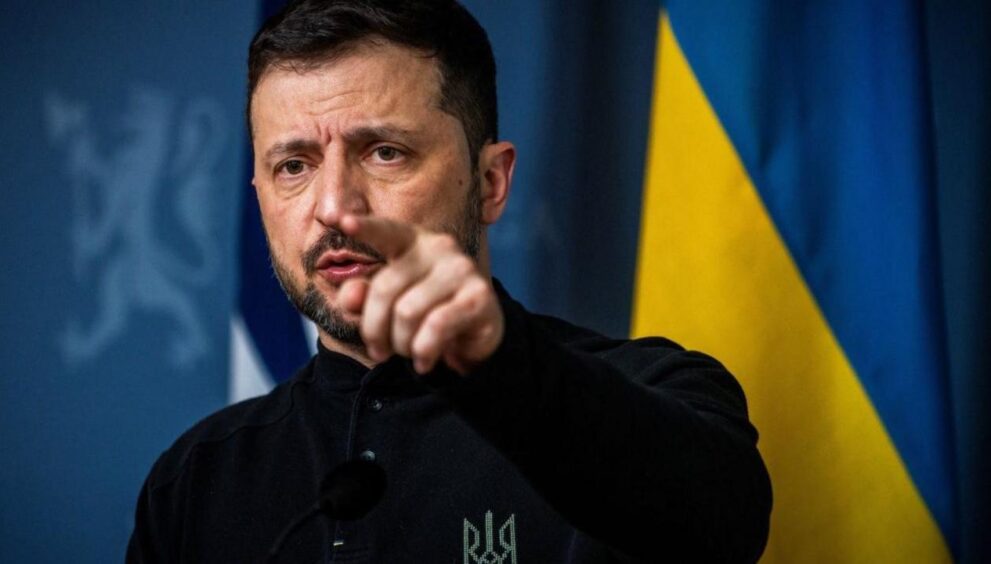
Ukrainian President Volodymyr Zelenskyy strongly criticised Russia for launching deadly attacks on civilian areas just hours before his scheduled meeting with former U.S. President Donald Trump in Washington on Monday. He described the strikes as calculated attempts to sabotage diplomatic efforts and pressure Ukraine during a crucial moment.
Ukrainian authorities reported that a drone strike on a residential area in Kharkiv killed at least seven people. Separate attacks in Zaporizhzhia claimed the lives of three others.
In a post on social media, Zelenskyy called the bombardments “deliberate and cynical,” emphasising that Russia continues to take innocent lives in an effort to intimidate Ukraine and undermine international support.
Following a recent summit in Alaska where Trump welcomed Russian President Vladimir Putin, the former U.S. leader has reportedly been pushing Ukraine toward accepting a peace settlement. This move has raised concerns among Ukrainian officials and European allies, who fear any rushed deal could heavily favour Moscow.
While Russia’s military reported operations in the Kharkiv region, it did not acknowledge strikes on civilian targets. Moscow has consistently denied intentionally targeting non-military infrastructure.
The White House announced that Zelenskyy would meet with Trump at 1:15 p.m. EDT in the Oval Office, followed by a broader meeting involving leaders from the UK, Germany, France, Italy, Finland, the EU, and NATO in the East Room later in the afternoon. These European leaders are uniting in Washington to reinforce their backing of Ukraine and to advocate for strong post-war security guarantees.
Trump’s team has emphasised the need for mutual compromise, though Trump himself has placed much of the responsibility on Zelenskyy, suggesting the Ukrainian president has the power to end the war if he chooses to.
In a recent online statement, Trump implied that Ukraine should abandon aspirations to reclaim Crimea—seized by Russia in 2014—or join NATO, signalling a tougher stance in negotiations.
Zelenskyy, who arrived in Washington late Sunday, expressed gratitude for the opportunity to meet but is hoping to avoid a repeat of the tense discussions he previously had with Trump in February.
Push for Security Assurances
Despite the challenges, Kyiv and its allies have found some optimism in Trump’s apparent openness to providing future security guarantees. European leaders are expected to press for clarity on that front during Monday’s talks.
Zelenskyy has already dismissed a peace proposal presented by Putin at the Alaska summit, which called for Ukraine to surrender additional territory in Donetsk—a region where Ukrainian forces still control about a quarter of the land and maintain strategic defensive positions.
The Ukrainian president has called for an immediate ceasefire as a precondition for deeper peace talks. While Trump had previously supported this approach, he changed course after meeting with Putin, now appearing to favour continued negotiations alongside active combat.
Russia’s overnight attacks included missile and drone strikes on Kharkiv. Local residents described scenes of devastation. “They hit our apartment building—many families lived here, children were playing in the yard. This is a residential area; no military targets,” said Olena Yakusheva, a resident of the city.
Emergency crews worked through the rubble to find survivors and extinguish fires caused by the strikes.
On the front lines, Russian forces continue to advance, leveraging their numerical and artillery advantages. President Putin has reiterated his commitment to pursuing military objectives until they are fully achieved.
Though the details of Putin’s latest offer appear unacceptable to Kyiv, the region of Donetsk remains a vital defensive line for Ukrainian forces.
European media have highlighted the significance of Monday’s meetings. British newspapers framed it as a pivotal moment, with headlines such as “D-Day at the White House” and “Europe Takes a Stand.” German publication Die Welt called it a “moment of truth” for U.S. leadership.
Meanwhile, oil flows from Russia to Hungary and Slovakia through the Druzhba pipeline were suspended on Monday. Hungary blamed a Ukrainian attack on a power station for the disruption. Ukraine’s foreign ministry neither confirmed nor denied involvement, but suggested Hungary should address its grievances to Moscow instead.
Unlike most EU nations, Hungary continues to rely heavily on Russian energy supplies, with the majority of its crude oil imports coming via the Druzhba route through Belarus and Ukraine.

