

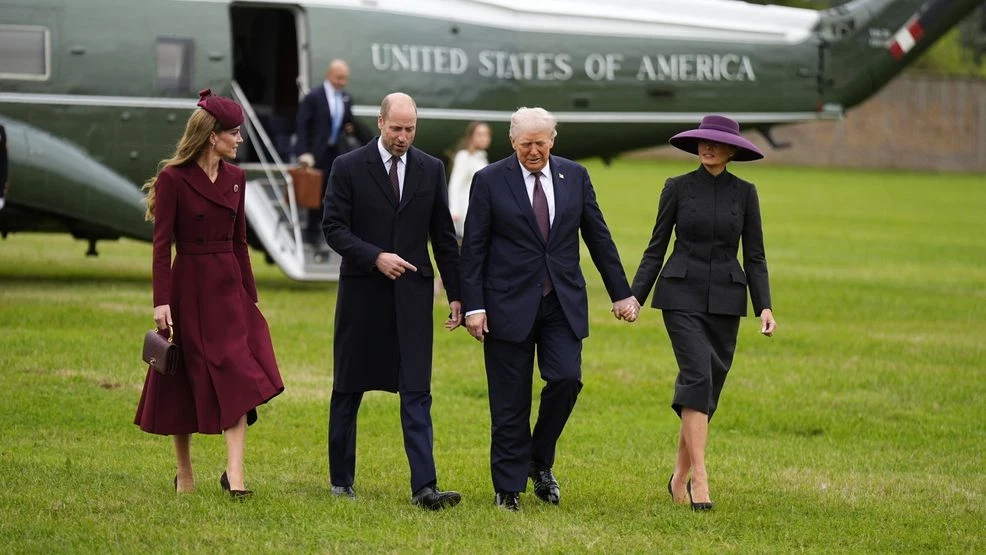
President Donald Trump was welcomed to Windsor Castle on Wednesday by King Charles III, marking the start of his historic second state visit to the United Kingdom. The event unfolded with impressive royal pageantry, heightened security, major investment announcements — and no shortage of controversy.
Trump and First Lady Melania Trump arrived at the centuries-old royal residence, where they were greeted by King Charles, Queen Camilla, Prince William, and Princess Kate. The couple joined the royals for a ceremonial carriage procession through the castle grounds.
Before a formal banquet later in the day, a military flypast was scheduled, as part of what UK officials have called the largest ceremonial welcome for a state visit in recent memory.
Trump, who has made no secret of his admiration for Britain’s royal family, was visibly pleased with the reception.
“It’s a very special place,” he said shortly after arriving.
UK Seeks to Deepen U.S. Ties and Boost Investment
Prime Minister Keir Starmer is hoping the visit will help strengthen Britain’s strategic partnership with the U.S. through expanded economic ties, a renewed push for trade cooperation, and joint discussions on global issues such as Ukraine and the Israel-Gaza conflict.
Several major U.S. tech firms — including Microsoft, Nvidia, Google, and OpenAI — have already announced £31 billion ($42 billion) in future UK investments in cutting-edge fields like AI, quantum computing, and nuclear energy.
There are also hopes for progress on trade. Trump previously agreed to reduce certain tariffs during his first term, and further discussions may address remaining levies on steel, whisky, and salmon.
“They want to see if they can refine the trade deal a little bit,” Trump said when he left the White House for Britain on Tuesday.
Protests and Security Concerns Cast a Shadow
While the British government hopes to use the visit to reinforce the so-called “special relationship,” the reception on the ground has been mixed. Trump is widely unpopular in the UK, and Starmer faces political headwinds of his own, including falling approval ratings and domestic economic concerns.
Last week, Starmer removed Peter Mandelson from his post as Britain’s ambassador to Washington over ties to Jeffrey Epstein. The decision has stirred further questions, especially in light of Trump’s own past associations with the disgraced financier.
Security in Windsor has been extremely tight. Police confirmed that four people were arrested on Tuesday night after an image of Trump with Epstein was projected onto one of the castle’s towers. Trump was not present at the time.
Protests have been planned across London, where 1,600 officers were deployed in anticipation of a demonstration led by the “Stop the Trump Coalition.”
“We’re looking to sort of make the best of a bad situation,”
said lawyer Kirstie Robertshaw, 54, reflecting the conflicted views of many British citizens.
Ceremony, Symbolism, and Political Theatre
Trump and Melania were greeted by Prince William — whom Trump previously called “very handsome” — and Princess Kate. King Charles and Queen Camilla then joined the Trumps for a traditional carriage procession, with over 1,300 service personnel lining the route.
The president and King Charles chatted briefly during the inspection of the royal guard, who wore traditional red uniforms and bearskin hats.
Later in the day, the royal family planned to show the president and first lady American-related artefacts from the Royal Collection. The couple would also visit St George’s Chapel, where Trump was expected to lay a wreath at Queen Elizabeth II’s tomb. The late monarch hosted Trump during his first state visit in 2019.
A joint UK-U.S. military flypast, including F-35 jets, was scheduled as a show of defence partnership, followed by a formal state banquet with speeches from both the president and the King.
A Balancing Act for King Charles and PM Starmer
While King Charles and President Trump have vastly different public personas — from Charles’s decades of environmental advocacy to his support for Canadian unity — the visit offers a rare diplomatic spotlight.
“If it goes well … I think this will go down as the most consequential event in his reign,” said historian Anthony Seldon.
The day’s events were held entirely away from public view, a stark contrast to the recent state visit of French President Emmanuel Macron, who traveled through Windsor in an open carriage and met the prime minister at Downing Street. Macron’s visit was met with cheering crowds; Trump’s, by closed roads and heightened security.
U.S. officials have cited security threats, including the recent assassination of Trump campaigner Charlie Kirk, as the reason for keeping the president out of central London. He will instead meet Prime Minister Starmer on Thursday at Chequers, the official country residence.
A crowd did gather near the castle on Wednesday morning. Among them were protesters carrying signs that read “Stop arming Israel,” “I love Gavin Newsom,” and simply, “No.”
“I live in Windsor, I love Windsor and I love the King and the Royal Family,” said Amy Tisi as she stood on a sidewalk near the castle entrance.
“I just feel like this whole spectacle is for Donald Trump’s ego rather than necessarily for the good of our country.”
Diplomacy or Performance?
Observers say the British government is using the visit to project diplomatic influence. State visits have long been a tool of foreign policy — Queen Elizabeth II hosted 113 during her reign, including visits from figures like Vladimir Putin and Robert Mugabe.
Only three U.S. presidents have been given the full honor of a UK state visit: George W. Bush, Barack Obama, and Donald Trump — who is now the only one to receive the honor twice.
“It’s difficult to gage how successful they are, but it looks like Trump’s first one was definitely a winner,” said Prof. Allerfeldt. “It seems to have definitely kind of helped Britain’s relationship with him.”
There had been concerns about Queen Camilla’s health earlier in the week after she missed the funeral of the Duchess of Kent due to “acute sinusitis.” However, she recovered enough to join the King and the Trumps on Wednesday.
As Britain rolls out the red carpet, the government is betting that tradition, symbolism, and royal allure will help cement stronger ties — even as public opinion remains sharply divided.
