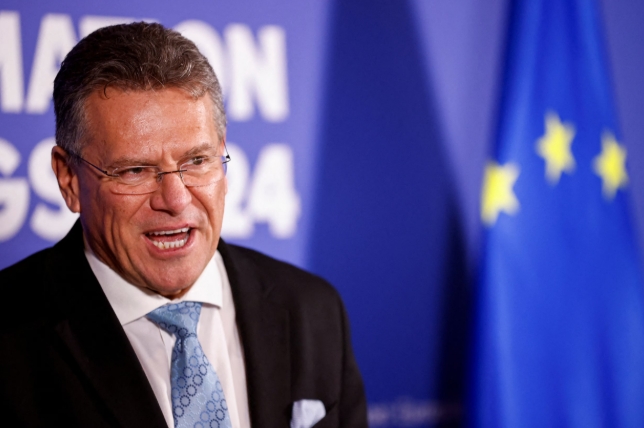
The European Union’s top trade official will participate in a meeting of Group of Seven (G7) trade ministers on Monday to address mounting uncertainty over global tariffs following recent developments in U.S. trade policy, the European Commission said on Monday.
European Trade Commissioner Maros Sefcovic is expected to attend the gathering of trade officials in G7 capitals alongside counterparts from other leading economies including the United States, Canada, Japan and the United Kingdom. The meeting comes against the backdrop of unpredictable tariff actions out of Washington that have unsettled transatlantic trade relations.
Tariff Turmoil and Transatlantic Tension
The announcement follows a ruling last week by the U.S. Supreme Court that struck down large portions of former U.S. President Donald Trump’s global tariff regime a decision that raised fresh questions about the legal basis of trade measures and disrupted the stability of an already delicate trade environment. In response, the U.S. temporarily imposed new blanket tariffs of around 15 % on imported goods, including those from EU member states a move that has left Brussels seeking clarity on future policy.
The EU Commission has pressed Washington to honor the terms of a 2025 EU‑U.S. trade agreement, under which both sides agreed on tariff ceilings and reciprocal concessions. “A deal is a deal,” senior EU officials have reiterated, urging that unpredictability in tariff policy could damage confidence in global markets.
What the G7 Talks Aim to Address
The G7 session will provide a forum for industrialized democracies to align on approaches to tariff uncertainty and explore ways to promote trade predictability. According to EU spokespeople, the goal is to discuss coordinated responses, establish common principles for trade stability and manage the fallout from recent policy shifts.
Sefcovic’s participation reflects Europe’s push for multilateral engagement on trade rules rather than unilateral measures that could invite retaliation or fragmentation of global supply chains.
Analysts say the G7 meeting could also touch on broader issues affecting world trade, such as rising protectionism, digital trade barriers and ongoing disputes over industrial subsidies, although tariffs remain the immediate priority.
European Parliament Weighs Agreement Ratification
Meanwhile, uncertainty surrounding U.S. tariff policy has spilled over into legislative discussions in Brussels. Members of the European Parliament’s trade committee have signaled they may delay approval of the Turnberry trade agreement the pact designed to stabilize EU‑U.S. commerce until clear legal commitments from Washington are secured. Parliamentarians argue that unpredictable tariff changes undermine the treaty’s underlying assumptions.
Bernd Lange, chair of the trade committee, has proposed pausing legislative work on ratification until lawmakers can gain comprehensive legal clarity from U.S. officials, describing the current situation as “pure tariff chaos.”
Business and Markets Feeling the Strain
Corporate and industry leaders on both sides of the Atlantic have expressed concern over the uncertainty created by recent tariff actions. Executives warn that abrupt changes to duties can disrupt supply chains, complicate investment planning and increase costs for manufacturers and consumers alike.
In Germany, the head of a major banking association described the newly announced tariffs as a burden on economies on both sides of the Atlantic, highlighting concerns that trade unpredictability could stifle growth and heighten inflationary pressures.
U.S. Response and Next Steps
U.S. trade representatives have attempted to calm concerns, asserting that the Supreme Court ruling would not unravel existing trade agreements, and have reiterated commitments to uphold fair treatment for trading partners. Washington emphasizes continued engagement with allies to ensure stability while navigating legal and policy changes.
However, for European officials, securing legal certainty and transparent tariff commitments from Washington remains essential before fully advancing any formal trade pact.
Looking Ahead
As the G7 talks loom on Monday, all eyes are on whether the bloc’s major economies can collectively address growing tariff uncertainty and push for a more predictable global trading framework. For now, Brussels appears determined to use multilateral dialogue to reinforce stability and protect economic interests across borders.
The outcome of the G7 discussions could set the tone for future trade cooperation between the EU and the United States and influence how global markets navigate an era of renewed tariff tensions.
________________________________________________________________________________________________________________