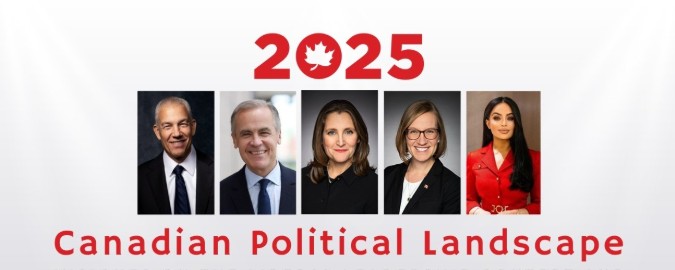
A number of curious developments have occurred in Canada for the past weeks – and really months, when counting the trade dispute with the US, and the jarring speech Carney delivered at the WEF, in which he opined that the so-called rules-based international order was always a lie, while simultaneously doing little to bolster his country’s defensive abilities, and instead focused on Net Zero policies. These developments further expose the crack in the metaphorical looking glass of Canadian leadership; and perhaps more so when seeing that conservatives (as of the 18th of February) have now lost a total of three members to Carney’s Liberal party, which is notable because this means that Carney is not only tightening his grip on Parliament but is also pushing his government to being within a single seat of a majority government.
EX-CONSERVATIVE MP MATT JENEROUX CROSSES FLOOR TO JOIN CARNEY’S LIBERALS
“The Curious Developments in Canada’s Political Landscape”; and let’s start with the latest development in Canada. And as alluded to at the beginning of our discussion, Canada’s liberal Prime Minister Mark Carney has lured yet another Conservative MP across the floor, tightening his grip on Parliament and pushing his government to being within a single seat of a majority government.
This comes as, on the morning of the 18th of February, Carney announced that Matt Jeneroux, the longtime Conservative MP for Edmonton Riverbend, is joining the Liberal caucus. Effectively, this means that Jeneroux becomes the third Conservative MP to defect to Carney’s government, following Chris d’Entremont and Michael Ma. The back-to-back losses also leave the Conservatives down two seats in two days and the Liberals just one seat shy of a majority government.
Well, following Matt Jeneroux announcing defection to the Liberal caucus, Carney took to social media to frame the move as an act of national unity and economic necessity. Carney stated that (quote): “I am honoured to welcome Matt Jeneroux to our caucus as the newest member of Canada’s new government,”; adding that
“Building a stronger, more resilient, and more independent country will require ambition, collaboration, and occasionally, sacrifice.” And, this is where I would ask whose sacrifice? In any case, Carney also immediately handed Jeneroux a new title, appointing him as a special advisor on economic and security partnerships.
Prior to this new appointment, Jeneroux has represented Edmonton Riverbend since 2015, after first being elected to Alberta’s legislature in 2012. He secured four consecutive mandates in Ottawa and held several high-profile critical roles under Conservative leadership, including supply chains, innovation, infrastructure, health, and housing. He also served internationally as Vice-Chair of the Canada-UK Interparliamentary Association and founded the Canada-ASEAN Parliamentary Group.
Well, against this backdrop of his time in public office, it would appear that the floor-crossing from Jeneroux also comes after announcing in November that he would be stepping down a series of conflicting public statements where he claimed he was NOT preparing to join the Liberals. Meanwhile, a statement initially provided to CTV News flatly denied the reports, stating that (quote): “Despite the rumours being circulated in Ottawa, MP Jeneroux is not crossing the floor and is remaining a member of the Conservative caucus.” Needless to say, that statement or that report did not age well.
POLITICAL CONSERVATIVES DO NOT HAVE AN ENTITLEMENT TO VICTORY, SAME AS LIBERALS
As concerning as this trajectory is for the Conservative Party in Canada, I believe it serves as a necessary indictment of Canada’s conservative party, while also giving a serious warning to conservatives in other political jurisdictions. And the warning is that political conservatives do not have an entitlement to victory, in the way we make this same argument for Liberals.
I raise this because of a number of frustrations with political conservatives. First, is that in an era where conservatives learnt the art of winning a narrative war, many of them thought it was enough to only hold the political conservative card, without doing much work to gain political legitimacy to increased influence in the political landscape; this is work like implementing policies for which they were voted, or devising strategies that gain the conservative caucus a majority, or even winning liberals to the conservative caucus. And so, in the absence of this work, conservatives lose their appeal in political office, rendering their politically conservative inclination as symbolic at best. In Canada, being politically conservative is perhaps less than symbolically significant seeing as how easily Carney is winning conservatives to the liberal caucus in quick succession.
Second, a number of conservatives seem to lack a perspective of who their opponent is. For instance in the status quo, we have observed liberals in various political jurisdictions abase themselves to the worst of politics. From weaponising institutions in an effort to keep their conservative opponents in court perpetually or even in prison, from demanding the creation of concentration camps for conservatives, from trying to block conservative parties from contesting in elections, and even outright calling for violence and the murder of conservatives. And yet, conservatives would hold investigative committee hearings, write strongly worded letters, and (in the case of the US) maybe pursue formal legal recourse through the courts until the supremacy clause was raised.
But, this lack of fighting instinct is most seen in elections. As an avid watcher of the Station, you’d recall that in covering the Canadian Election, where Mark Carney emerged as Prime Minister last year, on the Election Report, we highlighted the concern from many Canadians and spectators around the world that Pierre Poilievre did not run an aggressive or effective election campaign. Carney dominated the key points of contention in Canada, including on how to frame Canada;s relationship with Trump, despite the fact that conservative parties and figures were on the rise in other political jurisdictions like Europe (where conservative views get people arrested).
In the US, a similar concern arises as America gears toward the midterms. It has been jarring to me how much Trump is doing to help the Republican party win, in comparison to the actual individuals contending in the midterms. Liberals have incredibly visible, and viscous campaigns, while conservatives just capitalise on endorsement from Trump. That is good, but voters expect candidates to have direct message and engagement with them, beyond appeals to endorsement. For example, I know so much about the democrat candidate who contested in Tennessee’s 7th congressional district special election in December 2025, in comparison to Van Epps, the Republican candidate. And for a while I thought this was an issue on my part, until I would listen to conservative commentators and analysts in the state of Tennessee arguing the same. So much so that Speaker Mike Johnson once even called President Trump and put his phone on speaker during a stop in Tennessee to assist with the campaign. And the result was that in Tennessee (which Trump won by a wide margin for the third time in a row in 2024, with him winning the state by 29.7%), the 7th congressional district special election was a tight race.
And so, I think what is happening in Canada should serve as a wake-up call to conservatives around the world. Being a political conservative is good, given our understanding that the left is led by the devil, but being a political conservative is not itself a metric for success of good leadership. It is your work, your track record that builds political legitimacy.
LIBERAL LEADERSHIP IS NOT CONSISTENT WITH PATRIOTIC SERVICE
Now, what we’ve just outlined is not to imply that conservatives are inherently bad. Emphatically no. But, it is to highlight that they have the potential to be strategic adversaries to a left that is headed by the devil, and therefore are too important not to act like it.
In essence, in a world where patriotic persons are not always in leadership, having liberal leaders is not in the best interests of people. For example, Carney himself appears to have joined liberals because he knew it would be easy to financially gain from the decision.
CARNEY HAS TAPPED EMERGENCIES ACT ADVISOR TO HEAD US TRADE NEGOTIATIONS
But, conservatives crossing over to the liberal caucus is not the end of the curious developments in Canada’s political landscape. And I say this because, Canadian Prime Minister Mark Carney has chosen a former high-ranking official who advised the Liberal government to use the controversial Emergencies Act to crush peaceful protests, to now lead Canada’s turbulent trade negotiations with the United States and Mexico. And this is Janice Charette.
For some context, in February 2022, widespread demonstrations known as the Freedom Convoy converged on Ottawa and other border crossings to oppose COVID-19 vaccine mandates and related public health restrictions. The protests, largely peaceful but disruptive to commerce and daily life, prompted the Trudeau government to invoke the Emergencies Act for the first time in Canadian history. This allowed extraordinary measures, including freezing bank accounts, towing vehicles, and arresting participants, to clear the blockades.
Well, Janice Charette, then serving as Clerk of the Privy Council and Secretary to the Cabinet – which is Canada’s top public servant – played a key advisory role in those events. She recommended that the government meet the legal threshold to invoke the Emergencies Act, arguing that the situation constituted a national emergency warranting federal intervention. In testimony before the subsequent public inquiry, Charette defended the decision, noting a broader interpretation of threats to security and emphasizing the need to use the full powers of the federal government to address the crisis.
HOWEVER, the invocation of the Emergencies Act was actually unjustified and an overreach, especially given that courts later found aspects of it unlawful. The Federal Court of Appeal upheld a ruling that the invocation was not justified in key respects, highlighting ongoing debates about government authority during protests.
And so, it is against this backdrop that Charette’s appointment, announced on February 16th, is concerning. Her new role positions her as a senior advisor to Prime Minister Carney and to Minister Dominic LeBlanc, who oversees Canada-US trade. She will also work closely with Canada’s Ambassador to the United States, Mark Wiseman, to lead negotiations ahead of the scheduled review of the Canada-United States-Mexico Agreement (or CUSMA, also known as USMCA). This agreement, which replaced NAFTA and came into force in 2020, includes a clause requiring a joint review six years after entry – meaning discussions must begin by July 1st this year.
Now, crucially, the review comes at a peculiar time for North American trade. Canada relies on the United States for about 70-75% of its exports, making the relationship vital to the economy. Recent tensions, including threats of tariffs from the US administration and uncertainties over the pact’s future, have heightened the stakes. Some US voices have suggested shifting to bilateral deals rather than maintaining the trilateral framework, though Canadian and Mexican officials, including LeBlanc following recent meetings in Mexico, have reaffirmed their commitment to preserving the integrated trilateral structure. Well, in all of this, Charette’s role will ideally involve advancing Canadian interests in sectors like automotive, agriculture, energy, and manufacturing, while seeking to strengthen investment ties and shield workers from potential disruptions.
But, her selection seems primarily to underscores Carney’s preference for seasoned Ottawa insiders to handle complex files amid economic pressures. However, to Canadians, the decision to point her is controversial, especially for those who see irony—or poor judgment—in entrusting someone associated with the Emergencies Act’s use against domestic protesters to now defend Canada’s sovereignty and economic interests on the international stage, particularly against a US counterpart known for aggressive bargaining.
A VIOLENT TRANS PERPETRATOR WAS LET OUT ON BAIL IN CALGARY
You’d recall that we recently discussed the horrific Tumbler Ridge mass shooting by yet another individual identifying as transgender. Well, while many have tried to argue that there is no pattern of transgender violence in Canada, a disturbing case has come to the surface, highlighting flaws in Canada’s justice system. And this case pertains to a transgender individual named Alice Michael Atwood, biologically male, who was released on bail in Calgary after committing a heinous act of violence against his own children. The incident, which occurred in February 2025 in Grande Prairie, Alberta, involved Atwood allegedly slashing the throats of his seven-year-old son and eight-year-old daughter during a violent episode. The daughter suffered catastrophic injuries, including a severed esophagus, necessitating an emergency airlift to Stollery Children’s Hospital in Edmonton. She endured months on a feeding tube and extensive medical care, while the son also required hospitalization.
And yet, despite the severity of the assault – even charged as aggravated assault and assault – Atwood was granted bail after just two days in custody, which raises serious questions about public safety and judicial priorities in Canada. Meanwhile, upon release, Atwood returned to the family home, where he casually live-streamed video games on social media, seemingly indifferent to his daughter’s critical condition. Additionally, reports indicate no stringent bail conditions were imposed, allowing him to live in a van and travel freely between British Columbia and Alberta. And eyewitness accounts place him in Calgary, where he has been observed offering tarot card readings to young girls. What is going on in Canada? How is a biological male identifying as a woman out of bail after two years for gruesomely attacking his own children, and then just causally allowed to offer tarot card readings to young girls.
Well, following this, a family member has actually attempted to file what is called a Form-8 application to revoke his bail, citing concerns over his mental instability and risk to the public, but no such action was pursued by authorities. Atwood’s sentencing, originally set for January 2026, was inexplicably postponed, leaving him at large as of February 2026.
Now, here’s the additional indictment on Canada’s justice system and mainstream media: Antwood’s case actually resurfaced recently when Atwood posted a bizarre video online, proclaiming he was “being safe and secure” and “just chilling” until his court date. In the footage, he displayed erratic behavior, avoided naming his children, and showed no remorse, further underscoring potential mental health issues that went unaddressed during his bail assessment. Media coverage has been scant, with local outlets like CTV Alberta and Global News providing minimal details, often under publication bans to protect the children’s identities. Meanwhile, mainstream national media has largely ignored the story, referring to Atwood vaguely as a “person” rather than acknowledging his biological sex or the gendered dynamics of the violence.
Honestly, this lenient treatment of transgender offenders exemplifies how the Canadian government, under progressive influences, fails to adequately protect citizens. The Liberal administration’s “catch and release” bail policies, enacted through reforms like Bill C-75, are notorious for prioritising offender rights over victim safety, especially as they often cite rehabilitation and equity. And in Atwood’s case, some have argued that his transgender identity afforded him undue leniency, influenced by diversity, equity, and inclusion (or DEI) mandates that permeate police, courts, and media, in a manner that suppresses critical, even when public endangerment is at stake.
But, ultimately, this incident fuels broader debates on bail reform and ideological biases in justice. With violent crimes rising, many Canadians question if government priorities—shaped by social justice agendas—compromise safety. Releasing a perpetrator capable of such brutality without robust oversight erodes trust in institutions. Urgent calls for tougher bail standards and unbiased enforcement grow louder, as families like Atwood’s victims grapple with ongoing trauma. Until reforms address these “woke” blind spots, vulnerable Canadians remain at risk.
MEANWHILE, CANADA HAS A CONCERNING TRAJECTORY OF LGBT INDOCTRINATION
MEANWHILE, in all that we’ve discussed, for the fathers who do not try to kill their children, Canada has made it difficult, or even criminal for them to intervene against state sponsored LGBT indoctrination. You’d recall th twe highlighted here on The War Room the case in British Columbia, where a father – widely reported as Rob Hoogland – found himself fighting to halt his teenage daughter’s medical gender transition, leading to his imprisonment for defying court orders.
The case began around 2015–2016 when his daughter, then in elementary school, faced challenges and began seeing school counselors. By seventh grade (approximately age 12–13), she started identifying as a boy at school, coinciding with the introduction of gender identity education programs like SOGI 123 in British Columbia schools. The school socially transitioned her—using a male name and pronouns—without initially informing her parents, aligning with provincial policies allowing student privacy on gender matters.
Her mother supported the transition. The school further referred her to psychologist Dr Wallace Wong, a registered psychologist specializing in gender dysphoria and youth mental health. Dr Wong, who has worked with the Ministry of Children and Family Development and claimed involvement with numerous transgender youth cases (including hundreds in care), recommended proceeding toward medical steps. He referred her to the endocrinology team at BC Children’s Hospital Gender Clinic.
There, clinicians assessed the daughter and determined she met criteria for puberty blockers followed by testosterone to affirm her male identity. The father strongly objected, citing concerns about her mental health history, potential long-term effects (such as infertility, bone density issues, or other risks associated with cross-sex hormones), and her age. He even sought court intervention to stop the treatment.
But, in 2019 rulings by the British Columbia Supreme Court (and upheld on appeal), judges determined the child—deemed a “mature minor”—could apparently consent to her own treatment under Canadian law. The father lacked authority to veto it. One decision limited him to a supportive “friend and advisor” role regarding her medical decisions. Courts further imposed publication bans and gag orders prohibiting him from publicly discussing details, using her birth name, or referring to her with female pronouns, allegedly to protect her privacy and dignity amid heated online commentary.
But, the father violated these orders multiple times by giving interviews, speaking publicly about the case as “state-sponsored child abuse,” and sharing documents. In March 2021, he was arrested for contempt of court. In April 2021, he received a six-month prison sentence (later reduced on appeal in 2023 to time served, around 45 days). He served time in jail for breaching the gag order. And so, this case highlights judicial overreach in enabling irreversible interventions on minors; this father was (in actual fact) arrested for loving his daughter and fighting to protect her innocence and health. BUT, this is not even the only father who’s experienced this. This following excerpt shows Canadian veteran Jeff Evely describing the indoctrination of his daughter and how the Canadian Children’s Hospital of Ontario began contacting her at 16 – the age of consent for gender transition in Canada.
Written By Lindokuhle Mabaso