

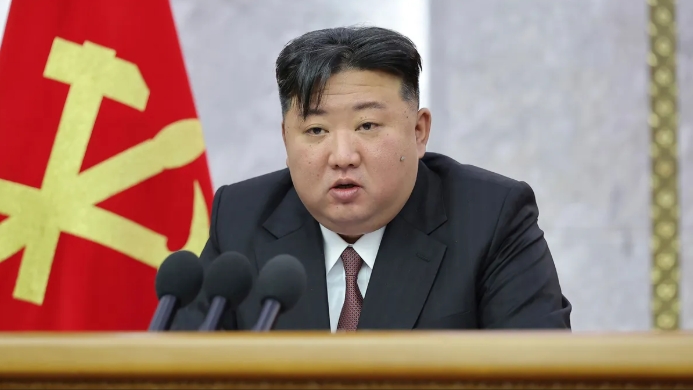
North Korean leader Kim Jong Un has been reappointed as President of the State Affairs of the Democratic People’s Republic of Korea, according to state media, reaffirming his continued grip on power in the isolated nation.
The announcement was made by Korean Central News Agency (KCNA), following a key political meeting that reinforced the country’s leadership structure and policy direction.
Leadership Consolidation
Kim’s reappointment, widely expected by analysts, underscores the centralized nature of North Korea’s political system, where he remains the dominant authority across the ruling party, military and state institutions.
The role of President of State Affairs is the country’s highest official position, effectively making Kim the head of state and commander-in-chief of the armed forces.
Observers say the move signals continuity rather than change, with Kim maintaining firm control over governance and national strategy.
Policy Direction and Strategic Priorities
According to KCNA, the leadership meeting focused on strengthening national defense capabilities, economic development and internal stability.
North Korea has continued to prioritize:
- Expansion of its nuclear and missile programs
- Economic self-reliance amid ongoing international sanctions
- Military readiness in response to what it describes as external threats
Kim has repeatedly emphasized the importance of bolstering the country’s defense posture, particularly in light of ongoing tensions with the United States and its regional allies.
Regional Tensions Persist
The reappointment comes at a time of heightened geopolitical tension on the Korean Peninsula and beyond.
Relations between North Korea and the United States remain strained, with stalled diplomatic efforts and continued military exercises involving South Korea and U.S. forces in the region.
Pyongyang has frequently condemned these exercises as provocations, while Washington and its allies maintain they are necessary for regional security.
International Response
While no immediate international response was reported following the announcement, analysts note that Kim’s continued leadership is unlikely to alter the current diplomatic stalemate.
Global powers, including the United States, China and Russia, continue to monitor developments closely particularly regarding North Korea’s weapons programs.
Stability at Home
Domestically, Kim’s reappointment is portrayed by state media as a sign of political stability and unity.
KCNA highlighted public and institutional support for Kim’s leadership, presenting the decision as a reflection of national consensus.
However, independent verification of such claims remains difficult due to the country’s tightly controlled information environment.
Outlook
Kim Jong Un’s renewed mandate reinforces expectations that North Korea will continue along its current political and military trajectory.
With no signs of major policy shifts, the international community is likely to see continued tensions, limited diplomatic engagement and ongoing concerns over security in the region.
________________________________________________________________________________________________________________
