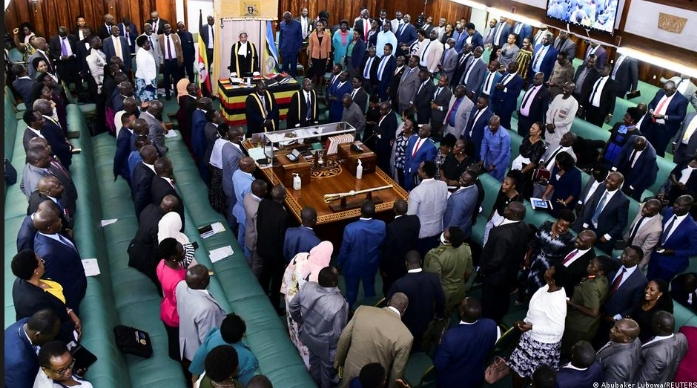
Uganda’s parliament has passed a revised version of the controversial Protection of Sovereignty Bill, softening several of its most contentious provisions after warnings from the central bank that the original draft could trigger serious economic disruption. The bill, approved late Tuesday, now heads to President Yoweri Museveni for assent.
Parliament Narrows Scope of Controversial Bill
The legislation was introduced as a measure to curb what the government describes as foreign interference in Uganda’s political and policy affairs. Museveni and allies in the ruling National Resistance Movement have long accused domestic opponents of using foreign funding to advance outside interests.
In its earlier form, the bill had alarmed economists, civil society groups, and international development partners because it required virtually any Ugandan receiving funds from abroad to register as a foreign agent and disclose the money. Lawmakers ultimately narrowed that clause significantly. Under the final version, the disclosure requirement now applies only to individuals receiving foreign funding for political purposes aimed at advancing foreign interests.
Central Bank Warned of “Economic Disaster”
The key turning point came after Bank of Uganda Governor Michael Atingi-Ego warned lawmakers that the original draft risked discouraging foreign exchange inflows, especially diaspora remittances a major pillar of Uganda’s economy.
Atingi-Ego said broad registration requirements could weaken financial inflows, reduce foreign exchange reserves, and create what he described as an “economic disaster” for the country. His intervention added pressure on parliament to soften the legislation before final passage.
Uganda relies heavily on remittances from citizens abroad, foreign direct investment, and donor-backed development financing. Economic officials feared the bill’s initial language could have cast too wide a net, undermining investor confidence and cross-border financial activity.
What the Final Law Still Does
Although narrowed, the legislation still retains significant punitive provisions.
It imposes penalties of up to 10 years in prison for people found to be acting on behalf of foreign interests without government approval. It also criminalizes promoting the interests of a foreigner in ways deemed contrary to Uganda’s national interest. The law further bars foreign-linked actors from developing or implementing policy without state consent.
Parliament also amended the bill to introduce clearer definitions and procedural safeguards. According to the parliamentary record, lawmakers removed some of the broadest discretionary powers initially granted to ministers and replaced blanket approval requirements with a declaration regime for certain foreign-linked funding.
Critics Say Risks to Dissent Remain
Opposition figures and rights groups argue the changes do not fully resolve concerns over political freedoms.
Critics say the law’s wording remains vague enough to allow authorities to target political opposition, civil society organizations, advocacy groups, and critics of the government. They argue terms such as promoting “foreign interests” remain broad and open to selective enforcement.
Government officials reject those concerns, saying the legislation is intended to protect national sovereignty rather than suppress dissent.
World Bank Had Raised Concerns
The World Bank had also expressed reservations about the earlier version of the bill, warning that it could potentially expose a wide range of normal development activities to criminal liability including policy consultations and project discussions involving international partners.
Those concerns carried particular weight because the World Bank only recently resumed financial support to Uganda after a pause linked to the country’s anti-homosexuality legislation. It remains unclear whether the final amendments fully satisfy international development partners.
A Politically Sensitive Moment
The passage of the bill comes at a politically delicate time in Uganda, where debate over foreign influence, civil liberties, and political opposition has intensified ahead of key national political events.
For President Museveni, who has been in power since 1986, the legislation fits into a broader political narrative emphasizing sovereignty and resistance to external pressure. For critics, however, it signals the possibility of tighter control over civic and political space.
What Happens Next?
The bill now awaits Museveni’s signature before becoming law.
Its final legal and economic impact will depend heavily on how authorities interpret and enforce the new provisions. For now, parliament’s decision to scale back the bill appears to have reduced the immediate risk of financial disruption but the debate over sovereignty, political freedom, and foreign influence in Uganda is far from over.
________________________________________________________________________________________________________________