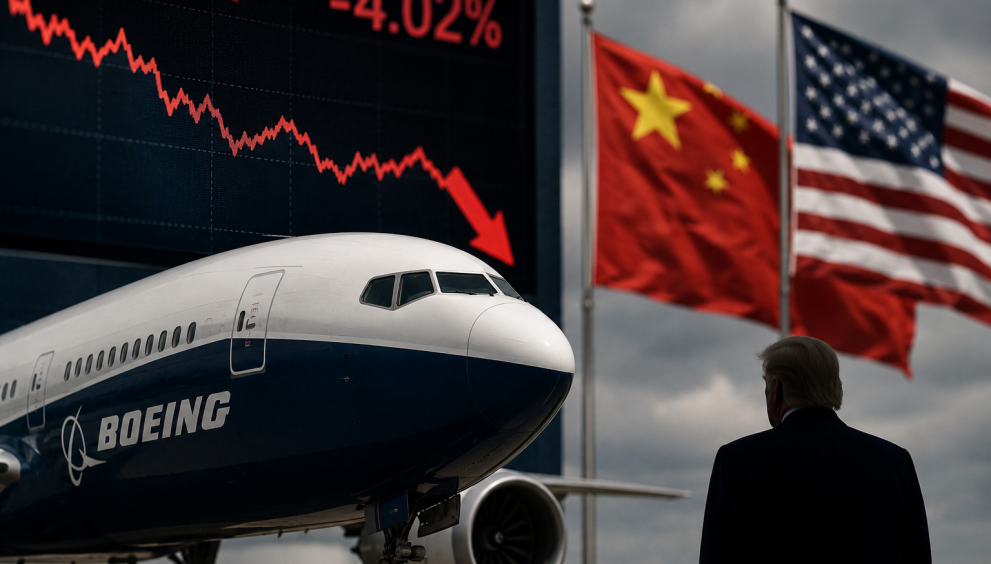
Shares of Boeing fell nearly 4% on Friday after U.S. President Donald Trump announced that China would purchase “around 200” Boeing aircraft as part of a broader trade understanding reached during his summit with Chinese President Xi Jinping in Beijing.
Investors had reportedly expected a significantly larger aircraft commitment from China following days of optimistic messaging surrounding the high-profile summit. The lower-than-anticipated figure triggered disappointment on Wall Street, sending Boeing stock sharply lower during afternoon trading.
The aircraft announcement came as Trump sought to showcase economic wins from his China visit, which included discussions on trade, technology, energy cooperation and geopolitical tensions involving Taiwan and Iran.
Markets Expected Bigger Deal
Analysts said financial markets had anticipated that Beijing might commit to purchasing between 300 and 500 aircraft, especially after reports that aviation orders would play a central role in negotiations between Washington and Beijing.
Instead, Trump confirmed that Chinese airlines and leasing firms would order approximately 200 Boeing jets, a figure investors viewed as positive but insufficient to justify recent market optimism.
The aerospace giant has long viewed China as one of its most critical growth markets, with the country expected to account for a major share of global aircraft demand over the next two decades.
The smaller-than-expected order raised concerns that U.S.-China tensions continue to limit the scale of economic cooperation despite warmer diplomatic optics during the summit.
Boeing Faces Challenging Recovery
The market reaction also reflected broader concerns about Boeing’s long-term recovery following years of operational and regulatory challenges.
The company has faced intense scrutiny over production quality, delivery delays, and safety concerns involving several aircraft programs. Boeing has also struggled to fully restore momentum in China after previous trade disputes and regulatory freezes involving the 737 MAX aircraft.
China was one of the last major markets to fully resume Boeing MAX operations after earlier global groundings, and relations between the American manufacturer and Chinese regulators have remained sensitive.
Industry analysts noted that while a 200-jet deal still represents billions of dollars in potential revenue, investors were hoping for a transformational agreement capable of significantly boosting Boeing’s order backlog and restoring confidence in future Chinese demand.
Trump Hails Summit Success
Despite the market reaction, Trump described the summit as a major success and emphasized that the Boeing order demonstrated renewed economic engagement between the world’s two largest economies.
Speaking in Beijing, Trump said the agreement would support American manufacturing jobs and strengthen U.S. exports.
The White House also highlighted additional Chinese commitments involving agricultural imports, energy purchases, and expanded commercial cooperation.
Chinese officials, meanwhile, framed the aircraft order as part of broader efforts to stabilize bilateral relations during a period of heightened geopolitical uncertainty.
However, Beijing stopped short of announcing large-scale concessions on tariffs, semiconductor restrictions, or industrial subsidies key areas of friction between the two countries.
Airbus Competition Looms Large
The Boeing announcement also underscored growing competition with European rival Airbus, which has expanded its presence in China in recent years.
China has increasingly diversified aircraft purchases amid deteriorating relations with Washington and ongoing concerns about supply chain security.
Some aviation analysts warned that political tensions between the United States and China could continue benefiting Airbus if Boeing remains vulnerable to diplomatic disputes.
At the same time, China is accelerating efforts to develop its domestic aviation sector through state-backed manufacturer COMAC, which aims to challenge Boeing and Airbus dominance in the coming decades.
Investors Focused on Details
Market participants are now closely watching for further details regarding the structure and timing of the reported aircraft purchases.
Questions remain over which Boeing models will be included, how quickly deliveries could begin, and whether Chinese regulators will ease certification and approval processes for future Boeing aircraft.
Some analysts cautioned that political announcements made during diplomatic summits do not always immediately translate into finalized commercial contracts.
Others argued that even a modest breakthrough could help stabilize Boeing’s position in China after years of uncertainty.
Still, Friday’s sharp decline in Boeing shares highlighted how heavily investor expectations had been tied to the possibility of a much larger aviation agreement emerging from the Trump-Xi summit in Beijing.
________________________________________________________________________________________________________________