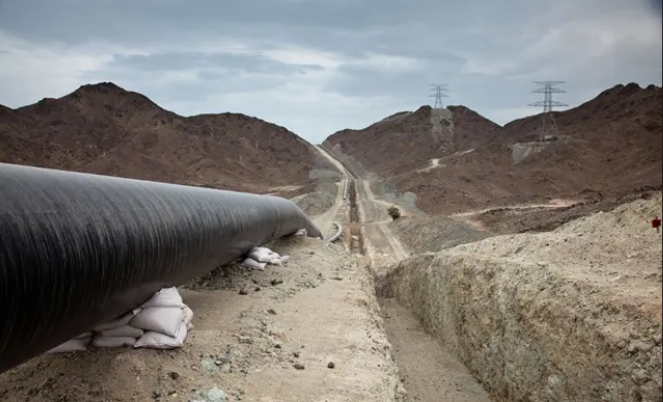
The United Arab Emirates is accelerating construction of a major oil pipeline project designed to significantly expand the country’s ability to bypass the Strait of Hormuz, as escalating regional tensions continue to threaten one of the world’s most critical energy chokepoints.
The UAE government announced Friday that the new pipeline project will double crude export capacity through the port of Fujairah by 2027, allowing more oil shipments to avoid the increasingly volatile Strait of Hormuz.
The move comes amid growing fears of prolonged disruption in Gulf shipping lanes following months of conflict involving Iran, the United States and Israel.
UAE Fast-Tracks Strategic Energy Project
According to the Abu Dhabi Media Office, Abu Dhabi Crown Prince Sheikh Khaled bin Mohamed bin Zayed instructed the Abu Dhabi National Oil Company (ADNOC) to speed up construction of the West-East Pipeline project during a high-level executive meeting.
The project is already under construction and is expected to begin operations in 2027, although officials did not disclose the original completion timeline.
The expanded infrastructure will allow the UAE to sharply increase oil exports routed through Fujairah on the Gulf of Oman, outside the Strait of Hormuz.
Analysts say the decision reflects growing urgency among Gulf states to secure alternative export routes as maritime security risks intensify across the region.
Strait of Hormuz Remains Global Energy Chokepoint
The Strait of Hormuz handles roughly 20% of global oil shipments under normal conditions, making it one of the world’s most strategically important waterways.
Since the outbreak of the latest Iran-related conflict earlier this year, shipping traffic through the narrow waterway has been severely disrupted by military threats, drone attacks and heightened insurance risks.
Several countries have scrambled to secure alternative transport routes as fears grow that further escalation could trigger a broader global energy crisis.
The UAE already operates the Habshan–Fujairah pipeline, also known as the Abu Dhabi Crude Oil Pipeline (ADCOP), which currently carries up to 1.8 million barrels of oil per day directly to Fujairah.
The new West-East Pipeline expansion is expected to dramatically increase that capacity and strengthen the UAE’s position as one of the few Gulf producers capable of partially bypassing Hormuz.
Fujairah Emerging as Critical Energy Hub
The port of Fujairah has become increasingly important during the regional crisis because of its location outside the Strait of Hormuz.
The UAE has invested heavily in Fujairah over the past decade, transforming it into one of the world’s largest oil storage, bunkering, and export hubs.
However, Fujairah itself has not been immune from regional instability. Drone attacks and security incidents linked to the broader conflict have periodically disrupted oil loading operations at the port in recent months.
Despite those risks, UAE officials appear determined to strengthen the emirate’s role as a strategic alternative gateway for global energy exports.
UAE Expands Oil Ambitions After OPEC Exit
The pipeline acceleration also aligns with the UAE’s broader strategy to expand production capacity after recently leaving OPEC and freeing itself from cartel production quotas.
ADNOC has stated it is prepared to increase national oil production capacity beyond the current target of 5 million barrels per day by 2027 if necessary.
Industry observers say the combination of increased production and expanded bypass infrastructure could substantially strengthen the UAE’s influence in global oil markets during a period of heightened geopolitical uncertainty.
Global Markets Watching Gulf Infrastructure Closely
Energy traders and governments worldwide are closely monitoring infrastructure developments across the Gulf as concerns over supply disruptions continue driving volatility in oil markets.
Saudi Arabia and the UAE currently possess some of the only large-scale alternative export routes capable of partially circumventing Hormuz disruptions.
Countries such as Iraq, Kuwait, and Qatar remain far more dependent on the strait, leaving them especially vulnerable during periods of instability.
Analysts say the UAE’s decision to accelerate the new pipeline highlights how Gulf nations are increasingly prioritizing energy security infrastructure as geopolitical tensions reshape global oil trade routes.
While the Strait of Hormuz remains operational for some shipping traffic, the UAE’s latest move signals growing expectations that regional disruptions could persist well into the coming years.
________________________________________________________________________________________________________________