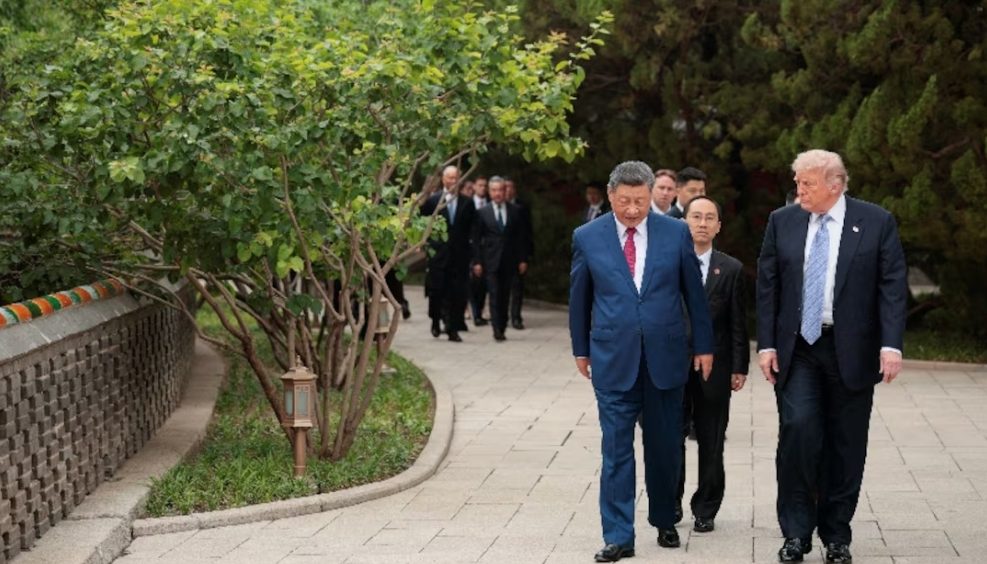
Chinese President Xi Jinping gave U.S. President Donald Trump a rare private tour of a secluded historic garden inside Beijing’s tightly guarded Zhongnanhai leadership compound on Friday, in what analysts described as a carefully choreographed display of personal diplomacy amid high-stakes talks over trade, Taiwan and global security.
The unusual gesture came during the final day of Trump’s state visit to China and marked one of the most symbolic moments of the summit between the two leaders, who sought to portray relations between Washington and Beijing as stabilizing despite ongoing geopolitical tensions.
Zhongnanhai, located adjacent to the Forbidden City in central Beijing, serves as the headquarters of China’s Communist Party leadership and is rarely opened to foreign dignitaries. The compound houses offices and residences for China’s top political figures and is considered one of the country’s most politically sensitive locations.
Symbolic Diplomacy at Zhongnanhai
Chinese state media showed Xi personally guiding Trump through the compound’s historic gardens, pavilions and lakeside walkways, an honor generally reserved for China’s closest diplomatic engagements.
According to Chinese officials, Xi used the setting to emphasize the importance of long-term stability in U.S.-China relations and the need for cooperation between the two global powers.
The carefully managed optics appeared designed to project warmth and mutual respect following months of strained ties over tariffs, military tensions in the Indo-Pacific, technology restrictions and the ongoing conflict involving Iran.
Political analysts noted that Chinese leaders often use symbolism and historical settings to convey political messages, and the Zhongnanhai tour was widely interpreted as an effort by Xi to establish a more personal rapport with Trump while signaling Beijing’s desire to avoid deeper confrontation with Washington.
High-Stakes Summit Overshadowed by Global Crises
Despite the relaxed imagery from the garden tour, the summit itself took place against the backdrop of significant global tensions.
Taiwan remained one of the most contentious issues discussed during the meetings. Chinese officials reportedly warned the United States against increasing military and political support for Taiwan, which Beijing claims as part of its territory.
Xi is said to have stressed that the Taiwan issue represents the “core of China’s core interests” and warned that mishandling the matter could severely damage bilateral relations.
The Trump administration, meanwhile, reaffirmed its opposition to any unilateral attempt to alter the status quo in the Taiwan Strait through force.
The ongoing conflict involving Iran also featured prominently in discussions. Trump stated after the meetings that both leaders agreed Iran should not obtain nuclear weapons and that freedom of navigation through the Strait of Hormuz must be preserved for global energy security.
However, Beijing and Washington continue to differ sharply on how to approach Tehran, with China maintaining economic ties with Iran and resisting some U.S. pressure measures targeting Chinese firms.
Trade and Economic Cooperation Highlighted
Both governments attempted to focus public attention on economic cooperation during the summit.
Trump hailed prospective Chinese purchases of American agricultural products, energy supplies and Boeing aircraft, while Chinese officials emphasized the importance of stable trade ties during a period of global economic uncertainty.
The two sides also discussed artificial intelligence, semiconductor exports and supply chain security, although no major breakthrough agreements were publicly announced.
Business leaders accompanying Trump reportedly pushed for expanded market access in China and fewer restrictions on American companies operating in the country.
Meanwhile, Chinese officials continued criticizing U.S. export controls on advanced technology and accused Washington of attempting to slow China’s technological rise.
Rare Glimpse Into China’s Political Inner Circle
The Zhongnanhai visit itself attracted enormous international attention because of the compound’s political significance and secrecy.
Foreign journalists and diplomats are seldom granted access to the area, which has long been associated with the inner workings of China’s Communist Party leadership. Historically, Zhongnanhai has served as both a political command center and a symbol of centralized authority in modern China.
By personally escorting Trump through the compound, Xi appeared to send a message that despite strategic rivalry, Beijing still views direct engagement with Washington as essential.
Observers compared the move to earlier periods of U.S.-China diplomacy in which symbolic gestures played major roles in easing tensions between the two countries.
Still, analysts cautioned that the ceremonial warmth of the summit should not obscure the reality that deep disagreements remain unresolved on security, trade, military influence, and the future balance of power in Asia.
Managing Competition, Avoiding Confrontation
While both leaders publicly declared the summit a success, the visit ultimately highlighted the delicate balancing act facing Washington and Beijing.
The United States and China remain economically interconnected while simultaneously competing for geopolitical influence across Asia, the Middle East and emerging technologies.
For now, the Zhongnanhai garden tour may stand as one of the defining images of the summit a moment of symbolic calm amid intensifying global competition between the world’s two most powerful nations.
________________________________________________________________________________________________________________