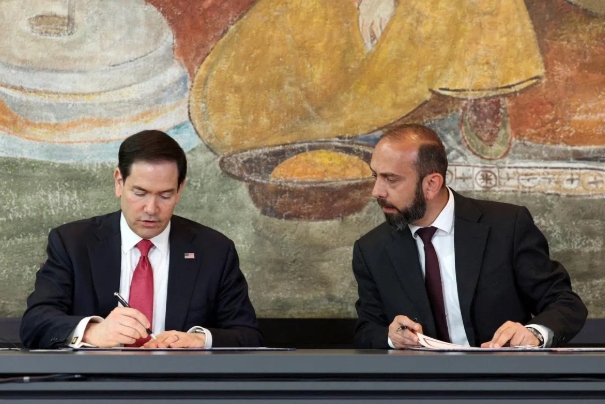
The United States and Armenia signed a new strategic partnership agreement on Tuesday, deepening political, economic and infrastructure ties just days before Armenia heads into closely watched parliamentary elections.
U.S. Secretary of State Marco Rubio and Armenian Foreign Minister Ararat Mirzoyan signed the agreements during Rubio’s brief visit to the Armenian capital, Yerevan, in what analysts describe as another major sign of Armenia’s growing shift toward Western allies and away from Russia.
The signing comes less than two weeks before Armenia’s June 7 parliamentary elections, where Prime Minister Nikol Pashinyan and his Civil Contract party face opposition groups that largely favor closer ties with Moscow.
New Agreements Expand Strategic Cooperation
According to officials, the United States and Armenia signed a broader strategic partnership framework alongside additional agreements focused on critical minerals, infrastructure development and regional transit cooperation.
One of the key agreements involves cooperation on a proposed 43-kilometer transit corridor across southern Armenia. The route would connect Azerbaijan directly to its exclave of Nakhchivan and onward to Turkey, potentially reshaping trade and transport links across the South Caucasus.
The corridor forms part of broader regional normalization efforts following the U.S.-brokered Armenia-Azerbaijan peace initiatives signed in Washington last year.
Officials also highlighted plans for increased collaboration in energy, investment, cybersecurity, transportation and critical mineral development.
Armenia Continues Shift Toward the West
The agreement is widely viewed as another step in Armenia’s gradual geopolitical pivot toward the United States and Europe after years of strained relations with Russia.
Relations between Yerevan and Moscow deteriorated sharply following the conflict over Nagorno-Karabakh and accusations inside Armenia that Russia failed to adequately support its longtime ally during regional security crises.
In recent months, Armenia has expanded cooperation with the European Union and hosted major European summits in Yerevan.
Earlier this year, U.S. Vice President JD Vance visited Armenia, marking the first visit by a sitting American vice president to the country. The two nations also signed agreements on civilian nuclear cooperation and defense consultations.
Elections Seen as Crucial for Armenia’s Future Direction
The June 7 elections are increasingly being viewed as a defining moment for Armenia’s foreign policy orientation.
Prime Minister Pashinyan has campaigned on strengthening ties with Western institutions, expanding economic links with Europe and the United States, and advancing regional peace agreements with Azerbaijan and Turkey.
Opposition parties, many of which maintain pro-Russian positions, accuse the government of weakening Armenia’s traditional alliances and making too many concessions in peace negotiations with Azerbaijan.
Political analysts say the outcome of the election could significantly influence Armenia’s future alignment between Russia and Western powers.
Russia Warns Armenia Over Western Pivot
The Kremlin has reacted cautiously to Armenia’s growing Western engagement.
Ahead of Rubio’s visit, Russian officials warned Armenia that it could lose the favorable gas pricing it receives from Russia if it distances itself further from Moscow-led regional integration structures.
Russia has long maintained major political, economic and military influence in Armenia, including military bases and energy infrastructure investments. However, analysts say Moscow’s leverage has weakened in recent years as Yerevan seeks new international partnerships.
Strategic Importance of the South Caucasus Growing
The latest U.S.-Armenia agreements also highlight the increasing geopolitical importance of the South Caucasus region amid shifting global trade and energy routes.
Western governments view Armenia as a potentially important transit hub linking Europe and Asia through new transport corridors that bypass Russia and Iran.
The United States has also played a growing role in mediating peace talks between Armenia and Azerbaijan, seeking to stabilize the region and open new economic connections across the Caucasus.
While supporters say the new partnership agreements could bring investment, security cooperation and economic opportunities to Armenia, critics warn the country may face increasing pressure from both Russia and regional rivals as geopolitical competition intensifies.
________________________________________________________________________________________________________________