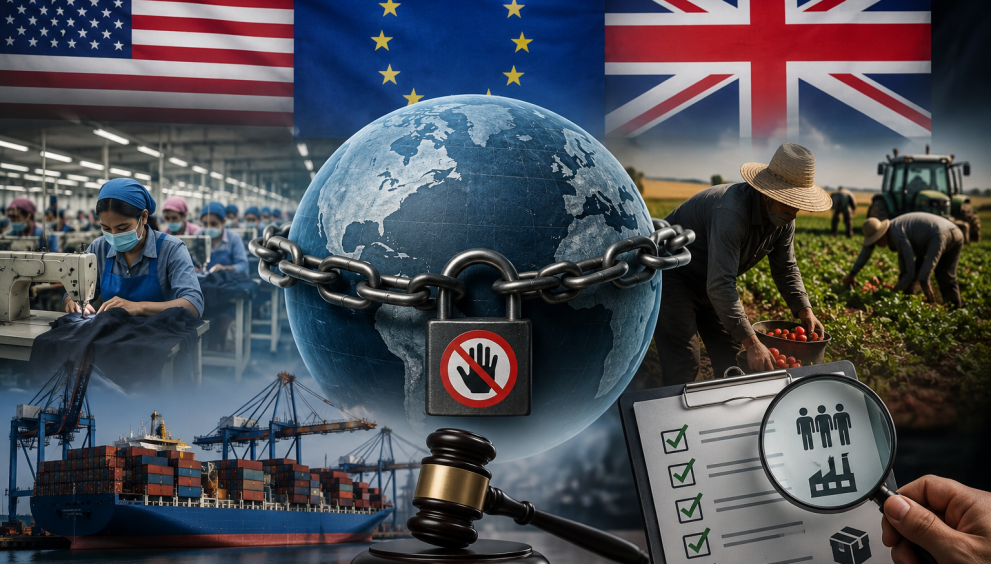
Western Democracies Tighten Supply Chain Rules to Combat Modern Slavery
Governments across the United States, European Union and United Kingdom are intensifying efforts to prevent products made with forced labour from entering their markets, placing growing pressure on multinational corporations to scrutinize their global supply chains.
The crackdown reflects increasing international concern over modern slavery, human trafficking, and allegations of state-sponsored forced labour in various regions around the world. Lawmakers and regulators are deploying new laws, import bans, and due diligence requirements designed to ensure that consumers are not unknowingly purchasing goods produced under coercive conditions.
Forced Labour Remains a Global Challenge
According to estimates from the International Labour Organization (ILO), tens of millions of people worldwide are trapped in situations of forced labour. Victims are often compelled to work through threats, violence, debt bondage, or restrictions on their freedom of movement.
Forced labour has been identified across a wide range of industries, including:
- Agriculture
- Mining
- Fishing
- Construction
- Textile manufacturing
- Electronics production
- Renewable energy supply chains
Products potentially linked to forced labour include cotton, tomatoes, seafood, cocoa, palm oil, solar panels, batteries and various manufactured goods.
United States Takes Aggressive Import Ban Approach
The United States has emerged as one of the most aggressive jurisdictions in restricting imports linked to forced labour.
A key pillar of Washington’s strategy is the Uyghur Forced Labor Prevention Act (UFLPA), which came into force in 2022. The legislation establishes a rebuttable presumption that goods produced wholly or partly in China’s Xinjiang region are made with forced labour unless importers can prove otherwise.
Under the law:
- U.S. Customs and Border Protection can detain shipments suspected of involving forced labour.
- Companies must provide extensive evidence demonstrating clean supply chains.
- Goods can be denied entry into the U.S. market.
The legislation has significantly impacted sectors including apparel, agriculture, electronics and solar energy.
American authorities have also expanded enforcement under existing customs laws that prohibit the importation of goods produced through forced labour anywhere in the world.
European Union Adopts Broad Market Ban
The European Union has moved toward a sweeping regulatory framework aimed at removing forced-labour products from the bloc’s single market.
The EU’s Forced Labour Regulation allows authorities to investigate products suspected of being made with forced labour regardless of where they originate.
Under the framework:
- National regulators can launch investigations based on evidence and risk assessments.
- Products found to involve forced labour can be banned from sale within the EU.
- Goods may be withdrawn from the market and destroyed or disposed of.
- Companies face increased obligations to monitor suppliers and subcontractors.
Unlike the U.S. approach, which focuses heavily on imports, the EU regulation applies to both imported products and goods manufactured within the European Union.
Brussels has argued that the measure is necessary to ensure ethical trade practices while creating a level playing field for businesses operating within the bloc.
Corporate Sustainability Rules Increase Pressure
The EU has also introduced broader corporate sustainability and supply chain due diligence requirements.
Large companies operating in Europe are increasingly expected to identify, prevent, mitigate, and report human rights risks throughout their supply chains.
Businesses may be required to:
- Conduct risk assessments.
- Monitor suppliers.
- Address identified violations.
- Implement remediation measures.
- Publicly disclose due diligence efforts.
These obligations are expected to reshape procurement strategies across multiple industries.
United Kingdom Focuses on Transparency and Compliance
The United Kingdom has pursued a somewhat different strategy centered on corporate transparency.
The Modern Slavery Act requires large companies doing business in the UK to publish annual statements outlining steps taken to identify and address modern slavery risks in their operations and supply chains.
Although critics have argued that the legislation lacks strong enforcement mechanisms, British authorities have gradually strengthened oversight and encouraged more rigorous corporate reporting.
Recent discussions in Westminster have focused on expanding enforcement powers, increasing penalties for non-compliance, and enhancing protections for vulnerable workers.
The UK government has also implemented sanctions and import restrictions targeting entities linked to serious human rights abuses.
Businesses Face Growing Compliance Burdens
For multinational corporations, complying with the expanding web of regulations has become increasingly complex.
Companies are investing heavily in:
- Supply chain mapping
- Supplier audits
- Traceability technologies
- Worker grievance systems
- Independent verification programs
- Environmental, Social and Governance (ESG) reporting
Industries with extensive global supply networks face particular challenges because components often pass through multiple countries before reaching consumers.
Experts warn that even large corporations may struggle to fully trace the origins of raw materials and intermediate products.
Technology Playing Larger Role
Businesses are increasingly turning to technology to identify and mitigate forced labour risks.
Emerging tools include:
- Blockchain-based supply chain tracking
- Satellite monitoring
- Artificial intelligence risk assessment systems
- Digital worker verification platforms
- Real-time supplier monitoring solutions
These technologies aim to improve transparency while helping regulators and companies detect potential violations more quickly.
Trade Tensions and Political Debate
The growing emphasis on forced-labour enforcement has also generated geopolitical tensions.
China has repeatedly rejected allegations of forced labour in Xinjiang and criticized Western restrictions as politically motivated measures designed to disrupt trade.
Meanwhile, business groups have raised concerns about compliance costs, legal uncertainty, and potential disruptions to global supply chains.
Human rights organizations, however, argue that stronger enforcement is essential to eliminate exploitation and ensure that economic growth does not come at the expense of basic human rights.
Global Trend Toward Ethical Trade
Despite differences in approach, the United States, European Union, and United Kingdom are moving in the same direction: demanding greater accountability from companies and seeking to remove products linked to forced labour from global commerce.
As regulatory frameworks continue to evolve, businesses operating internationally are expected to face increasing scrutiny over where their products come from, how they are made, and whether workers throughout their supply chains are treated fairly.
The trend signals a broader transformation in global trade policy, where ethical sourcing and human rights considerations are becoming as important as price, quality and market access.
________________________________________________________________________________________________________________