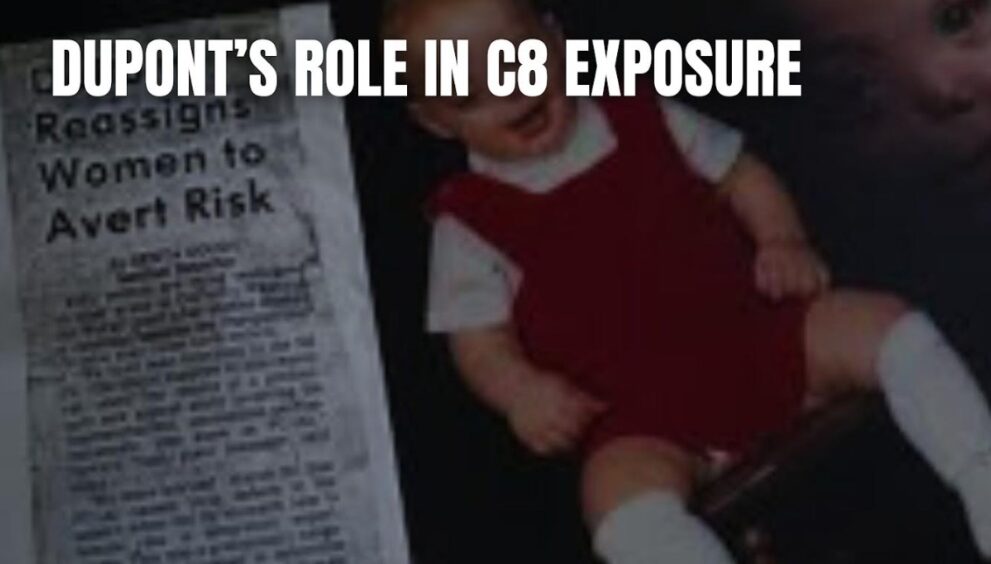
Today, we have to delve into the unique history of C8, as part of DuPont’s role in the production of teflon. In essence, DuPont’s C8, also known as perfluorooctanoic acid (PFOA), is a chemical used in the production of Teflon and other household products, and it has been linked to serious health issues. This chemical has its own notable context in DuPont’s role in teflon poisoning.
Today we will address three questions, namely: (1) Why was C8 used by DuPont? (2) What have been the ramifications from C8 poisoning? And (3) How has chemical dumping further exacerbated exposure to PFOA?
Which brings us to our first question, on: Why was C8 used by DuPont, to begin with? C8 WAS THE chemical that was used in DuPont’s production of Teflon and other household products at its Washington Works facility just outside Parkersburg, along the Ohio River. C8 is found in nonstick pans, waterproof clothing, stain-resistant carpets, microwave popcorn bags, fast-food wrappers and hundreds of other products. According to a 2007 study, C8 is in the blood of 99.7% of Americans. It’s called a “forever chemical” because it never fully degrades.
DuPont manufactured C8 from the 1950s to 2013 at its Washington Works plant near Parkersburg, West Virginia. The chemical has been found to be toxic and carcinogenic in animals, and it is remarkably persistent in water and soil.
However, DuPont had actually been aware since at least the 1960s that C8 was toxic in animals and since the 1970s that there were high concentrations of it in the blood of its factory workers. DuPont scientists were aware in the early 1990s of links to cancerous tumors from C8 exposure. But company executives failed to inform the Environmental Protection Agency [EPA] or the public.
This toxicity and the resultant injuries from C8 then resulted in a lawsuit against DuPont. The lawsuit stated that the company released millions of pounds of the chemical into the Ohio River and into the air from its plant in Parkersburg, West Virginia, causing thousands of persons to suffer injuries, including kidney and testicular cancer. More than 30 years ago DuPont became aware that C8 was in drinking water in Ohio and West Virginia at dangerous levels, yet said nothing to the government or public. In fact, DuPont increased its production, and continued to discharge C8 in a manner to enter the Ohio River and air. Here’s more on this lawsuit and DuPont’s History of Poisoning Entire Cities with C8.
THE RAMIFICATIONS OF C8 POISONING
This brings us to the second question, being: What have been the ramifications from C8 poisoning? Well, as we’ve established DuPont proceeded to face thousands of lawsuits from persons injured due to ingesting C8. But, this was not necessarily from the teflon coated pans, it was also lawsuits from people who experienced C8 poisoning as a result of drinking water the company contaminated with its proprietary chemical C8.
For instance, The six water districts in West Virginia and Ohio that became contaminated by C8 include: Little Hocking Water Association, City of Belpre, Tuppers Plains – Chester Water District, and Village of Pomeroy in Ohio; Lubeck Public Service District and Mason County Public Service District in West Virginia; in addition to numerous private water wells located within the geographic boundaries of the six water districts.
The question that emerged with the extent that Dupont had poisoned people with C8 was no longer one of ethical behaviour, it was whether DuPont was actually a crime syndicate, acting with a categorical intention of poisoning people.
Then, there are also the ramifications of c8 exposure on unborn children. In essence, exposure to c8 causes birth defects! In a notable case that has highlighted this issue, we ought look at the Bailey family. In April of 1980, Sue Bailey, who was an entry-level operator at the facility, was moved to the Teflon unit where she came in contact with fumes from perfluorooctanoic acid, also known as PFOA or C8.
Nine months later, Bailey’s son Bucky was born with facial deformities. Many doctors told her they had never seen anything like it before and were not sure he would survive. Now in his mid-30s, he has endured 30 surgeries.
CHEMICAL DUMPING OF PFOA ALSO CONTRIBUTES A MASSIVE ISSUE
This then brings us to our final question on: How has chemical dumping further exacerbated exposure to PFOA? And in light of this question, there is a notable case study we ought to look at. In the year 2022, Belgium was in the throes of the PFAS scandal surrounding the US chemical plant 3M in Zwijn-drecht, near Antwerp. The trail also lead from Antwerp to Alabama, where another 3M plant is located.
For years, the company legally and illegally discharged toxic substances into the river Scheldt. With all the consequences: people who live near the factory are not allowed to eat eggs and vegetables from their own garden. And the water of the Scheldt is so polluted that it is no longer responsible for shrimp fishing. Here’s more.
What started out as an innovation that made DuPont money became a multi-layered liability for many diverse communities, who’ve suffered diverse consequences. There truly is much that these corporations have to be held accountable for. And in our next discussion, we’ll zoom in on the chemical dioxin’s feature in this discussion of diabolical chemical companies.
Excerpt from Starting Point with Lindokuhle Mabaso