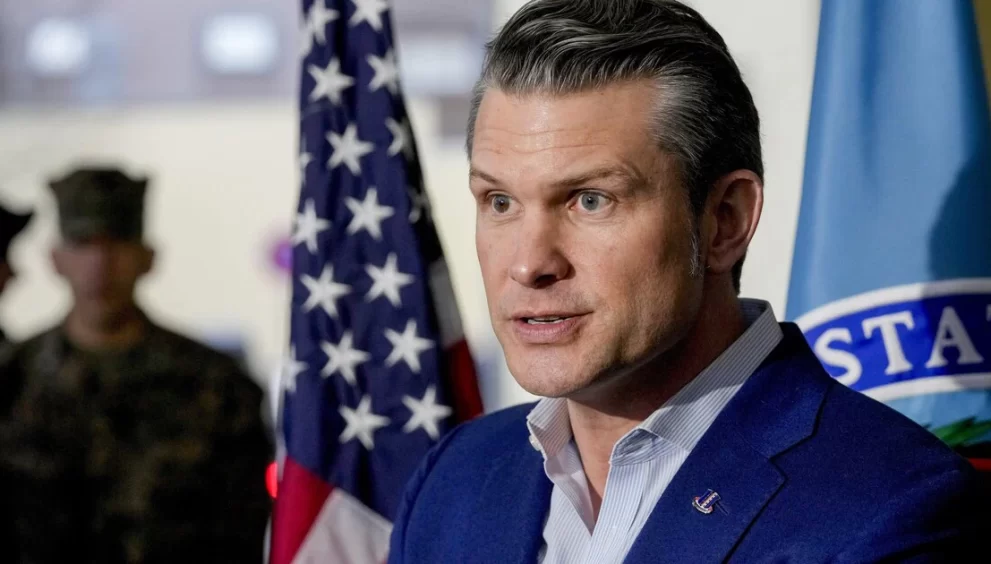
This weekend, global leaders, diplomats, and top defence officials, including French President Emmanuel Macron and U.S. Defence Secretary Pete Hegseth, are gathering in Singapore for a security conference. The forum will concentrate on issues like China’s increasing assertiveness, the worldwide consequences of Russia’s war in Ukraine, and rising conflicts in Asia.
Macron is scheduled to deliver the keynote speech on Friday evening, addressing these topics as well as the strain caused by the steep tariffs introduced under U.S. President Donald Trump’s administration, which affect Asian allies.
This marks Hegseth’s first appearance at the Shangri-La Dialogue, organized by the International Institute for Security Studies, taking place amid rising tensions between Beijing and Washington. The Trump administration has warned China with threats of tariffs exceeding 100%, and there is uncertainty in the region about America’s commitment to defending Taiwan—an island facing potential 32% U.S. tariffs.
China views Taiwan, a self-governing democracy, as its territory, and President Xi Jinping has not excluded the possibility of using force to assert control. China regularly sends military aircraft, naval vessels, and spy balloons near Taiwan in a campaign of continuous harassment, with an aircraft carrier currently positioned southeast of the island.
Before departing for Singapore, Hegseth told reporters that U.S. policies aim to deter any Chinese invasion of Taiwan. “We seek no conflict with anyone, including Communist China,” he said. “We will maintain strength in protecting our interests. That’s a key focus of this trip.”
Typically, China’s defence minister attends the Shangri-La forum, but this year China sent a lower-ranking delegation led by Major-General Hu Gangfeng, vice-president of the People’s Liberation Army National Defense University. The delegation was set to participate in a panel on “cooperative maritime security” alongside representatives from Japan, Vietnam, Chile, and the U.K. This is notable given China’s aggressive fishing activities, which have raised concerns not only in the Indo-Pacific but also as far afield as Latin America and the Arctic.
Defence officials traveling with Hegseth, speaking anonymously as they were not authorized for media comments, viewed China’s lower-level delegation as an opportunity for the U.S. to advance its influence. “We can’t predict China’s level of engagement. All we know is that we’re present, and we will remain so,” Hegseth said during a meeting with Philippine Defense Secretary Gilbert Teodoro.
Hegseth’s Singapore trip is his second visit to the region as defence secretary, following his March visit to the Philippines, which has experienced increasing tensions with China over territorial disputes in the South China Sea.
The U.S. is pursuing a “free and open Indo-Pacific” policy, which includes frequent naval passages through the Taiwan Strait and the South China Sea—an area nearly fully claimed by China.
While the European Union’s approach is more focused on economics, several European countries have also regularly participated in freedom of navigation exercises. France recently completed a five-month Indo-Pacific mission with a carrier strike group that ended in April.
France’s Indo-Pacific strategy emphasizes the importance of upholding a “rules-based international order” in response to “China’s rising power and territorial claims” and its competition with the U.S.
France maintains strong connections to the Indo-Pacific region, with over 1.6 million French citizens living in overseas territories there.
After meeting Singapore’s Prime Minister Lawrence Wong on Friday, Macron told reporters that the region has space for more than just the two superpowers. “We are neither China nor the U.S., and we do not want to depend solely on either,” he said. “We aim to cooperate with both as much as possible for growth, prosperity, stability for our people, and the world order. Many countries in the region share this view.”
Wong echoed Macron’s sentiment, emphasizing that Singapore and the wider region are not seeking exclusive partnerships with any single power. “We want to engage broadly with all parties and pursue win-win outcomes instead of zero-sum competition,” he said.