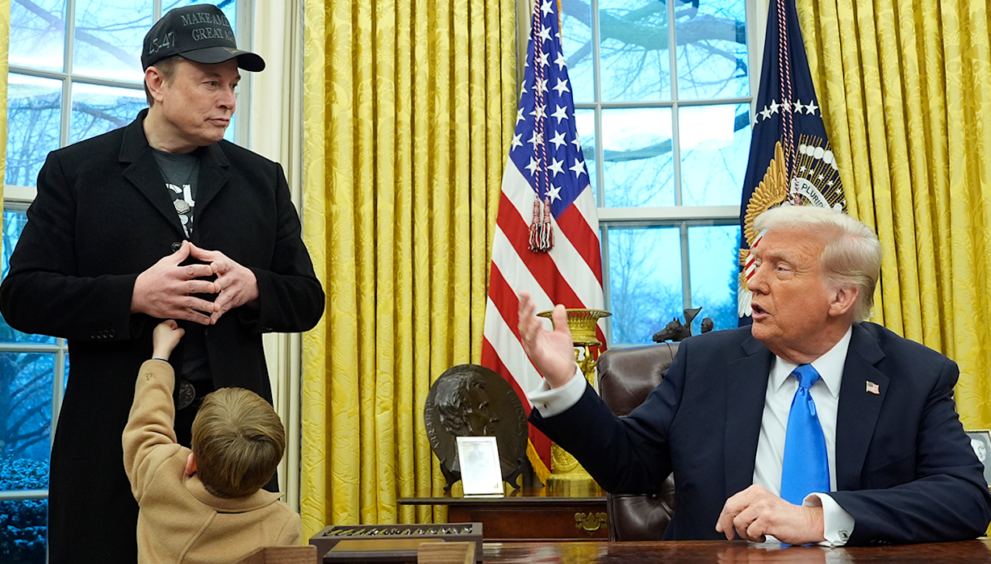
After 128 days serving as a fierce budget slasher for the Trump administration, Elon Musk is stepping down from his government role. Known for his leadership at companies like Tesla and SpaceX—and a reputation for bold claims that don’t always pan out—Musk has wavered on how deeply he wants to stay involved in politics.
Sources suggest he has grown disillusioned with the political process and frustrated by the difficulty of trying to reshape the federal government in the same way he overhauled a major social media platform. Tensions between Musk and the President have reportedly increased, signaling the end of a once close working relationship that had become a defining feature of the post-election period.
The breakdown may have begun after Musk backed a losing candidate in Wisconsin with a substantial donation. More recently, he allegedly accompanied the President on a trip to the Middle East to protest an AI initiative from which his companies were excluded. He later criticized a major legislative proposal, claiming it interfered with his efforts at DOGE.
With his legal term as a temporary federal worker set to end today, and opposition leaders pushing for his departure, now is a natural moment to assess his impact. Musk’s primary objective at DOGE was to reduce government spending significantly, promising to slash $1 trillion from the federal budget by the end of the fiscal year by eliminating inefficiency and misuse. This was already a scaled-back version of an earlier $2 trillion pledge, with a claim that most of the heavy lifting would be completed within 130 days.
As of late May, DOGE’s online tracker lists an estimated $175 billion in savings since the administration began, translating to just over $1,000 per taxpayer. However, the reliability of this figure is questionable.
Independent analysis has uncovered a number of problems with DOGE’s accounting, including counting future contracts as if they were already finalized, double or triple-counting savings, and basic math errors like confusing millions with billions. While some corrections have been made, many listed “savings” still rely on the full potential value of contracts that were never guaranteed payouts. Others offer no documentation at all—just a contractor name or vague description.
Some of these cuts may not even save money in the long run. Canceling research mid-project, for example, can render previous investments worthless. Meanwhile, broader financial data shows that overall federal spending has actually increased by about six to seven percent compared to the same timeframe last year.
Viewed purely as a cost-cutting mission, the initiative seems to have fallen short. But there are other ways to measure Musk’s influence in government.
If the goal was to blur the boundary between private enterprise and public governance, Musk’s time in this role—especially while trimming budgets at agencies scrutinizing his own companies—certainly pushed the envelope. If the aim was to reshape the federal workforce by removing perceived opposition and taking control of independent agencies, DOGE played a key part in making that happen.
The same is true for efforts to concentrate executive power, challenge legislative authority over spending, and even dismantle entire departments without congressional approval. Additionally, reports indicate DOGE personnel have been placed within various federal agencies, gaining access to sensitive databases and possibly compromising longstanding privacy protections.
Whether or not these moves were legal is still being reviewed by the courts, and lawmakers are demanding retroactive approval for roughly $9 billion in spending reductions. Over time, Musk’s controversial actions may cause political damage not only to himself but also to the administration he briefly served.