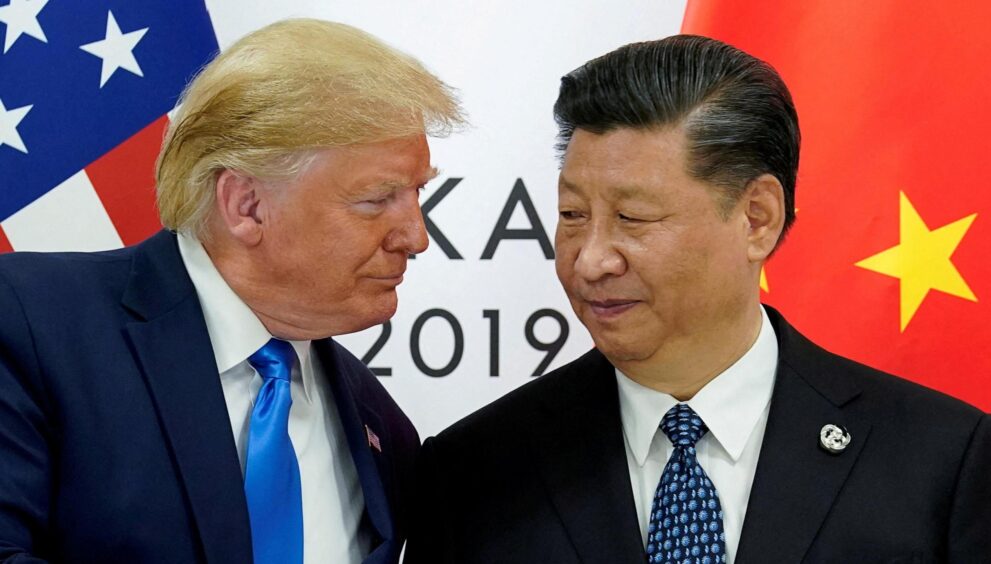
U.S. President Donald Trump said on Tuesday that a visit to China could happen soon as part of efforts to address growing tensions between the two nations over trade and security.
“President Xi has invited me to China, and we’ll probably be doing that in the not-too-distant future,” Trump told reporters in the White House’s Oval Office. “A little bit out, but not too distant. And I’ve been invited by a lot of people, and we’ll make those decisions pretty soon.”
Officials from both countries have been in discussions about arranging a meeting between the two leaders, potentially during Trump’s expected trip to Asia later this year. Among the possibilities being considered is a stop in China around the time of the Asia-Pacific Economic Cooperation summit in South Korea, which runs from October 30 to November 1. Another option under discussion is for Trump to attend a ceremony in Beijing on September 3, commemorating the 80th anniversary of the end of World War Two — an event Russian President Vladimir Putin is also planning to attend.
If confirmed, a face-to-face meeting between Trump and Xi — or Putin — would be their first since Trump began his second term in office on January 20. Both the White House and China’s Ministry of Foreign Affairs have declined to comment on reports of the possible trip.
Geopolitical Shifts in the Indo-Pacific
Trump’s remarks came during a meeting with Philippine President Ferdinand Marcos Jr., a key ally in the region. Trump praised the Philippines for strengthening ties with the U.S.
“The country was maybe tilting toward China for a period of time, but we un-tilted it very, very quickly,” Trump said. Trump added: “I don’t mind if he gets along with China because we’re getting along with China very well.”
Since taking office in 2022, Marcos has sought stronger support from Washington in light of rising maritime tensions with Beijing. While the Philippines has attempted to avoid direct conflict, China continues to claim most of the South China Sea. The United States and the Philippines share a defense treaty that has been in place for more than 70 years, meaning the U.S. could become involved in the event of a military clash between China and the Philippines.
Ongoing U.S.-China Tensions
The U.S. views China as its top strategic competitor. During his presidency, Trump initiated a series of tariffs on Chinese goods, sparking a trade war that disrupted international commerce. Tensions between the countries have been further fueled by issues such as China’s backing of Russia, restrictions on American residents in China, the flow of illicit opioids, and China’s increasing pressure on Taiwan.
Recently, Trump has attempted to ease tensions, describing his relationship with Xi as “healthy.”
At the same time, Trump continues to push for sweeping tariff policies. He has advocated for tariffs on nearly all imported goods — including those from allies like the Philippines — arguing that such measures will boost American manufacturing. Critics, however, warn this could drive up prices for U.S. consumers.
Trump has proposed a standard 10% tariff on all imports, with significantly higher rates for some nations. Chinese imports currently face the steepest tariff rate at 55%. Trump has set an August 12 deadline for reaching a lasting trade agreement with China.