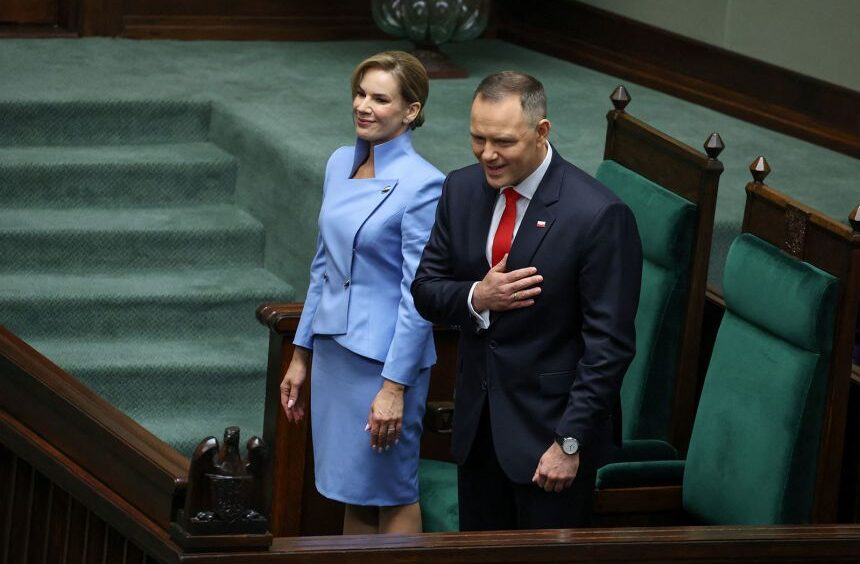
At the last moment, U.S. President Donald Trump requested that Polish President Karol Nawrocki, an ally of Trump’s MAGA movement, participate in a teleconference on Ukraine with European leaders instead of Polish Prime Minister Donald Tusk, who was originally expected to attend. Tusk, a centrist and Nawrocki’s political rival, revealed this unexpected change.
Nawrocki, known for his conservative nationalist stance and skepticism toward the European Union, has strong ties to Trump’s right-wing populist agenda. Earlier this year, during Poland’s presidential election, Nawrocki visited the White House and later defeated the candidate from Tusk’s pro-European party.
Tusk explained at a press briefing that just before midnight, European partners, including Poland, were informed that the U.S. preferred to communicate with the Polish president directly. The White House has not confirmed whether this request was formally made.
Initially, a Polish government official said Tusk, a former European Council leader, would join the call with Trump. However, Nawrocki’s foreign policy adviser, Marcin Przydacz, said he had no knowledge that Tusk had planned to participate and suggested Tusk’s team lacked strong connections with the Trump administration, which expected Tusk to attend.
A government spokesperson clarified that while Tusk would represent Poland in two other calls with European leaders that day, he would not participate in the call with Trump. Przydacz added that the offices of the president and prime minister would coordinate on the information shared during the meetings.
During the teleconference, European leaders and Ukraine’s President Volodymyr Zelenskyy spoke with Trump to emphasise the importance of protecting Kyiv’s interests ahead of Trump’s summit with Russian President Vladimir Putin in Alaska.
Krzysztof Izdebski, policy director at the Batory Foundation, expressed concern that having two political rivals represent Poland could lead to mixed messages. He said this situation highlights how internal political competition affects even critical foreign policy issues, potentially weakening Poland’s standing internationally.
Both Nawrocki and Tusk support Ukraine in its conflict with Russia, though they differ significantly on domestic issues such as abortion, family values, and the rule of law.
Tusk said he respected the U.S. preference to maintain communication at the presidential level but warned against using this as a way to pit Polish leaders against each other.