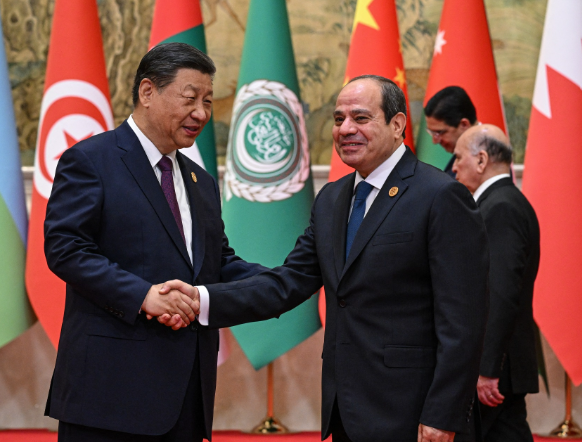
Chinese President Xi Jinping has arrived in Cairo for his first visit to Egypt in a decade, as Beijing and Cairo seek to transform their expanding relationship into a broader strategic partnership with mutual economic and geopolitical benefits.
Xi was received by Egyptian President Abdel Fattah al-Sisi at Cairo International Airport on Tuesday, September 1, beginning an official visit that coincides with the 70th anniversary of diplomatic relations between China and Egypt.
The visit comes as both countries look to deepen cooperation across political, economic and development sectors, while also consulting on regional and international issues.
Egyptian officials have described the visit as an opportunity to strengthen bilateral relations and follow up on the implementation of the two countries’ Comprehensive Strategic Partnership, established in 2014.
ECONOMIC RELATIONS AT THE HEART OF THE VISIT
Economic cooperation is expected to be a major focus of Xi’s discussions with President Sisi.
China is already Egypt’s largest trading partner in non-petroleum goods, with bilateral trade reaching almost $20.7 billion in 2025, according to Egyptian data cited by Al Jazeera.
Egyptian exports to China also increased sharply during the first half of 2026, while Chinese imports remained significantly higher, highlighting both the scale of the relationship and the trade imbalance between the two countries.
For Cairo, stronger economic ties with Beijing offer access to Chinese capital, technology, industrial expertise and international markets at a time when Egypt is seeking to expand manufacturing and attract foreign investment.
For Beijing, Egypt provides a strategically important gateway linking Africa, the Middle East, Asia and Europe.
CHINA EXPANDS INDUSTRIAL FOOTPRINT
Chinese investment in Egypt has increasingly moved beyond traditional trade into manufacturing, infrastructure, ports, technology and green energy.
One of the most prominent examples is the China-Egypt TEDA cooperation zone in Ain Sokhna, located near the Suez Canal. The industrial zone forms part of China’s Belt and Road Initiative and hosts around 200 companies, with investments exceeding $3.8 billion, according to Egyptian and Chinese state-linked sources.
The location is strategically important because the Suez Canal remains one of the world’s most significant maritime trade routes, connecting the Mediterranean with the Red Sea and providing a major link between Asian and European markets.
China’s growing presence around the canal therefore offers Beijing not only an economic opportunity but also a stronger industrial and logistics foothold in a strategically important part of the Global South.
A PARTNERSHIP BEYOND TRADE
Analysts say the significance of Xi’s visit extends beyond commercial relations.
The two countries have increasingly expanded cooperation into areas including technology, infrastructure, energy and security.
China and Egypt have also strengthened military engagement, including joint exercises involving Chinese J-16 fighter aircraft and Egyptian Rafale jets. The growing defence relationship illustrates how bilateral ties are developing beyond the traditional economic sphere.
The visit also comes at a time of major geopolitical change across the Middle East.
Regional conflicts and uncertainty surrounding the reliability of traditional Western partnerships have encouraged Egypt to diversify its international relationships, maintaining ties with China, Russia, Europe and the United States.
For Beijing, closer relations with Cairo provide an important connection to the Arab world and Africa, while reinforcing China’s broader engagement with countries of the Global South.
EGYPT SEEKS INVESTMENT AND TECHNOLOGY
For Egypt, the partnership with China comes with significant economic ambitions.
Cairo is seeking greater investment in manufacturing, infrastructure, technology and energy while attempting to position the country as a regional production and logistics hub.
Chinese companies have already become major participants in Egypt’s infrastructure and industrial development, while technology companies such as Huawei have expanded their presence in areas including cloud services and artificial intelligence.
Egypt’s strategic location, large domestic market and access to the Suez Canal make it an attractive destination for Chinese companies seeking to expand their reach into Africa, the Middle East and European markets.
A SYMBOLICALLY SIGNIFICANT VISIT
Riccardo Fabiani, North Africa project director at the International Crisis Group, described the symbolic importance of Xi’s visit as “extremely” significant, reflecting the depth and evolution of the China-Egypt relationship.
The timing is particularly notable, coming seven decades after Beijing and Cairo established diplomatic relations and amid a broader shift toward stronger South-South cooperation.
For Xi, the visit forms part of a wider diplomatic push as China strengthens relationships across the developing world.
For Sisi, closer engagement with Beijing offers Egypt another major international partner as Cairo seeks investment, technology and greater economic opportunities while maintaining strategic flexibility.
THE ROAD AHEAD
The challenge for both countries will be turning political commitments and growing trade into more balanced and sustainable economic gains.
Egypt wants increased investment, technology transfer, manufacturing opportunities and access to international markets. China, meanwhile, is seeking reliable markets, industrial capacity, logistics networks and stronger strategic relationships across the Global South.
Xi’s visit therefore represents more than a diplomatic reunion.
It is a sign that China-Egypt relations are evolving from a traditional trade partnership into a broader strategic relationship spanning economics, infrastructure, technology, security and geopolitics.
As Beijing and Cairo deepen their cooperation, the partnership could become increasingly important not only for the two countries but also for China’s expanding role in Africa and the Middle East.