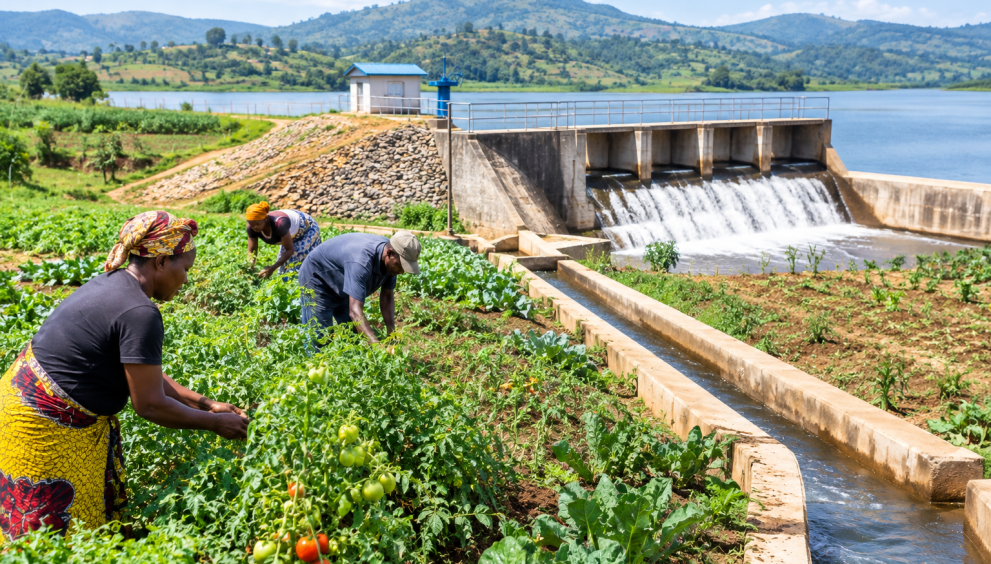
A community-managed irrigation dam in Burundi is helping more than 130 farming households improve agricultural production by providing a reliable source of water during the country’s dry season.
The Gatunguru dam, located in Burundi, currently provides irrigation water to 132 families, helping farmers cultivate crops on nearly 14 hectares of farmland. The project forms part of efforts to strengthen rural livelihoods, improve food production and make communities more resilient to changing weather conditions.
Water for Farming
Construction of the Gatunguru and Nyarugongo micro-dams began in May 2024, with local communities, project managers and authorities working together on the infrastructure and irrigation channels.
Since the works were completed in July 2024, farmers have been using the stored water to support cultivation during Season C, Burundi’s dry-season agricultural period. Crops benefiting from irrigation include beans, tomatoes, maize and aubergines.
The Nyarugongo dam is providing additional irrigation to 76 families across more than 22 hectares, bringing the combined number of beneficiary families from the two projects to more than 200.
Community Ownership
The irrigation infrastructure is owned by local municipalities, while farmer-producer groups are responsible for maintenance through community management committees. This model is intended to give local residents a direct role in protecting and maintaining the infrastructure over the long term. access and energy supply. Agriculture remains central to the country’s economy and rural livelihoods, making reliable water infrastructure particularly important for food security.
Broader Push for Sustainable Infrastructure
Burundi is also expanding its renewable-energy infrastructure. In June 2026, the country inaugurated the 17-megawatt Mulembwe hydropower plant, following the 32.5-megawatt Jiji plant inaugurated in 2025. Together, the facilities have a combined capacity of 49.5 MW and are expected to supply electricity to thousands of households, businesses and industrial facilities.
The developments highlight Burundi’s broader effort to use water resources to strengthen both agricultural resilience and access to clean energy.
________________________________________________________________________________________________________________