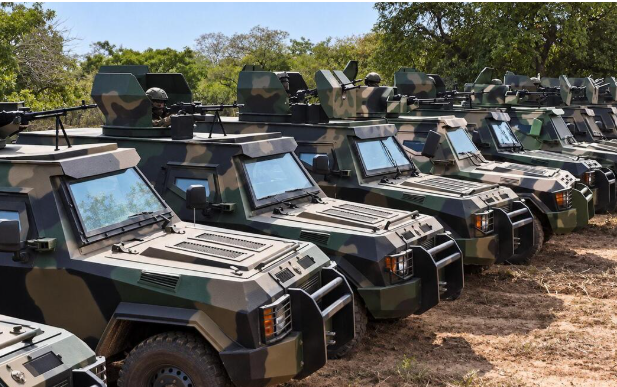
‘NANGA’ ARMOURED FLEET MARKS LATEST STEP IN OUAGADOUGOU’S DRIVE FOR MILITARY SELF-RELIANCE
Burkina Faso’s transitional President, Captain Ibrahim Traoré, says the country will stop ordering armoured vehicles from foreign suppliers as it expands efforts to manufacture military equipment domestically.
The announcement came as Burkina Faso unveiled a first fleet of locally produced “Nanga” armoured vehicles, presented by authorities as part of the country’s drive to strengthen its defence capabilities and reduce reliance on foreign supply chains.
PUSH FOR MILITARY SELF-RELIANCE
Traoré said domestic production is essential to protecting Burkina Faso’s sovereignty and reducing dependence on foreign defence suppliers.
The move forms part of a broader policy under his administration to increase local production and industrial capacity. Burkina Faso has previously acquired armoured vehicles and other military equipment from abroad to support its forces fighting armed groups. In October 2025, the government announced the delivery of additional combat vehicles to military units involved in counterterrorism operations.
‘NANGA’ FLEET UNVEILED
The newly presented vehicles have been identified as Nanga, a name associated with the scorpion. Reports said the vehicles were displayed as part of the country’s latest push to develop locally made or locally adapted military equipment.
Traoré’s announcement signals a shift from dependence on foreign purchases toward greater domestic involvement in the design, adaptation and production of defence equipment.
However, independent reporting has raised questions about the scale and industrial capacity behind the vehicles displayed by the government, meaning the extent of full domestic mass production remains difficult to independently establish.
INDUSTRIALISATION A WIDER PRIORITY
The defence manufacturing initiative forms part of a broader industrialisation agenda promoted by Traoré’s government.
In September, Burkina Faso inaugurated the TEXFORCES-BF industrial complex in Bobo-Dioulasso to manufacture uniforms for the country’s defence and security forces using locally produced cotton. Government officials described the project as part of a policy aimed at strengthening national sovereignty and local transformation.
The government has also previously said locally assembled equipment could help reduce spending on foreign purchases while building domestic industrial capabilities.
SECURITY PRESSURES IN THE SAHEL
Burkina Faso continues to face a prolonged security crisis involving armed insurgent groups, making military equipment a major priority for the transitional government.
Authorities have repeatedly expanded the country’s military equipment programme, including the acquisition of armoured vehicles, weapons and engineering equipment.
The decision to end foreign armoured vehicle orders therefore represents both a defence policy shift and an industrial strategy, as Ouagadougou seeks to develop greater control over the equipment used by its armed forces.