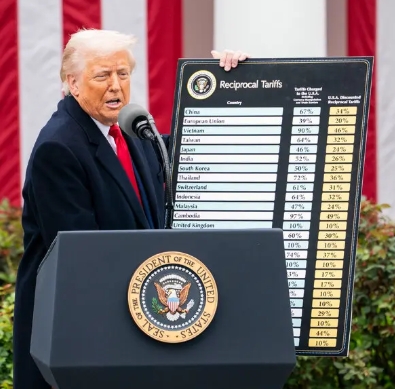
The U.S. dollar weakened on Thursday after a federal court struck down former President Donald Trump’s signature tariff measures, a decision that rattled currency markets and reignited debate over the long-term direction of U.S. trade policy. Investors said the ruling injected a fresh layer of uncertainty into an already fragile policy environment, prompting a broad pullback in the greenback and renewed volatility across global markets.
Court ruling reshapes tariff landscape
The decision, handed down by a federal trade court, invalidated several of the sweeping tariffs imposed during the Trump administration under emergency trade powers. Those tariffs, introduced beginning in 2018, targeted hundreds of billions of dollars in imports, particularly from China, and formed the backbone of Washington’s hardline trade strategy.
At the center of the ruling was the use of executive authority to levy tariffs under national security and emergency provisions. The court found that the legal justification for some of the measures did not meet statutory requirements, opening the door for potential revisions or repeal.
While the case may proceed through appeals, the immediate market reaction underscored how sensitive investors remain to shifts in U.S. trade policy.
Dollar dips as policy uncertainty rises
The U.S. Dollar Index, which tracks the greenback against a basket of major currencies, slipped in early trading. The dollar weakened against the euro and Japanese yen, with traders citing both the legal uncertainty and the broader implications for trade negotiations.
Currency analysts said the ruling complicates the outlook for U.S. economic strategy. “Markets don’t like ambiguity,” said one senior FX strategist at a global investment bank. “If the tariff framework that shaped trade flows for years is suddenly in question, investors have to reassess growth, inflation, and capital flows.”
The dollar had previously drawn support from relatively strong U.S. growth and higher interest rates compared with other developed economies. However, the prospect of abrupt policy reversals could dampen foreign investor appetite for dollar-denominated assets.
Trade tensions and economic ripple effects
The tariffs imposed during Trump’s presidency triggered retaliatory measures from Beijing, sparking a prolonged trade war between the United States and China. While subsequent negotiations led to a “Phase One” trade deal in 2020, many tariffs remained in place.
Businesses had adjusted supply chains in response to the levies, shifting sourcing away from China toward other manufacturing hubs in Southeast Asia and Latin America. The court’s decision raises questions about whether those changes could now be reassessed.
Economists say the potential removal of tariffs could ease price pressures on certain imported goods, theoretically helping to contain inflation. However, the broader impact may depend on whether the ruling survives appeal and how current policymakers respond.
Investor reaction: cautious recalibration
Equity markets were mixed following the news. Shares of companies heavily reliant on imported components rose modestly, while sectors that had benefited from protectionist measures saw limited declines.
Bond markets also reflected a cautious tone. Treasury yields edged lower, suggesting investors were seeking safety amid uncertainty. Some traders speculated that reduced tariffs might lessen inflationary risks, which in turn could influence expectations for Federal Reserve policy.
Although the Federal Reserve operates independently of trade policy, shifts in tariffs can affect price levels and growth projections key inputs in monetary policy decisions.
Political implications heading into election season
The timing of the ruling carries political weight. Trade policy remains a central campaign issue as candidates outline their economic visions. Trump has repeatedly defended his tariffs as necessary to rebalance trade and protect American industries, arguing they generated leverage in negotiations with China.
Critics, however, contend that the tariffs raised costs for U.S. consumers and businesses while delivering limited structural change in trade relationships.
If the decision stands, it could reshape campaign rhetoric around trade and economic nationalism. Legal experts note that the case also tests the scope of presidential authority in economic emergencies, a question likely to resonate beyond this specific dispute.
Global markets watching closely
International markets responded cautiously. The euro strengthened modestly, while several Asian currencies gained ground. Analysts said a sustained weakening of the dollar could ease financial conditions in emerging markets, many of which carry significant dollar-denominated debt.
At the same time, a rapid unwinding of tariff structures could alter global trade patterns once again. Supply chains that were reconfigured over the past five years may face renewed adjustments.
“Businesses crave stability,” said an economist at a multinational consultancy. “Whether tariffs stay or go, what companies need most is predictability. This ruling reopens a debate that many thought had settled.”
What happens going forward?
Legal analysts expect the case to move swiftly through appellate courts. In the interim, the administration may seek to maintain existing tariffs under alternative legal justifications or pursue legislative backing.
For currency markets, the immediate focus will be on clarity. Traders will monitor statements from policymakers, reactions from Beijing, and signals from the Federal Reserve for clues about the broader economic trajectory.
The dollar’s decline, while modest, highlights how deeply intertwined trade policy and financial markets remain. Years after the height of the U.S.-China trade war, its legacy continues to shape investor sentiment and global economic dynamics.
As appeals proceed and political debate intensifies, markets appear poised for further volatility. For now, the softer dollar reflects not only a court decision, but a reminder that U.S. economic policy and the legal foundations underpinning it can shift in ways that reverberate far beyond Washington.
________________________________________________________________________________________________________________