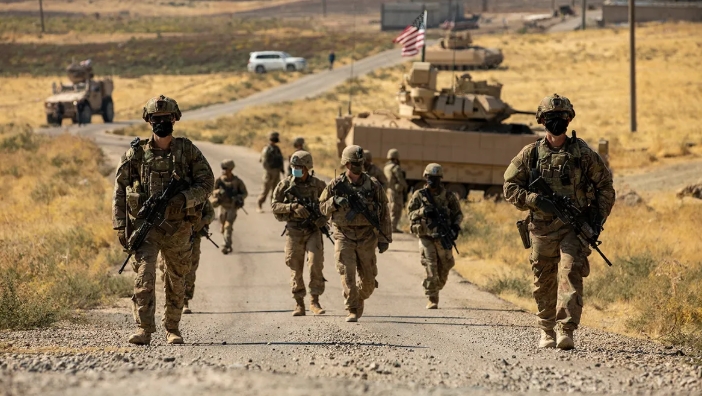
The United States military has begun withdrawing personnel and equipment from its main base in northeast Syria, according to Syrian security and local sources, in a move that could reshape the balance of power in a volatile region still grappling with the remnants of the Islamic State group and competing foreign interests.
While U.S. officials have not publicly confirmed a full pullout, regional sources said convoys of armored vehicles and logistical units were seen departing from facilities near key operational hubs in Syria’s northeast. The development has sparked concerns among Kurdish-led forces, local civilians and international observers about what comes next in a region where alliances have long been fragile.
How the U.S. Military Presence in Northeast Syria Began
The U.S. military’s involvement in northeast Syria traces back to 2014, when the rapid rise of the Islamic State group shocked the international community. Emerging from the chaos of the Syrian civil war and instability in neighboring Iraq, ISIS captured major cities including Raqqa in Syria and Mosul in Iraq, declaring a so-called “caliphate” that spanned large swathes of territory.
At the time, Syria’s civil war which began in 2011 following anti-government protests against President Bashar al-Assad had already fractured the country. Multiple armed factions were fighting for control, including government forces, rebel groups, Islamist factions, and Kurdish militias in the north.
ISIS’ expansion changed the strategic landscape. In September 2014, then-President Barack Obama announced the formation of a U.S.-led international coalition to “degrade and ultimately destroy” the group. Airstrikes began in Syria shortly afterward, targeting ISIS strongholds, oil infrastructure and leadership figures.
However, airpower alone proved insufficient. The United States sought reliable local partners on the ground. In northeast Syria, Kurdish fighters particularly the People’s Protection Units (YPG) had been resisting ISIS advances, most notably during the siege of Kobani near the Turkish border.
In 2015, the Kurdish-led forces formally reorganized under the banner of the Syrian Democratic Forces (SDF), a broader coalition that included Arab and minority militias. The U.S. began providing the SDF with weapons, training, intelligence and special operations support. Small numbers of American troops were deployed to coordinate airstrikes and assist local fighters.
Over time, that partnership became the backbone of the anti-ISIS campaign in Syria. With U.S. backing, the SDF gradually recaptured key territory, including the ISIS capital of Raqqa in 2017. By March 2019, the group’s final territorial enclave in Baghouz fell, marking the end of its self-declared caliphate.
Yet the mission did not end there.
Although ISIS lost its territorial control, thousands of fighters melted into rural desert areas, launching insurgent-style attacks. The U.S. military presence shifted toward stabilization, counterterrorism raids, and guarding detention facilities holding suspected ISIS members.
The American deployment also took on broader strategic significance. U.S. troops were stationed near oil fields in Deir El-Zour province, officially to prevent ISIS from regaining revenue streams. Their presence also acted as a buffer against Syrian government forces and allied militias seeking to reclaim the resource rich region.
Tensions escalated at times. In 2018, U.S. forces carried out airstrikes against pro-government fighters including Russian mercenaries who approached a coalition base near Deir El-Zour. Meanwhile, Turkey repeatedly criticized Washington’s support for Kurdish groups it considers linked to the Kurdistan Workers’ Party (PKK), which Ankara designates as a terrorist organization.
In October 2019, then-President Donald Trump ordered a partial withdrawal of U.S. troops from parts of northern Syria, prompting a Turkish military incursion. The move triggered bipartisan criticism in Washington and forced Kurdish-led authorities to negotiate limited security arrangements with Damascus and Russia.
Although troop numbers fluctuated over the years, the United States maintained several hundred personnel in northeast Syria, focused primarily on counter-ISIS operations. The mission operated under the legal framework of the 2001 Authorization for Use of Military Force (AUMF), originally passed after the September 11 attacks.
Today’s reported withdrawal marks the latest chapter in a complex, decade-long engagement that evolved from an urgent campaign against a rapidly expanding extremist group into a broader geopolitical balancing act involving regional and global powers.
Understanding how the U.S. presence began rooted in the fight against ISIS and shaped by shifting alliances is key to grasping the stakes of any new drawdown. What started as an emergency counterterrorism mission became an anchor of regional stability for some, and a point of contention for others. Any significant change to that footprint carries consequences that extend well beyond the battlefield.
Strategic footprint under review
The United States has maintained a military presence in northeast Syria since 2014 as part of the international coalition against the Islamic State, also known as ISIS. American forces partnered primarily with the Kurdish-led Syrian Democratic Forces (SDF) to dismantle the group’s territorial “caliphate,” which once spanned vast areas of Syria and Iraq.
At its height, ISIS controlled territory the size of a small country. The group’s territorial defeat was declared in 2019, but thousands of fighters remain active in sleeper cells across Syria’s desert regions.
U.S. troops have been stationed at several bases in the northeast, including facilities near oil fields and strategic border crossings. The mission has evolved from active combat operations to stabilization efforts, intelligence gathering and counterterrorism raids.
Regional implications
Northeast Syria is a patchwork of competing authorities. The SDF administers large swathes of territory, while the Syrian government under President Bashar al-Assad controls much of the country’s west and south. Meanwhile, Turkey maintains troops and allied Syrian militias along stretches of the northern border, viewing Kurdish groups as security threats.
Any U.S. withdrawal could create openings for Damascus, Ankara or even Moscow to expand their influence. Russia, a key backer of Assad, has maintained a military presence in Syria since 2015, helping tilt the civil war in the Syrian government’s favor.
Analysts say even a partial U.S. redeployment could trigger rapid recalculations among regional actors. “Power vacuums in Syria rarely remain empty for long,” said one Middle East security expert. “The question is who moves first and how local forces respond.”
Kurdish-led forces on edge
For the SDF, the presence of U.S. troops has served as both a security guarantee and a political shield. American forces have deterred large-scale incursions by Turkey and limited the reach of Syrian government forces in the northeast.
SDF officials have repeatedly warned that a sudden U.S. departure would destabilize the region, potentially allowing ISIS to regroup and emboldening hostile actors.
In 2019, when then-President Donald Trump announced a withdrawal of U.S. troops from parts of northern Syria, Turkish forces launched a cross-border operation days later. That episode led to clashes, civilian displacement and a reshuffling of control lines.
While it remains unclear whether the current move signals a full exit or a tactical repositioning, memories of that abrupt policy shift loom large among local communities.
Counterterrorism concerns
U.S. officials have long argued that a limited military presence in Syria is necessary to prevent the resurgence of ISIS. Thousands of suspected ISIS fighters remain detained in makeshift prisons guarded by Kurdish-led forces, while tens of thousands of women and children linked to the group live in sprawling camps such as al-Hol.
Humanitarian organizations have warned that overcrowded conditions and limited resources in these camps create fertile ground for radicalization.
If American forces scale back significantly, the burden of securing detention facilities would fall even more heavily on the SDF. Regional observers fear that reduced oversight or support could lead to prison breaks or coordinated attacks by ISIS remnants.
Washington’s calculus
The Biden administration has publicly maintained that U.S. troops in Syria are focused solely on counterterrorism operations. Officials have emphasized that American forces are not engaged in nation-building and have no permanent occupation mission.
Domestic political pressure to reduce overseas military commitments has grown in recent years, particularly after the U.S. withdrawal from Afghanistan in 2021. Lawmakers from both major parties have questioned the legal framework underpinning U.S. operations in Syria, which rely in part on authorizations passed after the September 11 attacks.
At the same time, defense officials have cautioned that a precipitous withdrawal could undo hard-won gains against ISIS and destabilize neighboring Iraq.
Damascus and Tehran watching closely
The Syrian government has consistently denounced the U.S. presence as an illegal occupation. Any drawdown could strengthen Damascus’ claim to sovereignty over oil-rich northeastern territories.
Iran, another key ally of Assad, may also see opportunities to expand its logistical corridors through Syria, linking Tehran to allied groups in Lebanon. Israeli officials have repeatedly conducted airstrikes in Syria aimed at preventing Iranian entrenchment near its borders.
The shifting military map underscores how Syria remains a theater for broader geopolitical rivalries, more than a decade after the uprising against Assad spiraled into civil war.
Humanitarian dimension
Civilians in northeast Syria face ongoing economic hardship, infrastructure damage and limited public services. Aid agencies warn that uncertainty over security arrangements can quickly translate into disruptions in humanitarian access.
Many residents fear renewed clashes between Kurdish forces and Turkish-backed factions. Others worry about forced conscription, economic isolation or the return of extremist violence.
“The people here are exhausted,” said a community organizer in the region. “Every time there’s talk of foreign troops leaving, anxiety spreads. We’ve seen what happens when front lines shift.”
What comes next?
Pentagon officials are expected to provide clarification in the coming days about the scope and timeline of any troop movements. Military analysts note that withdrawals often occur in phases, with equipment redeployed before personnel reductions are finalized.
Even a symbolic reduction in troop numbers could carry outsized political and psychological impact.
For now, Syrian sources say activity at key U.S. facilities suggests at least a partial redeployment is underway. Whether it marks the beginning of a broader exit strategy or merely a recalibration of mission posture remains to be seen.
What is clear is that northeast Syria sits at a delicate crossroads. The defeat of ISIS’ territorial rule did not end the region’s instability. Instead, it ushered in a complex balance maintained largely through external guarantees.
If one of those guarantees is weakening, the ripple effects could extend far beyond Syria’s borders reshaping alliances, reigniting dormant conflicts and testing the durability of the international coalition that once united against a common enemy.
As events unfold, regional actors, global powers and local communities alike will be watching closely, aware that in Syria, even incremental changes can quickly alter the course of history.
________________________________________________________________________________________________________________