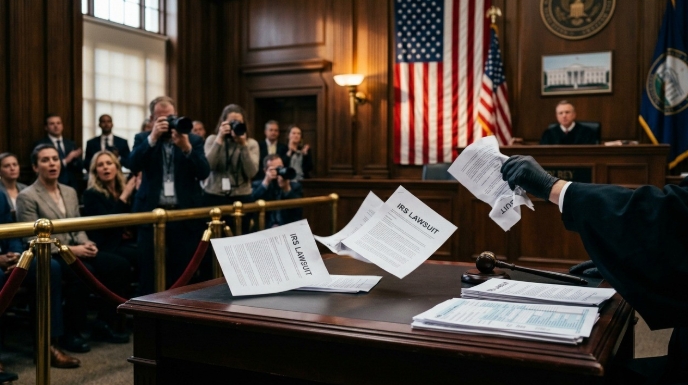
U.S. President Donald Trump has agreed to drop a major $10 billion lawsuit against the Internal Revenue Service (IRS) in exchange for the creation of a $1.76 billion federal “Anti-Weaponization Fund,” according to court filings and administration statements.
The move marks one of the most unusual legal settlements involving a sitting U.S. president, combining the dismissal of a high-stakes federal lawsuit with the establishment of a taxpayer-backed compensation program for individuals alleging political targeting by government agencies.
What the Deal Involves
Under the agreement, Trump will withdraw his lawsuit against the IRS, which stemmed from the unauthorized release of his tax records by a former government contractor.
In return, the Department of Justice (DOJ) will establish a $1.76 billion fund designed to compensate individuals who claim they were victims of “government weaponization” or politically motivated investigations.
Acting Attorney General Todd Blanche said the initiative is intended to “correct past wrongs and ensure government power is never misused for political purposes.”
The fund will reportedly be overseen by a five-member commission, with most members appointed by the Justice Department.
Background to the IRS Lawsuit
Trump and members of his family filed the lawsuit earlier this year, arguing that the IRS failed to prevent the leak of his confidential tax returns by a contractor who later faced criminal prosecution.
The leaked records, published by major media outlets, revealed details of Trump’s tax payments and sparked long-running legal and political disputes over privacy, government accountability and media access to sensitive information.
The case was approaching a court hearing to determine whether it met constitutional requirements for a valid legal dispute before the settlement was reached.
What Is the “Weaponization Fund”?
The newly created fund described by officials as an “Anti-Weaponization Fund” will provide financial compensation to individuals who can demonstrate they were unfairly targeted by federal investigations or legal actions.
Officials say claims will be reviewed by an independent commission, and payouts could include reimbursement of legal costs and damages for reputational harm.
Supporters argue the fund addresses concerns that federal agencies were used to pursue political objectives in recent years.
Critics, however, have described it as highly unusual and potentially unconstitutional, warning it could become a politically driven compensation system funded by taxpayers.
Political Reactions and Controversy
The decision has triggered immediate backlash from Democratic lawmakers and legal watchdog groups, who accuse the administration of blurring the lines between legal settlements and political compensation.
Some opponents argue the arrangement sets a precedent where lawsuits involving government agencies could be leveraged into large-scale funding mechanisms for political allies.
Republicans are divided, with some praising the move as a correction of past government overreach, while others privately express concern about the legal and ethical implications.
Wider Context of “Government Weaponization” Claims
The settlement reflects a broader political narrative promoted by Trump and allies that federal agencies, including the IRS and Department of Justice, were previously used to target political opponents.
The issue has become a central theme in debates over law enforcement independence, especially following high-profile investigations involving January 6 Capitol riot defendants and other political cases.
Legal and Constitutional Questions
Legal experts say the agreement raises novel constitutional questions, particularly around presidential authority, executive branch settlements, and the use of federal funds for politically framed compensation programs.
Some analysts warn that the structure of the fund and the appointment process for its oversight commission could face legal challenges in federal courts.
What Happens Next
The IRS lawsuit will now be formally dismissed following court approval, while the DOJ begins the process of establishing the compensation fund and appointing commissioners.
The program is expected to begin accepting claims once administrative rules are finalized, with operations reportedly continuing through 2028.
For now, the deal stands as one of the most politically significant and controversial legal settlements in recent U.S. history, combining litigation, governance and compensation into a single sweeping agreement.
________________________________________________________________________________________________________________