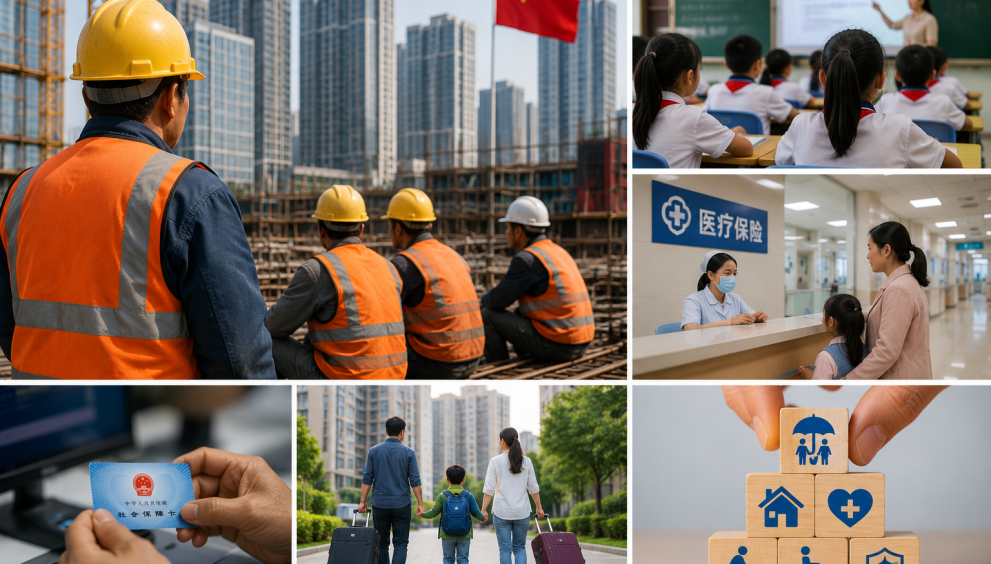
China has unveiled new measures aimed at expanding access to public services for millions of migrant workers living in cities without local household registration, marking one of the country’s most significant social policy reforms in recent years.
The guidelines, released by Chinese authorities on Friday, are designed to ease long-standing restrictions tied to the country’s “hukou” household registration system, which has historically limited access to education, healthcare, housing, and social welfare benefits for internal migrants living outside their hometowns.
The reforms are expected to affect hundreds of millions of migrant workers who have moved from rural regions to urban centers in search of employment, helping integrate them more fully into city life while supporting China’s broader economic goals.
Major Changes to the Hukou System
Under China’s hukou system, citizens are officially registered in a specific hometown or region and access to many public services has traditionally depended on that registration status rather than actual residence.
For decades, migrant workers living in major cities often struggled to access public schools, affordable healthcare, housing subsidies, and local social insurance programs because they lacked urban hukou permits.
The newly announced guidelines seek to reduce those barriers by shifting eligibility for many public services toward actual residence and stable employment instead of household registration status.
Chinese officials said the reforms would improve “equal access” to public services and strengthen protections for migrant workers and their families.
Expanded Access to Education and Healthcare
Among the most significant measures is expanded access to urban public education for migrant children.
Under the new policy framework, migrant children will increasingly be allowed to attend local public schools and sit entrance examinations in the cities where their families live and work, rather than being forced to return to their hometowns.
The reforms also call for broader access to healthcare services, social insurance programs, and public welfare support.
Authorities said migrant workers will be encouraged to participate in local pension, medical, unemployment and workplace injury insurance systems.
The policy additionally includes plans to expand access to childcare, elderly care, disability assistance, and public rental housing for families without local hukou registration but with stable employment.
Boosting Domestic Consumption
Economists say the reforms could provide important economic benefits at a time when China is seeking to strengthen domestic demand and reduce reliance on exports.
By improving social protections and reducing uncertainty for migrant families, policymakers hope households will feel more financially secure and willing to spend more on consumption.
Analysts note that migrant workers often maintain high savings rates because of concerns over healthcare costs, education expenses, and housing insecurity.
The expanded social safety net could therefore help stimulate consumer spending and support broader economic growth.
China’s leadership has repeatedly emphasized the importance of “people-centered urbanization” as part of its long-term development strategy.
Part of Broader Economic Strategy
The latest reforms align with priorities outlined in China’s 15th Five-Year Plan and recent government work reports emphasizing urban integration, service-sector development, and improved social welfare systems.
Premier Li Qiang has previously highlighted the importance of integrating migrant workers into urban economies to drive domestic consumption and industrial modernization.
Chinese policymakers have also promoted reforms aimed at expanding employment opportunities, improving worker protections, and reducing wage arrears for migrant laborers.
Challenges Remain
Despite the reforms, experts caution that implementation could vary widely across China’s provinces and cities, especially in densely populated urban centers where public resources are already under pressure.
Large cities including Beijing, Shanghai, and Shenzhen have historically maintained stricter hukou requirements due to concerns about overcrowding and fiscal costs.
Local governments may also face financial challenges in expanding services to millions of additional residents.
Researchers note that migrant workers still face barriers in accessing high-quality healthcare and education in some areas, while gaps in social insurance participation remain significant.
Still, analysts describe the reforms as a major step toward reducing inequality between rural and urban populations and modernizing China’s social welfare system.
A Shift in Urban Policy
China’s migrant worker population remains one of the largest internal migration groups in the world, forming a critical part of the country’s manufacturing, construction, logistics, and service industries.
The government’s latest reforms signal a broader policy shift toward integrating migrant workers more permanently into urban society rather than treating them as temporary labor.
Officials say the goal is to create a more inclusive urban economy capable of supporting sustainable long-term growth while improving living standards for millions of families across the country.
________________________________________________________________________________________________________________