U.S. President Donald Trump has said that any prospective agreement with Iran could be tied to a broader expansion of the Abraham Accords, in a major diplomatic proposal that could reshape alliances across the Middle East.
Trump suggested that several Arab and Muslim-majority countries including Pakistan, Saudi Arabia, Qatar, Egypt, Jordan and Turkey should join the Abraham Accords as part of a wider framework linked to ongoing negotiations with Iran, according to statements made on Monday and reports from U.S. officials.
The comments come as Washington intensifies diplomatic efforts aimed at reaching a resolution to the Iran conflict and stabilizing regional tensions that have disrupted energy routes and trade corridors in recent months.
“One big deal” approach to Iran negotiations
Trump has framed the emerging diplomatic effort as a single comprehensive agreement that combines peace with Iran and normalization of relations between Israel and regional states.
He reiterated that negotiations with Iran were “proceeding nicely,” while warning that any final deal must be decisive and enforceable.
In remarks reported by multiple outlets, Trump indicated that the United States envisions a unified regional settlement in which countries entering the Iran agreement would also commit to joining the Abraham Accords framework, which normalizes relations with Israel.
Expansion of Abraham Accords at the center of strategy
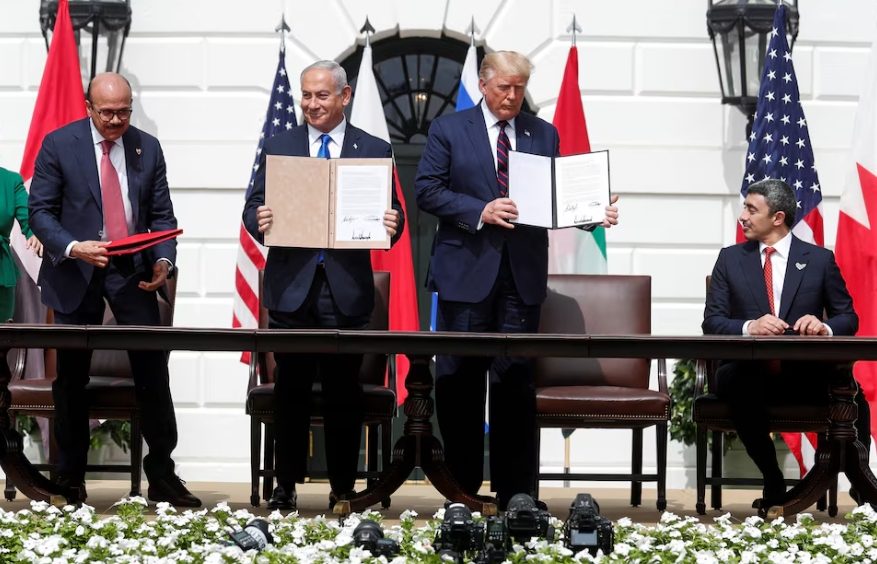
The Abraham Accords originally signed in 2020 between Israel, the United Arab Emirates, Bahrain, Morocco and later other countries have become a central pillar of U.S. Middle East policy.
Trump’s latest remarks suggest a renewed push to significantly expand the agreement’s membership, potentially bringing in major regional powers such as Saudi Arabia and Pakistan, alongside other key Muslim-majority states.
According to officials familiar with recent discussions, the proposal reflects Washington’s broader attempt to reshape regional alliances after years of conflict and shifting geopolitical alignments.
Iran deal linked to regional normalization
Under the proposed framework, countries participating in a future Iran peace or nuclear agreement would simultaneously commit to normalizing relations with Israel through the Abraham Accords structure.
Trump also suggested that Iran itself could eventually be invited to join the accords if it agrees to a comprehensive settlement, a move he described as part of a “historic regional realignment,” according to reports.
The idea marks a significant expansion of the original accords, which were initially focused on normalization between Israel and select Arab states without direct linkage to Iran policy.
Regional reactions and diplomatic implications
While the proposal has drawn attention across diplomatic circles, officials in several countries named in the discussions have not yet issued formal responses.
Analysts say linking the Iran negotiations to the Abraham Accords could increase diplomatic pressure on regional governments but may also complicate already delicate negotiations involving security guarantees, sanctions relief, and nuclear compliance.
The inclusion of countries such as Pakistan and Turkey would represent a major geopolitical shift, potentially broadening the accords from a Middle East framework into a wider Islamic-world diplomatic structure.
High-stakes moment for Middle East diplomacy
The announcement comes at a time of continued volatility in the region, with ongoing tensions tied to the Iran conflict, maritime security in the Strait of Hormuz, and broader realignments among Gulf states.
Observers say the proposal reflects a U.S. strategy aimed at consolidating multiple diplomatic tracks peace negotiations, economic normalization, and security arrangements into a single integrated deal.
However, significant challenges remain, including regional mistrust, unresolved conflicts and differing political priorities among key states.
Conclusion
Trump’s linking of the Abraham Accords to a potential Iran agreement signals an ambitious and complex diplomatic vision that could redefine alliances across the Middle East.
Whether the proposal gains traction among regional powers will likely determine the next phase of U.S.-led peace efforts and the future structure of Middle Eastern diplomacy.
________________________________________________________________________________________________________________