

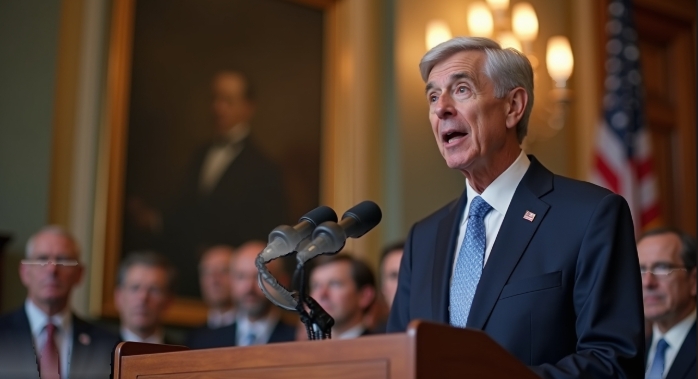
U.S. Treasury Secretary Scott Bessent delivered a major economic security speech on Friday, arguing that the United States had spent decades neglecting the strategic risks tied to global supply chains and overreliance on foreign adversaries, particularly China.
Speaking at the Reagan National Economic Forum in California, Bessent laid out what administration officials described as a broad economic security doctrine aimed at reshaping American manufacturing, trade, and industrial policy under President Donald Trump’s “America First” agenda.
The speech comes at a time of heightened geopolitical tensions, ongoing trade disputes, and growing concerns in Washington over the vulnerability of critical U.S. supply chains.
“Economic Security Is National Security”
In his address, Bessent argued that the United States had become too dependent on foreign production and globalized supply chains, leaving the country exposed economically and strategically.
“Economic security is national security,” Bessent said, warning that America had prioritized efficiency and cheap imports over resilience and domestic production capacity.
The Treasury secretary said past economic policies encouraged the outsourcing of manufacturing and weakened the nation’s industrial base, especially in sectors considered vital to national security, including semiconductors, pharmaceuticals, mining, shipbuilding, and rare earth minerals.
“For a nation that cannot manufacture, mine, ship or refine its needs gradually cedes its strength — and sovereignty — to others,” Bessent said during the speech.
Trump Administration Defends “America First” Strategy
Bessent strongly defended President Trump’s trade and industrial policies, including tariffs and efforts to encourage domestic manufacturing.
According to the Treasury chief, the administration believes decades of globalization and trade liberalization created dangerous dependencies on geopolitical rivals, especially China.
He criticized previous bipartisan decisions, including support for China’s entry into the World Trade Organization, arguing that such policies accelerated the decline of U.S. manufacturing communities.
The administration’s strategy, Bessent said, focuses on rebuilding industrial capacity, strengthening supply chains, and reducing vulnerabilities in strategically important industries.
However, he stressed that the United States is not seeking total economic isolation from the rest of the world.
“We do not seek disengagement,” Bessent said, adding that Washington wants “fairer, stronger, and more sustainable” economic relationships globally.
China and Supply Chains at Center of Concerns
A major theme throughout the speech was the growing competition between the United States and China.
Bessent argued that overdependence on Chinese manufacturing and supply chains had created national security risks for the United States and many Western economies.
The remarks reflect broader concerns in Washington about economic coercion, technology competition, cybersecurity threats, and strategic access to critical materials.
Policy experts increasingly describe economic power as a central component of modern geopolitical competition, where trade, finance, and industrial policy are viewed as national security tools alongside military capabilities.
The administration’s focus on economic resilience has also expanded into ongoing trade negotiations with allies and regional partners.
Trade Talks and Global Tensions Shape Agenda
Bessent’s speech came shortly after U.S. officials concluded the first round of updated trade negotiations with Mexico under the United States-Mexico-Canada Agreement (USMCA). The discussions focused heavily on automotive manufacturing, metals, and economic security cooperation.
At the same time, rising geopolitical tensions in the Middle East and uncertainty surrounding U.S.-Iran negotiations continue to impact global markets and energy prices.
Analysts say the administration increasingly views economic policy, trade, energy security, and military strategy as interconnected parts of a broader national security framework.
Mixed Reactions From Economists and Analysts
Supporters of the administration’s approach argue that rebuilding domestic manufacturing and diversifying supply chains are necessary to protect the U.S. economy from geopolitical shocks.
Critics, however, warn that aggressive tariffs and protectionist policies could increase costs for consumers, disrupt global trade, and strain relations with allies.
Some economists also caution that reshaping supply chains away from China will take years and could raise inflationary pressures in the short term.
Still, the speech signals that economic security is expected to remain a central pillar of U.S. policy heading into the second half of 2026.
Analysts say Washington’s growing focus on industrial resilience, strategic competition with China, and supply chain security is likely to shape future trade agreements, investment policy, and international economic relations for years to come.
________________________________________________________________________________________________________________

