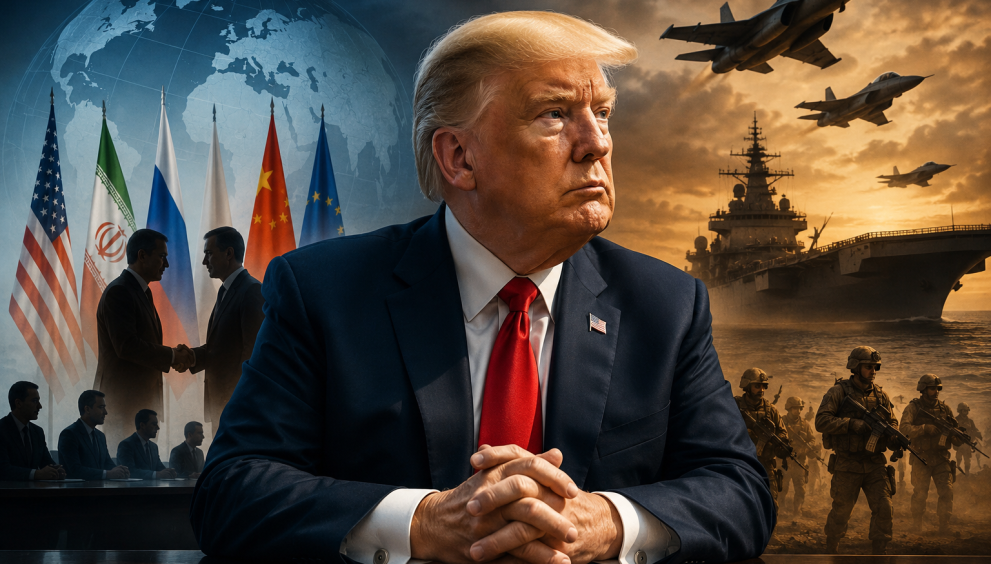
U.S. President Donald Trump has intensified his administration’s foreign policy messaging by combining renewed diplomatic outreach with explicit warnings that the United States is prepared to use military force if its national security interests or allies are threatened.
Speaking during recent meetings with foreign leaders and in remarks to reporters, Trump emphasized that his administration prefers negotiated solutions to international disputes but would not hesitate to authorize military action should diplomacy fail. The approach reflects the White House’s strategy of pairing high-level negotiations with a strong deterrence posture as it manages several geopolitical crises simultaneously.
The administration’s latest messaging comes as Washington remains engaged in negotiations involving Iran’s nuclear program, efforts to stabilize the Middle East following months of conflict, continued support for Ukraine, and growing strategic competition with China.
“Peace Through Strength”
Trump has repeatedly framed his foreign policy around the principle of “peace through strength,” arguing that maintaining a credible military deterrent encourages adversaries to negotiate rather than escalate conflicts.
“We want peace, but peace comes from strength,” Trump said during recent remarks, reiterating that the United States seeks diplomatic agreements while ensuring its armed forces remain prepared to respond to emerging threats.
Senior administration officials have echoed that message, stressing that diplomacy is most effective when backed by credible military capabilities.
Middle East Remains a Central Focus
The administration continues to prioritize stability in the Middle East following months of heightened tensions involving Iran, Israel, Hezbollah, and regional proxy groups.
Washington has encouraged indirect negotiations aimed at limiting Iran’s nuclear activities while simultaneously maintaining economic sanctions and preserving a significant U.S. military presence across the region.
Trump has repeatedly warned Tehran that while his administration remains open to dialogue, any attempt to accelerate uranium enrichment or threaten American personnel would prompt a decisive response.
At the same time, the White House has continued supporting ceasefire negotiations involving Israel and Hamas while encouraging broader regional diplomatic engagement.
Balancing Pressure and Negotiation
Administration officials describe Trump’s strategy as one that combines sustained diplomatic engagement with economic pressure and military readiness.
Analysts say the approach reflects a long-standing belief that negotiations are more likely to succeed when opponents believe military options remain available.
This strategy has been evident in ongoing talks involving Iran, where U.S. negotiators continue discussions over nuclear restrictions while American military assets remain positioned throughout the Gulf region.
Similarly, Washington has maintained close coordination with NATO allies while urging Russia to pursue negotiations aimed at ending the war in Ukraine.
China Watches Closely
Beyond the Middle East, the administration has continued to apply a similar strategy toward China.
Trump has called for greater cooperation on trade, investment, and regional security while simultaneously strengthening U.S. military partnerships across the Indo-Pacific.
The administration has expanded defense cooperation with allies including Japan, South Korea, Australia, and the Philippines, emphasizing freedom of navigation and regional stability.
Officials argue that maintaining a strong military presence helps deter conflict while creating conditions for productive diplomatic engagement.
Reassuring Allies
The White House has sought to reassure allies that the United States remains committed to existing defense partnerships despite encouraging greater burden-sharing among NATO members and Indo-Pacific allies.
Trump has repeatedly urged allied nations to increase defense spending while affirming America’s commitment to collective security arrangements.
European and Asian partners have generally welcomed continued U.S. engagement while closely monitoring Washington’s evolving diplomatic priorities.
Critics Voice Concerns
Critics argue that combining diplomacy with repeated military warnings risks increasing tensions and could complicate sensitive negotiations.
Some foreign policy experts contend that public threats may harden the positions of rival governments, making diplomatic breakthroughs more difficult.
Others, however, believe that maintaining military credibility strengthens the negotiating position of the United States and reduces the likelihood of miscalculation by adversaries.
The debate reflects broader divisions over how best to balance deterrence and diplomacy in an increasingly complex international security environment.
Congress Monitors Developments
Members of Congress from both parties continue to monitor the administration’s foreign policy decisions, particularly regarding the potential use of military force.
Several lawmakers have called for continued diplomatic engagement while emphasizing that any significant military action should involve consultation with Congress.
Administration officials have responded by stating that they remain committed to working with lawmakers while ensuring the president retains the flexibility needed to respond quickly to emerging threats.
Looking Ahead
As geopolitical challenges continue to evolve, the Trump administration appears determined to pursue a strategy that combines active diplomacy with visible military preparedness.
Whether addressing Iran’s nuclear ambitions, supporting allies in Europe and Asia, or seeking stability in the Middle East, the White House has consistently maintained that negotiations are most effective when backed by a credible willingness to defend U.S. interests.
With multiple diplomatic initiatives underway and several international flashpoints still unresolved, the effectiveness of Trump’s dual-track approach offering dialogue while warning of military consequences will remain a defining feature of U.S. foreign policy in the months ahead.
________________________________________________________________________________________________________________