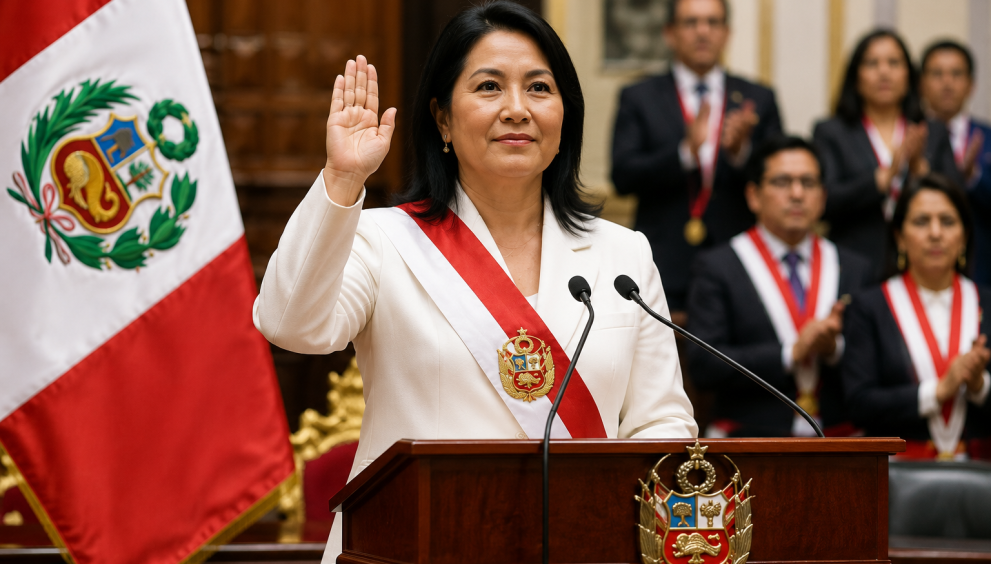
Conservative politician Keiko Fujimori was sworn in as Peru’s president on Wednesday after securing a narrow and fiercely contested election victory, marking a dramatic return of the Fujimori political dynasty to the country’s highest office.
Fujimori took the oath of office before Peru’s Congress in Lima, pledging to restore political stability, strengthen public security, revive economic growth, and combat corruption after years of institutional turmoil that have seen Peru cycle through multiple presidents and repeated confrontations between the executive branch and lawmakers.
A divisive but historic victory
The election was one of the closest in Peru’s recent history. Official results showed Fujimori winning by a slim margin of fewer than two percentage points, defeating her left-wing rival after weeks of vote counting, legal challenges, and allegations of irregularities from both political camps.
The narrow outcome exposed deep divisions between urban and rural voters, wealthier coastal regions and poorer Andean communities, and Peruvians who view Fujimori as a guarantor of economic stability and those who associate her family name with authoritarianism and corruption.
Supporters gathered outside Congress waving Peruvian flags and celebrating what they described as a return to strong leadership, while protesters staged demonstrations in parts of Lima, accusing the new administration of representing entrenched political elites.
Return of the Fujimori dynasty
Keiko Fujimori, 51, is the daughter of former President Alberto Fujimori, who governed Peru from 1990 to 2000. His administration is credited by supporters with defeating the Shining Path insurgency and stabilizing the economy, but it has also been widely criticized for human rights abuses, authoritarian practices, and corruption scandals.
This is Fujimori’s fourth attempt at the presidency. After losing previous runoffs in 2011, 2016, and 2021, her victory represents a significant political comeback for both her and her Popular Force (Fuerza Popular) party.
In her inaugural address, Fujimori acknowledged the polarized political climate and called for national reconciliation.
“I will govern for all Peruvians, including those who did not vote for me. Peru needs unity, investment, jobs, and security,” she told lawmakers during the ceremony.
Key challenges ahead
Fujimori assumes office at a difficult moment for Peru. The country has experienced years of political instability, with repeated impeachment battles, corruption investigations involving senior officials, and declining public confidence in democratic institutions.
Her administration faces several urgent challenges:
- Rising violent crime and organized extortion networks
- Slowing economic growth despite Peru’s vast mineral wealth
- High levels of informal employment
- Persistent poverty in rural Andean regions
- Tense relations between Congress and the presidency
Economists expect Fujimori to pursue market-friendly policies, encourage foreign investment in Peru’s important copper and mining sectors, and seek closer ties with international investors concerned about regulatory uncertainty.
International reaction
Regional leaders and international partners quickly issued congratulatory messages, emphasizing the importance of democratic continuity in South America. Analysts say foreign governments will be watching closely to see whether Fujimori can maintain institutional stability and avoid the prolonged political crises that have characterized much of Peru’s recent history.
Financial markets reacted cautiously, with investors welcoming the prospect of a more business-oriented administration while remaining concerned about potential social unrest and legislative deadlock.
Opposition remains strong
Despite her victory, Fujimori enters office with significant opposition both in Congress and on the streets. Left-wing parties have vowed to resist any attempt to weaken anti-corruption institutions or expand presidential powers, while civil society groups have promised continued scrutiny of her administration.
Political analysts note that Peru’s fragmented Congress could make it difficult for Fujimori to pass major reforms without building broader alliances beyond her own party.
What comes next
Fujimori is expected to announce her cabinet and economic team within days, with particular attention focused on the appointments of the finance minister, interior minister, and justice minister. Those choices will provide the first clear indication of whether her government intends to prioritize technocratic economic management, a hard-line security approach, or broader political coalition-building.
Her inauguration opens a new chapter in Peru’s turbulent political history, but the narrowness of her victory suggests that governing may prove far more difficult than winning the election. Whether Keiko Fujimori can deliver the stability she has promised while overcoming the controversies surrounding her family’s legacy is likely to shape Peru’s political future for years to come.
________________________________________________________________________________________________________________