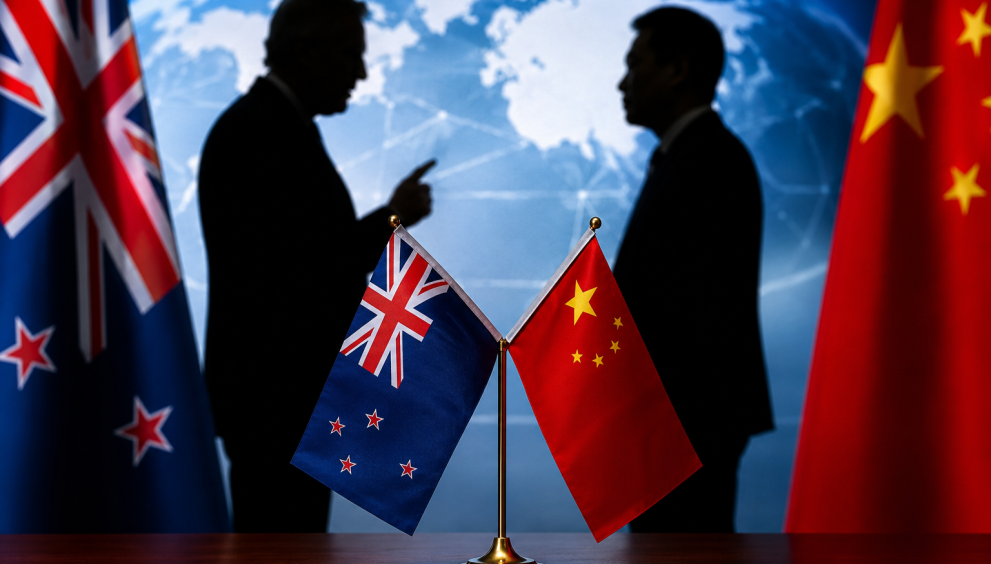
China has lodged a formal diplomatic protest with New Zealand after comments made by Foreign Minister Winston Peters during a parliamentary debate triggered a political storm in Wellington and drew condemnation from Beijing.
The controversy erupted during a debate on the government’s response to the COVID-19 pandemic, when Peters responded to interjections from Lawrence Xu-Nan, a Green Party lawmaker who was born in Tianjin, China, and moved to New Zealand as a child. During the heated exchange, Peters referred to Xu-Nan as a “loudmouth” and told him to “go back to your own country.” Reuters reported that Peters also contrasted New Zealand’s democratic system with what he said Xu-Nan was “used to.”
Beijing issues formal protest
China’s embassy in Wellington said on Thursday that it had made “solemn representations” to New Zealand’s Ministry of Foreign Affairs and Trade over what it described as “negative China-related remarks.” The embassy urged New Zealand to take steps that would contribute to healthy bilateral relations rather than undermine them. Reuters, July 30, 2026.
Chinese Ambassador Wang Xiaolong also weighed in publicly, writing on social media that the comments “say more about the person that makes it than anything or anybody else.”
The unusually direct response from Beijing highlights the sensitivity surrounding comments involving people of Chinese origin and comes at a time when relations between the two countries have already been tested by disagreements over Taiwan, regional security, and China’s growing influence in the Pacific.
Peters refuses to back down
Despite the backlash, Peters later defended his remarks, saying he was standing up for New Zealand’s democratic values and free speech. According to local media reports cited by Reuters, he dismissed critics as “pearl-clutchers” and accused some opponents of being “communist shills.”
Peters is the leader of the New Zealand First Party, a populist coalition partner in Prime Minister Christopher Luxon’s government, and has long been known for his combative political style.
Luxon criticises coalition partner
Prime Minister Christopher Luxon publicly criticised the foreign minister’s comments, describing them as “inappropriate attention-seeking comments.” While Luxon stopped short of calling for Peters’ resignation, his intervention signalled discomfort within the governing coalition over the diplomatic and political fallout.
Opposition parties were more forceful, accusing Peters of using language that could alienate migrant communities and inflame racial tensions.
Xu-Nan says migrants are being scapegoated
Speaking to New Zealand broadcaster TVNZ, Xu-Nan said Peters was “scapegoating the migrant communities” in an attempt to distract attention from the government’s performance.
Xu-Nan has represented the Green Party since entering Parliament and has spoken publicly about his experience as a Chinese-born New Zealander who grew up in East Auckland.
A sensitive moment in China–New Zealand relations
The dispute comes only weeks after Beijing imposed entry bans on several New Zealand lawmakers who had visited Taiwan, a move that Wellington said was unexpected and concerning. The latest incident risks adding another layer of tension to an already complicated relationship.
China remains New Zealand’s largest trading partner, with two-way trade exceeding NZ$41 billion in the year to September 2025, making stability in the relationship economically significant for both countries.
Analysts say the episode illustrates the growing challenge facing democratic governments as domestic political rhetoric increasingly intersects with sensitive foreign-policy relationships, particularly those involving China and ethnic Chinese communities abroad.
What happens next?
New Zealand’s Foreign Ministry has not publicly detailed the substance of its meeting with Chinese officials, and there has been no indication that Peters intends to apologise. However, the incident is likely to continue dominating political debate in Wellington and could feature in upcoming parliamentary scrutiny of the government’s handling of race relations, immigration, and foreign affairs.
For Beijing, the formal protest sends a clear signal that comments directed at a Chinese-born legislator can have broader diplomatic consequences, especially when made by a country’s serving foreign minister.
________________________________________________________________________________________________________________